
4 Pillars of Crypto: Algorithms, Blockchain, Mining, and Staking
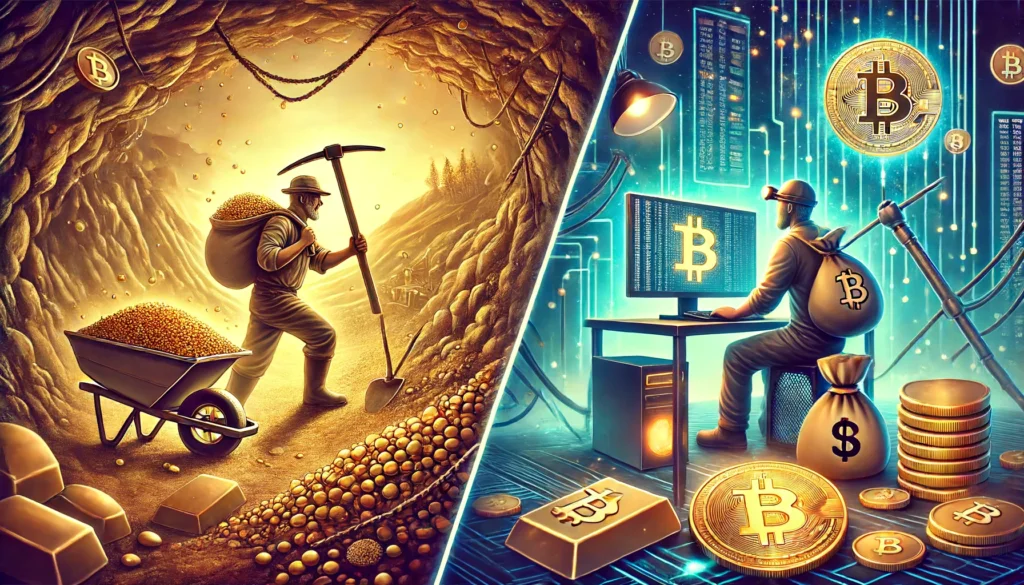
The Journey into Crypto Mining: Digging into Digital Gold Imagine you’re a treasure hunter, sifting through the earth, seeking gold. The excitement of finding those shiny nuggets is exhilarating, isn’t it? Now, let’s switch our scenery from dusty mines to the digital realm. Instead of a pickaxe and shovel, you have a computer and some specialized software. Welcome to the world of crypto mining – the modern-day equivalent of gold mining, but for digital treasures like Bitcoin. The Birth of Bitcoin and Crypto Mining Our story begins in 2009, when an anonymous person (or group) named Satoshi Nakamoto introduced Bitcoin, the first cryptocurrency. Bitcoin was revolutionary. It promised a new form of money, free from banks and government control. But how could new Bitcoins be created and verified? This is where mining comes into play. What is Crypto Mining? Crypto mining is like a gigantic online puzzle game. Imagine thousands of computers around the world racing to solve a complex mathematical problem. The first one to solve it gets to add a new block to the blockchain – a public ledger that records all Bitcoin transactions. As a reward, the solver receives a certain number of Bitcoins. This process is called “mining” because it mimics the extraction of precious metals from the earth. The Early Days of Crypto Mining In the beginning, crypto mining was relatively straightforward. Anyone with a decent computer could participate. Enthusiasts set up mining rigs in their garages and basements, hoping to strike digital gold. The competition was friendly and the rewards were significant. However, as more people joined the race, the puzzles (or algorithms) became increasingly difficult to solve. This was intentional, ensuring that new Bitcoins were released at a steady, controlled rate. To keep up with the escalating difficulty, miners began using more powerful hardware, eventually leading to the creation of specialized mining machines called ASICs (Application-Specific Integrated Circuits). Mining Algorithms: The Brains Behind the Operation At the heart of crypto mining are algorithms – the brains behind the puzzles. Different cryptocurrencies use different algorithms. Let’s explore a few: SHA-256 (Bitcoin): This is the algorithm used by Bitcoin. It’s highly secure but requires immense computational power. Think of it as the toughest puzzle in the game, requiring a supercomputer to solve. Scrypt (Litecoin): Litecoin, often dubbed the silver to Bitcoin’s gold, uses the Scrypt algorithm. It’s designed to be more memory-intensive, making it harder for ASICs to dominate and allowing more people to participate using regular computers. Ethash (Ethereum): Ethereum, another popular cryptocurrency, used Ethash. It’s designed to be ASIC-resistant, promoting decentralization by allowing more people to mine using standard graphics cards (GPUs). X11 (Dash): Dash uses the X11 algorithm, which involves multiple rounds of hashing to ensure high security. It’s a bit like solving multiple smaller puzzles to get to the main prize. The Great Bitcoin Cash Fork As Bitcoin’s popularity soared, so did the number of transactions. This led to congestion, with transactions taking longer to process and fees increasing. A debate erupted within the Bitcoin community on how to address these issues. One faction wanted to increase the block size (the amount of data each block can hold) to speed up transactions. Another group favored keeping the block size small to maintain decentralization. This disagreement culminated in 2017 with a hard fork, a split in the blockchain. The original Bitcoin continued with the smaller block size, while a new version, Bitcoin Cash, was created with a larger block size. Think of it as a river splitting into two streams, each following a different path but stemming from the same source. The Rise of Staking: A New Way to Earn While mining has been the cornerstone of many cryptocurrencies, it’s not the only way to earn digital coins. Enter staking, a newer, more energy-efficient method. Instead of solving complex puzzles, staking involves holding a certain amount of cryptocurrency in a wallet to support the network’s operations, like validating transactions. In return, stakers earn rewards. Why the Shift from Mining to Staking? Mining, especially with high-power hardware, consumes vast amounts of electricity. This has raised concerns about its environmental impact. Staking, on the other hand, requires significantly less energy. It’s like (though not exactly the same) to earning interest by keeping money in a savings account rather than working physically demanding jobs to earn your keep. Ethereum, for instance, has been transitioning from a mining-based system (Proof of Work) to a staking-based system (Proof of Stake) with its Ethereum 2.0 upgrade. This shift aims to make the network more sustainable and scalable. Challenges and Evolution in Crypto Mining Crypto mining isn’t without its challenges. Here are a few: Environmental Concerns: As mentioned, mining requires a lot of energy. It is claimed that Bitcoin mining alone consumes more electricity than some small countries. This has led to calls for greener practices or a shift to less energy-intensive methods like staking. Centralization Risks: Over time, mining has become dominated by large players with significant resources, leading to concerns about centralization. This goes against the very ethos of cryptocurrencies, which aim to be decentralized. Regulatory Scrutiny: Governments worldwide are grappling with how to regulate cryptocurrencies and mining. Some countries have embraced it, while others have imposed strict regulations or outright bans. Technological Arms Race: As mining becomes more competitive, there’s a constant race to develop more efficient hardware. This can make it difficult for smaller players to compete. The Future of Crypto Mining and Beyond The world of crypto mining is constantly evolving. New technologies and methods are being developed to address current challenges. For example, there are ongoing efforts to create more energy-efficient mining algorithms and hardware. Additionally, the rise of staking and other consensus mechanisms is providing alternative ways to secure and validate blockchain networks. Despite its challenges, crypto mining remains a critical component of the cryptocurrency ecosystem. It’s the process that ensures transactions are verified and new coins are created. As technology advances and the industry matures, we can expect continued innovation
Layer 2 Chains For Blockchain Scalability

The Magic of Layer 2 Chains: Making Blockchain Faster and Cheaper Imagine you live in a bustling city where traffic jams are the norm. Every day, you spend hours stuck on the road, inching forward at a snail’s pace. Frustrating, right? Now, imagine that instead of expanding the crowded streets, the city planners build a network of high-speed trains that run above the city. These trains can carry people quickly to their destinations without getting stuck in traffic. This is a lot like what Layer 2 chains do for blockchain networks. Let’s dive into this fascinating world and see how it all works. The Blockchain Traffic Jam First, let’s understand the problem. A blockchain is like a public ledger where every transaction is recorded. The most well-known blockchain is Bitcoin, but Ethereum is also a major player, enabling smart contracts and decentralized applications (dApps). Every transaction on these blockchains needs to be verified by many participants (miners or validators), which can take time and consume a lot of resources. Imagine you’re in a grocery store, but instead of having multiple checkout lines, there’s only one cashier. Whether you’re buying a pack of gum or a full cart of groceries, everyone has to wait in the same line. This causes long delays and can be very costly, especially if you’re in a hurry. Similarly, as more people use Ethereum, for example, the network gets congested, making transactions slower and more expensive. Enter Layer 2 Chains Layer 2 chains are like the high-speed trains in our city analogy. They run on top of the main blockchain (Layer 1) and handle many transactions off the main network, only interacting with it when necessary. This significantly reduces congestion and lowers costs. Think of Layer 1 as the main roads and highways, and Layer 2 as an efficient train system that helps people avoid traffic jams. There are several types of Layer 2 solutions, but today, we’ll focus on a specific type called zk-Rollups, with zkSync being a popular example. But before we get into zk-Rollups, let’s quickly explore the broader landscape of Layer 2 solutions. Different Types of Layer 2 Solutions Understanding zk-Rollups Let’s dive deeper into zk-Rollups, particularly zkSync, to see how they work and why they’re so exciting. Zero-Knowledge Proofs To understand zk-Rollups, we first need to grasp the concept of zero-knowledge proofs (zk-proofs). Imagine you have a secret and you want to prove to someone that you know this secret without revealing what it is. This might sound impossible, but zero-knowledge proofs make it possible. A zero-knowledge proof allows one party to prove to another that they know a value (the secret) without disclosing the value itself. It’s like proving you have the answer to a puzzle without showing the actual solution. This cryptographic magic is the foundation of zk-Rollups. How zk-Rollups Work zk-Rollups bundle hundreds or even thousands of transactions into a single batch. Instead of verifying each transaction individually on the Ethereum mainnet, they create a cryptographic proof that all the transactions in the batch are valid. This proof is then submitted to the Ethereum blockchain. Here’s a simplified step-by-step process of how zk-Rollups work: This process dramatically reduces the load on the Ethereum network, making transactions faster and cheaper. zkSync in Action zkSync is a specific implementation of zk-Rollups designed to be user-friendly and developer-friendly. It aims to bring Ethereum’s scalability and affordability to the masses without compromising on security. Here’s why zkSync is a game-changer: Imagine paying for a cup of coffee with Ethereum. Without zkSync, the transaction fee could be more than the coffee itself. With zkSync, the fee becomes negligible, making micro-transactions viable. The Broader Impact of Layer 2 Solutions Layer 2 solutions like zkSync are crucial for the future of blockchain technology. Here’s why: Scalability Scalability is a major hurdle for blockchain networks. Without it, blockchains can’t support mass adoption. Layer 2 solutions enhance scalability, making blockchains capable of handling millions of users and transactions without breaking a sweat. Lower Costs High transaction fees are a significant barrier to entry for many users. Layer 2 solutions lower these costs, making blockchain technology accessible to everyone, from individual users to large enterprises. Improved User Experience Slow and expensive transactions can be frustrating. By making transactions faster and cheaper, Layer 2 solutions improve the overall user experience, encouraging more people to use blockchain-based applications. Greater Innovation With the scalability and cost issues addressed, developers can focus on creating innovative applications that leverage blockchain technology. This could lead to breakthroughs in various industries, from finance to supply chain management, gaming, and beyond. Real-World Examples and Applications Let’s look at some real-world examples to see how Layer 2 solutions like zkSync are making a difference: Decentralized Finance (DeFi) DeFi platforms allow users to borrow, lend, and trade assets without intermediaries. However, high fees and slow transactions can hinder their usability. zkSync enables faster and cheaper transactions, making DeFi more accessible and efficient. NFT Marketplaces Non-fungible tokens (NFTs) represent ownership of unique digital items like art, music, and collectibles. High transaction fees on the Ethereum network have been a major pain point for NFT creators and buyers. Layer 2 solutions like Arbitrum reduce these fees, enabling more artists to participate in the NFT space. Gaming Blockchain-based games often require frequent micro-transactions, which can be prohibitively expensive on the Ethereum mainnet. By leveraging layer 2 solutions, game developers can provide a seamless and cost-effective experience for players. Micropayments Services that rely on micropayments, such as tipping content creators or paying for digital goods, benefit immensely from the low fees and high throughput of Layer 2 solutions. zkSync and strk like networks make it feasible to send tiny amounts of money without losing a significant portion to transaction fees. The Road Ahead The development of Layer 2 solutions is a rapidly evolving field. As technology advances, we can expect even more efficient and innovative ways to scale blockchain networks. Here are some future trends to watch: Interoperability Different Layer 2
Understanding Bitcoin’s Scarcity: The Stock-to-Flow Model Explained

Imagine you’re a child who loves collecting rare stickers. Some stickers are common and easy to find, while others are incredibly rare and much more valuable. Now, let’s think about Bitcoin as one of those rare stickers. This is where the concept of scarcity comes into play, and a fascinating model called the “Stock-to-Flow” (S2F) helps us understand why Bitcoin might be considered so valuable. What is the Stock-to-Flow Model? The Stock-to-Flow model is a way to measure the scarcity of a particular asset. It was originally created by a financial analyst who goes by the pseudonym “PlanB“. He used this model to predict Bitcoin’s price by examining its scarcity. In simple terms, the S2F model compares the current stock (total amount available) of an asset with its flow (the amount produced each year). For example, if we think of gold, the stock is all the gold ever mined, and the flow is how much gold is mined each year. How Does S2F Apply to Bitcoin? Bitcoin is like digital gold. There will only ever be 21 million Bitcoins, which makes it scarce. To create new Bitcoins, miners solve complex puzzles, and this process gets harder over time, slowing down the production rate. This means the flow of new Bitcoins decreases over time, making Bitcoin scarcer and scarcer. The S2F model uses this concept to predict Bitcoin’s price. It suggests that as Bitcoin becomes more scarce, its price should increase. If we look at the chart below, we see Bitcoin’s price (in colourful dots) closely following the S2F model (in grey). We will discuss colours of dots in future. For now, we are trying to understand its concept. This has happened consistently over the past decade. Bitcoin vs. Gold in S2F Terms Let’s compare Bitcoin and gold using the S2F model: Gold: Gold has been around for thousands of years. There’s a large stock of gold already mined, and each year, a relatively small amount is added to this stock. This gives gold a high S2F ratio, indicating it is very scarce. Bitcoin: Bitcoin, although only around since 2009, also has a high S2F ratio. The stock of Bitcoin is increasing at a slower rate because the creation of new Bitcoins is halved approximately every four years (an event known as “halving”). In terms of S2F, Bitcoin’s ratio is expected to surpass that of gold in the future, making it even scarcer. This is one reason why many believe Bitcoin’s price will continue to rise over the long term. The Results and Future of Bitcoin’s S2F Model So far, the S2F model has been remarkably accurate in predicting Bitcoin’s price. This accuracy has made it a popular tool among Bitcoin investors. However, it’s important to remember that no model can predict the future with 100% certainty. Factors such as government regulations, technological changes, and market sentiment can all influence Bitcoin’s price. Looking ahead, the S2F model suggests that Bitcoin’s price will continue to rise as it becomes more scarce. If the past is any indication, and if Bitcoin continues to follow the S2F model, we might see significant price increases in the coming years. As per S2F the price can increase to $400K till Q3 of 2025 but again, no model can predict the future with 100% certainty. Summary In summary, the Stock-to-Flow model is a useful tool for understanding the value of scarce assets like Bitcoin. Created by PlanB, it compares the current stock of an asset with its flow to measure scarcity. Both Bitcoin and gold have high S2F ratios, but Bitcoin’s is expected to surpass gold’s, potentially driving its price higher in the future. While the S2F model has been accurate in the past, always remember that investing in Bitcoin, like any investment, comes with risks. It’s an exciting space, but it’s crucial to stay informed and cautious as the landscape evolves.
Ethereum: The Digital City of Decentralized Dreams

Imagine you live in a bustling city where everything relies on a central authority. For every transaction, whether it’s buying groceries or signing a lease, you need a trusted intermediary like a bank or a lawyer. Now, imagine if you could cut out these middlemen and directly connect with others securely and transparently. Welcome to the world of Ethereum, a digital city where transactions are decentralized, and everyone has equal power. What is Ethereum? Ethereum is a type of cryptocurrency, similar to Bitcoin, but with much more to offer. Think of Bitcoin as digital gold—a valuable, yet limited resource. Ethereum, on the other hand, is more like a vast digital playground where you can build anything from simple transactions to complex applications. At its core, Ethereum is a decentralized platform that runs smart contracts. These are self-executing contracts where the terms of the agreement are directly written into code. Imagine a vending machine: you put in money, select your item, and the machine automatically delivers it. No need for a cashier. Smart contracts work similarly, ensuring that transactions and agreements happen automatically when predefined conditions are met. The Importance of Ethereum Ethereum’s significance lies in its ability to decentralize not just money, but also entire applications. This decentralization means there is no single point of control or failure. Imagine if Facebook were decentralized; it wouldn’t be owned by a single company but rather run by its users, making it nearly impossible for anyone to shut it down or misuse data. Ethereum’s technology has paved the way for numerous innovations: Decentralized Finance (DeFi): This allows people to lend, borrow, and trade without relying on traditional banks. Non-Fungible Tokens (NFTs): These are unique digital items that can represent art, music, or even virtual real estate. Decentralized Applications (DApps): These are apps that run on a network of computers rather than a single server, making them more resilient and transparent. Proof of Work (PoW) and Proof of Stake (PoS) To understand how Ethereum functions, we need to dive into two important concepts: Proof of Work (PoW) and Proof of Stake (PoS). Proof of Work (PoW) In the PoW system, transactions are verified and added to the blockchain by miners. Miners use powerful computers to solve complex mathematical puzzles, and the first one to solve the puzzle gets to add the transaction to the blockchain and is rewarded with some Ethereum. This process is energy-intensive and requires significant computational power, much like a giant puzzle-solving competition. Proof of Stake (PoS) Ethereum is transitioning from PoW to PoS to address the energy consumption issue. In the PoS system, validators are chosen to add new transactions based on the number of coins they hold and are willing to “stake” as collateral. This method is much more energy-efficient and is expected to make the network faster and more scalable. The Ethereum Fork and Ethereum Classic (ETC) Ethereum’s journey hasn’t been without bumps. In 2016, a major event called “The DAO Hack” occurred. A smart contract named The DAO, which was meant to act as a venture capital fund, was exploited, and a significant amount of Ether (Ethereum’s currency) was stolen. To address this, the Ethereum community decided to perform a “hard fork.” A hard fork is like a software update that creates two separate versions of the blockchain. The new version, which reversed the hack and returned the stolen funds, continued as Ethereum (ETH). The original, unaltered version of the blockchain persisted as Ethereum Classic (ETC). Conclusion Ethereum represents a revolution in the way we think about transactions and trust. By decentralizing control and enabling smart contracts, it opens up endless possibilities for innovation in finance, art, gaming, and more. The shift from Proof of Work to Proof of Stake marks a significant step towards a more sustainable and scalable future for the network. And while the hard fork that created Ethereum Classic shows that the journey hasn’t been without its challenges, it also highlights the resilience and adaptability of this remarkable digital ecosystem. In this digital city, the only limit is your imagination. So, whether you’re an artist looking to sell your work as NFTs, a developer wanting to build the next big DApp, or just someone curious about the future of technology, Ethereum is a space where you can explore and create like never before.
Guarding the Blockchain: Understanding and Preventing 51% Attacks

Imagine you’re playing a game of Jenga with a group of friends. Each block you carefully stack represents a piece of the game’s history. The taller the tower gets, the more secure and unchangeable the lower blocks become because they are buried under a growing pile of more recent blocks. This is much like how a blockchain works, especially those using Proof of Work (PoW) mechanisms like Bitcoin. In the blockchain world, each “block” contains a record of transactions, and these blocks are linked together in a chronological chain. The integrity of the chain relies on the majority of participants (or nodes) in the network agreeing on the state of the blockchain. This agreement is reached through a consensus mechanism, which for PoW chains, involves solving complex mathematical puzzles. Now, let’s introduce a potential problem: the 51% majority attack. This scenario is akin to a group of players in our Jenga game suddenly gaining control over more than half of the blocks. If one player or a group of colluding players can control more than 51% of the network’s computing power (hashrate), they can manipulate the game’s outcome to their advantage. How a 51% Attack Works In a 51% attack, a malicious actor gains control over the majority of the network’s mining power. With this control, the attacker can: Double-Spend Coins: Imagine if you could pull out blocks from the middle of the Jenga tower without it collapsing. The attacker can rewrite recent transactions, allowing them to spend the same coins more than once. Prevent Confirmations: They can stop new transactions from gaining confirmations, effectively halting payments and transfers. Block Miners: They can exclude or modify the ordering of transactions, preventing other miners from adding new blocks to the chain. However, the attacker can’t change the entire history of the blockchain. They can only alter the most recent blocks since the computational power required to redo the entire chain would be astronomically high. Impacts on PoW Chains A 51% attack undermines trust in the blockchain. Since the network’s security relies on decentralization and distributed consensus, such an attack can lead to: Loss of Confidence: Users and investors may lose faith in the security and reliability of the blockchain. Financial Losses: Double-spending can result in significant financial damage to businesses and individuals. Network Instability: Frequent attacks can make the network unreliable for everyday transactions. Solutions in the Blockchain Industry To counter the threat of 51% attacks, the blockchain industry employs several strategies: Increasing Network Hashrate: By encouraging more miners to join the network, the total computational power increases, making it harder and more expensive for any single entity to gain majority control. Algorithm Changes: Some blockchains switch to different consensus algorithms (like Proof of Stake or hybrid systems) that are less susceptible to such attacks. For example, Ethereum has been transitioning from PoW to PoS to enhance security. Checkpointing: This involves setting certain blocks as immutable checkpoints. Once a block is checkpointed, even if an attacker gains 51% control, they cannot alter any transactions before that point. Incentive Structures: Designing economic incentives that discourage attacks. If attacking the network costs more than the potential rewards, it becomes a less attractive option. Community Vigilance: Active monitoring and quick responses to unusual activity can help mitigate the effects of an attack. For instance, exchanges can increase the number of confirmations required for large transactions, making double-spending attacks less effective. In conclusion, while a 51% attack poses a serious threat to PoW blockchains by allowing the possibility of double-spending and transaction manipulation, it doesn’t enable the attacker to rewrite the entire blockchain history. The blockchain community continues to develop and implement various strategies to strengthen network security and maintain trust in these decentralized systems. Just like in our Jenga game, the goal is to keep building higher and stronger, ensuring that the foundation remains secure and reliable for everyone involved.
Blockchain Explained

Imagine you’re part of a huge international book club. Members from all over the world read and exchange books, and every time a book is lent or returned, the transaction is recorded. Instead of relying on a single librarian to keep track of all these transactions, what if every member of the book club kept their own record? Whenever a book changes hands, all members update their records simultaneously after confirming the transaction’s authenticity. This decentralized system is similar to how blockchain technology operates. The Birth of Blockchain: Blockchain technology was first conceptualized in 2008 by an unknown person (or group) under the pseudonym Satoshi Nakamoto. Nakamoto introduced blockchain through the creation of Bitcoin, a decentralized digital currency. The idea was to remove the need for a central authority like a bank, allowing people to trade directly and securely with one another. In fact, this theory was written before in different researches but Nakamoto gave this life removing all flaws. A blockchain is essentially a digital ledger of transactions that is duplicated and distributed across the entire network of computer systems on the blockchain. Each block in the chain contains a number of transactions, and every time a new transaction occurs, it is added to every participant’s ledger. This decentralization ensures transparency and security. How Blockchain Works: To understand how blockchain functions, think about the book club. When a member wants to borrow a book, they announce their intention to the entire club. Members then verify the availability of the book and confirm the borrower’s identity. Once verified, this transaction is added to everyone’s record, or block, which is then linked to the previous block, forming a chain of transactions that cannot be altered without the consensus of the majority. Blockchain’s Evolution: Initially, blockchain was mainly associated with Bitcoin. However, its potential far exceeded just digital currency. In 2015, Ethereum was introduced, bringing with it the concept of smart contracts—self-executing contracts with the terms directly written into code. This advancement opened the door for blockchain applications in various fields like supply chain management, voting systems, and beyond. Challenges and Developments: Despite its groundbreaking potential, blockchain faces several challenges, including scalability, high energy consumption, and slow transaction speeds. For example, Bitcoin’s blockchain can only handle a limited number of transactions per second, leading to bottlenecks during high-demand periods. To overcome these issues, new solutions have been proposed, such as Directed Acyclic Graphs (DAGs). Introduction to DAGs: A DAG is a different type of data structure that offers an alternative to the traditional blockchain. Instead of having a single, linear chain of blocks, DAGs use a graph structure where each transaction is linked to multiple other transactions. This allows for much greater scalability and faster transaction processing. DAG in Action: One prominent implementation of DAG is IOTA, a cryptocurrency designed for the Internet of Things (IoT). In a DAG-based system like IOTA, each transaction confirms two previous transactions, forming a tangled web of interconnected transactions. This eliminates the need for miners, reduces transaction fees, and increases the speed of the network as more transactions are made. The Current Landscape: Today, blockchain technology continues to advance. Numerous projects are working on improving efficiency, security, and scalability. Blockchain is being integrated into various industries, from finance and healthcare to supply chain management and entertainment. Meanwhile, DAGs and other innovative data structures are being developed to address the limitations of traditional blockchains. Conclusion: Blockchain technology, with its promise of decentralization, transparency, and security, has the potential to transform many sectors. While it still faces some challenges, ongoing innovations like DAGs are paving the way for a more scalable and efficient future. As we continue to explore the possibilities of blockchain and DAG technology, we can expect to see even more transformative changes in how we conduct transactions and manage data in our increasingly digital world.
The Rise of Altcoins: A Journey from Bitcoin to Stark

In the bustling marketplace of a vibrant city, imagine Bitcoin as the pioneer merchant who set up the very first stall. When Bitcoin unfurled its banner in 2009, it wasn’t just selling a new product; it was introducing an entirely new concept to the masses. This concept was decentralized digital currency, a revolutionary idea where money was not controlled by any government or central authority but rather by the people themselves, using cryptographic principles and blockchain technology. The Basics of Bitcoin Bitcoin’s humble beginnings were akin to the opening of a mysterious new shop in a quiet corner, piquing the curiosity of a few early adopters who believed in its potential. They saw beyond the skepticism of the mainstream financial world and understood the allure of a system where transactions could be made securely, transparently, and without the need for intermediaries. These early believers, or “miners,” used their computers to solve complex mathematical problems, thereby validating transactions and securing the network, all while earning Bitcoin as a reward. As Bitcoin’s stall grew more popular, it attracted attention from a wide array of people, from tech enthusiasts and libertarians to investors and speculators. The success of Bitcoin was undeniable, but like any marketplace, it sparked competition and innovation. Enter the era of altcoins—alternative cryptocurrencies that sought to improve upon or differentiate themselves from Bitcoin’s model. The Birth of Altcoins The first of these was Namecoin, introduced in 2011. Namecoin was like a specialty shop that sprang up next to Bitcoin’s general store. It aimed to decentralize the internet’s domain name system (DNS), which would make internet censorship more difficult. Though it never reached mainstream popularity, Namecoin’s launch was significant—it showed that the blockchain technology Bitcoin was built on could be adapted for other uses. Following Namecoin, the marketplace began to teem with a variety of stalls, each offering unique twists on Bitcoin’s blueprint. Litecoin emerged in 2011, branded as the “silver to Bitcoin’s gold.” Litecoin’s promise was faster transaction times and a more abundant supply, catering to those who found Bitcoin’s processing times and scarcity limiting. Then came Ripple (XRP) in 2012, setting up shop with a focus on enabling instant, low-cost international payments. Ripple’s approach was more cooperative with traditional financial institutions, envisioning a world where cryptocurrencies and conventional banking systems could work hand-in-hand. The Evolution and Diversification of Altcoins As the years went by, new altcoins continued to appear, each one adding its own flavor to the marketplace. Ethereum, launched in 2015 by the young prodigy Vitalik Buterin, was not just another digital currency. Ethereum’s innovation was its ability to execute smart contracts—self-executing contracts with the terms of the agreement directly written into code. This opened up a world of possibilities for decentralized applications (dApps), attracting developers and entrepreneurs who saw the potential for blockchain technology beyond simple transactions. With the foundation laid by Ethereum, the marketplace exploded with creativity and innovation. Coins like Dash, which emphasized privacy and speedy transactions, and Monero, which focused on untraceable transactions, found their niche audiences. The ecosystem became a bustling bazaar, each altcoin stall drawing in different kinds of customers with its unique value proposition. Modern-Day Altcoins and Their Uses In recent years, altcoins have continued to evolve and diversify. Some have become platforms for decentralized finance (DeFi), such as Aave, which allows users to lend, borrow, and earn interest on their crypto assets without traditional banks. Others, like Polkadot and Cardano, aim to solve issues of scalability and interoperability between different blockchain networks, ensuring that the various stalls in this crowded marketplace can communicate and interact smoothly. One of the latest entries in this dynamic marketplace is Stark, a layer 2 solution for Ethereum. Stark aims to provide more speed and lower fees, enhancing the capabilities of Ethereum’s network. Stark represents the continuing innovation within the cryptocurrency world, highlighting how Bitcoin’s original vision has inspired a multitude of paths and purposes, proving that the marketplace is far from reaching its potential. Conclusion In layman’s terms, the rise of altcoins can be likened to the expansion of a bustling market. Bitcoin’s original stall set the stage for a diverse array of new shops, each bringing something unique to the table. These altcoins cater to different needs and desires, from faster transactions and enhanced privacy to the ability to create complex financial contracts without middlemen. Just as a vibrant market thrives on diversity and innovation, the world of cryptocurrencies is continuously enriched by the introduction of new ideas and technologies. This ever-expanding marketplace invites us all to explore, invest, and participate in the exciting evolution of digital finance. Whether you’re an early adopter, a casual observer, or a savvy investor, the story of altcoins is a testament to the transformative power of innovation, driven by the visionaries who dared to dream beyond Bitcoin’s horizon.
Origin of Bitcoin

Bitcoin: Understanding the Digital Gold In the modern era, where everything from your morning coffee to your evening commute is influenced by technology, Bitcoin represents a revolutionary step in how we think about money. Imagine a world where you could send money across the globe without waiting for bank approvals, paying hefty fees, or worrying about exchange rates. That’s the world Bitcoin has begun to create—a financial system built not by banks or governments, but by people. What is Bitcoin? Bitcoin is like digital gold. Just as you can mine gold from the earth, Bitcoin is “mined” through computers. This mining involves solving complex mathematical puzzles, which requires significant computer power. When these puzzles are solved, the miner is rewarded with Bitcoin, much like a gold miner being rewarded with a nugget. Imagine you have a magic notebook. Whatever you write in it, the entries cannot be erased or altered. Bitcoin uses a similar concept where all transactions are recorded in a digital ledger called the blockchain. This ledger is maintained by a network of computers across the world, making Bitcoin a truly decentralized system. No single entity, like a bank or government, controls the Bitcoin network. The Origin of Bitcoin Bitcoin was created in 2009 by an unknown person (or group of people) using the pseudonym Satoshi Nakamoto. The idea was to create a currency independent of any central authority, transferable electronically, more or less instantly, with very low transaction fees. The timing was perfect, as it followed the 2008 financial crisis, highlighting the need for a financial system without the control of banks and governments. Bitcoin vs. Traditional Money To understand Bitcoin better, consider the game of Monopoly. In Monopoly, the bank controls the money, giving it out as it sees fit and taking it back as penalties and taxes. Now, imagine if Monopoly were played where all players could monitor the bank’s actions, and no single player could secretly spend or distribute money. This is similar to how Bitcoin operates—transparently and democratically. The Decentralization of Gold Historically, gold has been seen as a decentralized form of money. It is not issued by any government or central bank. Its value comes from its scarcity and the universal demand for it. Before modern currencies, gold was used worldwide for trade and was a direct means of payment. Bitcoin is often referred to as ‘digital gold’ because, like gold, it is also decentralized and not controlled by a single entity. The main difference is that Bitcoin’s existence and transactions are digital and secured by cryptography. Why Bitcoin? Bitcoin offers several advantages over traditional currencies. For instance, you can send Bitcoin to anyone in the world without going through a bank. It’s like emailing a postcard: direct from you to the recipient without needing the post office. Moreover, Bitcoin is borderless and functions the same way in every country. Real-World Applications Consider a scenario where you want to send money to a relative in another country. Typically, this would involve banks, exchange rates, and fees, and it might take days. With Bitcoin, you could send the equivalent amount directly from your digital wallet to theirs, potentially within minutes, with minimal fees, regardless of where both of you are in the world. In summary, Bitcoin is not just a new kind of money; it’s a new way to think about what money is and what it can do. It strips away the control from centralized institutions and gives it back to the people. This digital gold is creating a new era of finance, echoing the natural and inherent values that gold has represented for millennia. As we move forward, Bitcoin, like gold, may become a cornerstone of secure, decentralized, and democratic economies.