
Decentralized Identity (DID): The New Concept of Identity in Web3
Introduction In today’s digital landscape, identity is both a cornerstone and a vulnerability. From social media platforms to financial services, users are required to hand over their personal data—email addresses, passwords, names, government IDs—to centralized entities. These platforms often become honeypots for hackers, and history is filled with high-profile data breaches affecting millions. Moreover, users have little to no control over how their data is used, shared, or monetized. Surveillance capitalism thrives on this imbalance, where digital identity becomes a commodity sold behind users’ backs. This is the crux of the problem with traditional, centralized identity systems. Enter Web3—a decentralized web paradigm built on blockchain technology. Web3 advocates for user ownership, privacy, and interoperability. At the heart of this shift lies a revolutionary concept: Decentralized Identity (DID). It promises a model where individuals create, own, and manage their identities without reliance on central authorities. Technical Foundation of DID What Are DIDs? A Decentralized Identifier (DID) is a globally unique, resolvable identifier that does not rely on a centralized registry. Unlike email addresses or usernames issued by companies, a DID is created and controlled by the user. It is essentially a pointer to a set of public metadata and verifiable credentials. Each DID is cryptographically secured, often anchored to a blockchain or a decentralized ledger, and can be verified without revealing personal information. Blockchain, Verifiable Credentials, and Public-Key Cryptography At the core of DID systems are three technologies: Blockchain ensures tamper-proof, decentralized storage of identifiers or credential registries. Public/Private Key Cryptography enables identity holders to sign and authenticate without disclosing sensitive details. Verifiable Credentials (VCs) are digitally signed statements issued by trusted parties (e.g., universities, governments), linked to a DID. They can be presented and cryptographically verified without contacting the issuer. W3C DID Specification The World Wide Web Consortium (W3C) defines the standard for DIDs to ensure interoperability. A DID Document contains the public key and service endpoints associated with the identifier, enabling secure communication and verification. DIDs vs. Verifiable Credentials DIDs represent identity—a decentralized reference point. VCs represent claims about identity (e.g., “Alice has a driver’s license”). The separation of identifier and credential is key to achieving privacy, control, and trust. How DID Works in Web3 Ecosystems Identity Creation and Authentication To create a DID, users generate a public/private key pair. The public key becomes part of the DID document, while the private key remains securely with the user. This pair is then used to prove ownership and sign credentials. Authentication is performed by proving control over the private key—no need for passwords, captchas, or centralized servers. DIDs can also be linked with biometric authentication, further enhancing security. Selective Disclosure and SSI Self-Sovereign Identity (SSI) is a model where users manage their own credentials and disclose only what is necessary. For instance, instead of providing a full ID card to prove age, one can present a zero-knowledge proof (ZKP) that confirms “over 18” without revealing birthdate or name. Real-World Example Imagine logging into a decentralized application (dApp) without an email or password. Instead, your DID is authenticated via your wallet, and access is granted based on the credentials in your control—fully secure, private, and instant. Privacy, Security, and Control Traditional systems centralize data into silos that are prone to leaks and misuse. DIDs allow users to: Avoid unnecessary data exposure. Decide who accesses what, and when. Revoke access at any time. Zero-Knowledge Proofs (ZKPs) With ZKPs, users can prove claims without revealing the underlying data, ideal for privacy in KYC, voting, and credentialing. Comparison to OAuth2 and SSO OAuth2 and Single Sign-On (SSO) solutions offer convenience but rely on trust in the identity provider (e.g., Google, Facebook). DIDs remove this dependency, providing trustless authentication. Use Cases and Applications DeFi Platforms Decentralized finance (DeFi) can use verifiable credentials for KYC compliance without exposing user data to protocols or counterparties. DAOs DAOs use DIDs to validate members for voting rights, task assignments, or rewards distribution based on participation history. NFT Platforms Artists can prove authorship through DID-linked credentials, and buyers can verify authenticity and ownership—fighting fraud and plagiarism. Web3 Social Networks Platforms like Lens Protocol are integrating DIDs to give users full control of their profile, social graph, and content. Supply Chain & Healthcare In supply chains, DIDs track asset provenance. In healthcare, patients can share verifiable medical records without compromising confidentiality. Education Universities can issue digital diplomas as verifiable credentials, instantly sharable with employers or institutions without the need for third-party verification. Popular DID Frameworks and Tools Several projects and networks have emerged to support DID adoption: Sovrin Network – Open-source infrastructure for self-sovereign identity. uPort – Ethereum-based identity protocol. Ceramic Network – Composable data streams for Web3 identities. Evernym – Creator of the Aries/Indy agent framework. Microsoft ION – A public DID network built on Bitcoin. Polygon ID – Scalable solution using zkProofs and Ethereum Layer 2. Many of these are integrated into crypto wallets and protocols, enabling seamless interaction with dApps, DAOs, and DeFi. Regulatory Considerations KYC/AML Compliance DIDs can support regulation by providing compliance-friendly credentials (e.g., “KYC Verified”) without exposing sensitive data. GDPR and Data Sovereignty Since data is stored under the user’s control, DIDs align well with GDPR’s data minimization and right-to-be-forgotten principles. Governments vs. DID Some governments are pursuing centralized digital IDs, which conflict with DID principles. However, others are exploring hybrid models that combine regulation with user autonomy. Challenges and Limitations Scalability Current blockchain infrastructures face speed and cost barriers in hosting large-scale identity registries. Interoperability With multiple DID methods (e.g., did:ethr, did:key, did:ion), ensuring cross-platform compatibility is an ongoing challenge. Adoption and Key Management Non-technical users may find it difficult to manage keys, store credentials, or understand revocation mechanics. Trust Frameworks Determining which credential issuers are trustworthy remains a key issue. Decentralization shifts trust from platforms to networks of reputation and audits. The Future of Digital Identity in Web3 DIDs are poised to become the foundation of digital interaction in Web3: In the Metaverse: Each avatar or entity can be linked to a
CBDCs vs Stablecoins: Government Control vs Public Freedom 5 Important things to know
🏦 CBDCs: Government-Backed Digital Mint Central Bank Digital Currencies (CBDCs) are digital forms of national currencies, issued and regulated directly by a country’s central bank. These digital assets are not cryptocurrencies in the traditional sense; rather, they are sovereign currencies with legal tender status, backed by the full faith and credit of the issuing nation. Examples include China’s digital yuan (e-CNY), the European Union’s digital euro, and the UK’s upcoming digital pound. CBDCs represent a fundamental shift in monetary systems. Unlike decentralized cryptocurrencies, which are built to operate without a central authority, CBDCs are designed for centralized control. Governments and central banks can issue, monitor, and regulate every unit of currency in real-time, allowing them to enforce monetary policies with surgical precision. One of the key benefits of CBDCs is security and regulatory oversight. Since they are built on permissioned blockchain or secure databases, CBDCs allow for high levels of control, traceability, and protection against fraud. This level of security makes them attractive for high-volume financial systems, especially in national and cross-border settlements. Another powerful feature is programmability. CBDCs can be designed to support smart payment logic—such as conditional disbursements, expiry dates on stimulus packages, or automatic tax collection. This could enable real-time implementation of fiscal policies, targeted subsidies, and instant social welfare disbursements. CBDCs also promise greater financial inclusion and cost efficiency. For underserved populations lacking access to traditional banks, CBDCs could offer mobile-based access to digital money. Cross-border remittances, typically slow and expensive, could become faster and cheaper through CBDC-powered international corridors. However, the downsides are significant. The introduction of CBDCs raises concerns over privacy and surveillance, as governments could technically track every transaction. There are fears that authoritarian regimes may misuse this capability to restrict dissent or control behavior. Additionally, the potential for bank disintermediation is real—if individuals can hold money directly with central banks, commercial banks may lose deposits, weakening their role in credit creation. Critics also warn about the politicization of financial systems, where governments might freeze or redirect funds based on political agendas. For example, programmable money could be restricted to certain uses or areas, curbing financial freedom. Despite these concerns, many countries are rapidly advancing their CBDC experiments. Nations like China, the UAE, Sweden, and the UK are conducting active pilot programs. While full-scale national rollouts may still take a few more years, industry experts expect many CBDCs to enter public circulation by the mid-to-late 2020s. CBDCs are not merely a digital extension of fiat—they signal a reshaping of how money itself is understood, issued, and controlled. Whether they become tools of empowerment or instruments of control will depend on how they are implemented, regulated, and balanced with civil liberties. 🪙 Stablecoins: Private Innovation & Decentralized Utility 💵 Stablecoins: Privately-Issued Digital Alternatives Stablecoins are digital tokens typically issued by private companies or decentralized protocols, designed to maintain a stable value by being pegged to another asset—most commonly fiat currencies like the US dollar, but also sometimes commodities or even algorithmic models. Some of the most well-known examples include Tether (USDT), USD Coin (USDC), and DAI. What sets stablecoins apart is their value stabilization mechanisms. Fiat-backed stablecoins rely on cash or asset reserves held in banks or custodians to ensure each token is redeemable for one unit of the underlying currency. In contrast, algorithmic stablecoins maintain parity through supply-adjusting code that automatically burns or mints tokens based on demand. This programmability allows for on-chain value management without a central authority—although it comes with its own set of risks. A significant advantage of stablecoins is their interoperability with decentralized finance (DeFi). They serve as the foundational layer for numerous DeFi applications, enabling users to trade, lend, borrow, and earn yields across various decentralized platforms. Their ability to function seamlessly across different blockchain networks has made them the preferred medium for on-chain financial transactions and cross-border remittances. The adoption of stablecoins is accelerating worldwide, particularly in regions facing currency instability or banking access issues. For individuals in countries with high inflation or limited financial infrastructure, stablecoins offer a means to preserve value and participate in global commerce using just a mobile phone and internet connection. Industry forecasts suggest that stablecoin usage could surpass $2 trillion annually by 2028, underlining their transformative potential in the digital economy. However, stablecoins are not without challenges. Concerns often arise around the transparency and safety of their reserves, especially in cases where issuers do not undergo frequent or independent audits. There are also cybersecurity risks, as stablecoin platforms can be targeted by sophisticated attacks that compromise funds. Additionally, regulatory ambiguity poses a major hurdle, with governments unsure how to classify, supervise, or integrate stablecoins within existing legal frameworks. In response to these concerns, legislative efforts are underway in jurisdictions like the United States. Proposals such as the STABLE Act and the GENIUS Act aim to introduce legal clarity by mandating regular audits, enforcing capital reserve requirements, and creating standards for operational transparency. These regulatory moves indicate that while stablecoins are decentralized in use, they are increasingly subject to centralized scrutiny. 🔍 Side-by-Side Comparison Issuer CBDC: Central bank (e.g., digital euro, digital pound) Stablecoins: Private companies or algorithmic protocols Trust Anchor CBDC: Backed by sovereign government guarantee Stablecoins: Backed by audited reserves or algorithmic codes Regulation CBDC: Fully regulated by state authorities Stablecoins: Partially regulated; evolving legal frameworks Decentralization CBDC: Fully centralized control Stablecoins: Hybrid — decentralized in DeFi, centralized in fiat-backed models Innovation Speed CBDC: Slow, due to government-led development and policy constraints Stablecoins: Rapid innovation driven by private sector competition Privacy CBDC: Low — prone to potential surveillance and transaction tracking Stablecoins: Generally higher, depending on design and issuer policy DeFi & Programmability CBDC: Programmable only if configured by central authorities Stablecoins: Native compatibility with dApps and smart contracts Financial Inclusion CBDC: Broad national access, but digital literacy gaps remain Stablecoins: Global access for anyone with a smartphone and internet 🤝 CBDC and Stablecoin Coexistence Researchers envision a hybrid ecosystem, where CBDCs provide foundational stability and transparency, while stablecoins
Web3 and Its Relationship with the Financial System

Introduction The financial system has always been central to human progress — evolving from barter to banknotes, from centralized institutions to decentralized finance. Now, as technology moves into the next phase of the internet — Web3 — the way we perceive, manage, and interact with money is undergoing a radical transformation. Web3 isn’t just a technical innovation; it’s a philosophical shift in how trust, ownership, and value are managed online. This article explores what Web3 really means, how it’s reshaping the financial system, and what it could mean for individuals, institutions, and the global economy. What is Web3? Web3 is the third generation of the internet, where control shifts from centralized platforms (like Google, Facebook, and Amazon) to decentralized networks built on blockchain technology. It empowers users with ownership of their data, digital assets, and identity. Unlike Web2, where data and power are concentrated in the hands of a few corporations, Web3 is about openness, transparency, and self-governance. Core components of Web3 include: Decentralized applications (dApps) Smart contracts Decentralized finance (DeFi) NFTs and digital ownership Token-based incentives Self-sovereign identity The Traditional Financial System: Centralized and Regulated The current financial system is built on centralized institutions — banks, governments, insurance companies, and regulatory bodies. It relies on intermediaries for trust and compliance, with strict controls on transactions, identity verification, credit scoring, and capital flow. Some of the key characteristics include: Regulated access: Only licensed entities can issue money or provide financial services. Delayed settlement: Payments can take days to process. Limited access: Billions of people remain underbanked or excluded entirely. Privacy concerns: Financial data is stored and managed by third parties. While this system offers stability and control, it is also expensive, slow, and often exclusionary. Web3: A New Financial Paradigm Web3 disrupts traditional finance by enabling peer-to-peer transactions without centralized gatekeepers. Through the use of blockchains, smart contracts, and token economies, Web3 makes it possible to recreate many financial services — lending, borrowing, investing, insurance, asset trading — in an open, permissionless environment. Let’s examine some core innovations that connect Web3 to finance: 1. Decentralized Finance (DeFi) DeFi is perhaps the clearest bridge between Web3 and finance. It replaces traditional financial intermediaries with code-based protocols running on blockchains like Ethereum. DeFi platforms allow users to: Lend or borrow assets without a bank Earn yield through staking or liquidity mining Trade tokens on decentralized exchanges (DEXs) Take out insurance via smart contracts DeFi is borderless, available 24/7, and often more efficient than legacy systems. In Web3, liquidity comes from users, not institutions — creating a more participatory economy. 2. Programmable Money and Smart Contracts Smart contracts — self-executing agreements coded on blockchain — allow for automated financial transactions. From recurring payments to complex derivatives, smart contracts eliminate the need for legal middlemen and manual processing. In Web3: Loans can be issued and settled autonomously. Crowdfunding can be trustless and transparent. Payrolls can be distributed instantly to wallets. This “programmable money” concept radically expands what money can do and how it can be managed. 3. Tokenization of Assets Web3 introduces tokenization, where real-world or digital assets are represented as tokens on a blockchain. Anything from real estate, stocks, art, or intellectual property can be turned into tradable tokens, enabling: Fractional ownership Instant global liquidity 24/7 trading without brokers More accessible investing This has massive implications for how wealth is created and transferred. 4. Self-Custody and Wallets Web3 emphasizes self-custody — users control their own funds via crypto wallets (e.g., MetaMask, Ledger) without relying on banks. This aligns with the philosophy of financial sovereignty. While this increases responsibility, it also offers: Greater privacy Resistance to censorship Access to decentralized services This is particularly impactful for populations in unstable economies or under authoritarian regimes. 5. Global Financial Inclusion According to the World Bank, over 1.4 billion people are unbanked. Web3 removes many barriers: No need for formal ID or credit history No reliance on banking infrastructure Mobile and internet-based access With just a smartphone and internet, anyone can participate in DeFi, earn yield, and send or receive payments globally. Web3 has the potential to be a powerful tool for financial inclusion and empowerment. Challenges to Web3 in Finance Despite its promise, Web3’s integration into global finance is not without hurdles: Regulatory uncertainty: Governments are still figuring out how to regulate DeFi and token-based economies. Security risks: Hacks, exploits, and smart contract bugs can lead to massive losses. User experience: Web3 tools can be complex and intimidating for non-technical users. Scalability: Blockchains still struggle with speed and transaction fees during high demand. Volatility: The value of tokens can swing dramatically, making financial planning difficult. Web3 and the Future of Banking As traditional banks explore central bank digital currencies (CBDCs) and begin to offer crypto custody, we may see a convergence between Web2 institutions and Web3 innovations. Banks could: Use blockchain for real-time settlement Offer access to DeFi products Integrate digital identity with on-chain records However, the core difference will remain: Web3 empowers the individual, while traditional finance serves institutions. Whether the two models can coexist or compete remains an open question. Philosophical Shifts: From Trust in Institutions to Trust in Code One of the most profound transformations Web3 brings is not technical — it’s philosophical. In traditional finance, trust is placed in human institutions, laws, and regulators. In Web3, trust shifts to open-source code, community governance, and mathematical certainty. This shift has wide-reaching implications: Financial systems become more transparent and audit-able. Corruption and fraud become harder to hide. Trust is earned through algorithms, not authority. Conclusion Web3 is more than just a buzzword or a blockchain upgrade — it’s a new financial operating system. It reimagines ownership, access, and value creation in ways that are more inclusive, transparent, and participatory. While the technology is still maturing, and many challenges remain, the direction is clear: Web3 is reshaping finance at its core — offering not just new tools, but a new vision for how global finance should work in a digitally connected world. For individuals,
بلز اور بئیرز کی نفسیات: کامیاب کرپٹو ٹریڈر بننے کے لیے مکمل گائیڈ (2025)

بلز اور بئیرز کی نفسیات: ایک کرپٹو ٹریڈر کے لیے لازمی فہم جب کرپٹو مارکیٹ کی بات کی جاتی ہے تو اکثر دو اصطلاحات سننے کو ملتی ہیں: “بلز” (Bulls) اور “بئیرز” (Bears)۔ ان کا بنیادی مطلب یہ ہوتا ہے کہ بلز مارکیٹ کو اوپر جاتا ہوا دیکھتے ہیں، جبکہ بئیرز نیچے کی طرف۔ لیکن ایک سنجیدہ اور کامیاب ٹریڈر کے لیے صرف یہ سمجھ لینا کافی نہیں کہ بلش کا مطلب اضافہ اور بئیرش کا مطلب کمی ہے۔ حقیقی کامیابی اس وقت آتی ہے جب ایک ٹریڈر ان دونوں سوچوں کی نفسیاتی ساخت کو سمجھتا ہے، تاکہ وہ مارکیٹ میں جذبات کے بہاؤ میں بہہ کر غلط فیصلے نہ کرے۔ بلز کی سائیکولوجی: ہر حال میں مثبت سوچ بلز وہ افراد ہوتے ہیں جو ہر وقت مارکیٹ میں رجائیت (Optimism) رکھتے ہیں۔ ان کی ذہنیت کچھ اس طرح کام کرتی ہے: وہ ہر نیوز یا اپ ڈیٹ کو مارکیٹ میں ایک نئی ریلی کا آغاز سمجھتے ہیں۔ ان میں “Fear of Missing Out” یعنی FOMO بہت شدت سے پایا جاتا ہے؛ انہیں ہر لمحہ یہ خطرہ ہوتا ہے کہ شاید وہ کوئی بڑا موقع ضائع نہ کر بیٹھیں۔ ان کی سوچ میں ہر ڈِپ ایک بہترین خریداری کا موقع ہوتا ہے اور ہر resistance ایک نیا breakout بننے کو تیار ہوتا ہے۔ اگرچہ بلش سوچ میں توانائی اور جوش ہوتا ہے، مگر اس میں کئی خطرات بھی پوشیدہ ہیں۔ بلز اکثر خطرے کو نظر انداز کر دیتے ہیں اور مارکیٹ کے کرش یا correction کی علامات کو اہمیت نہیں دیتے۔ وہ over-leverage، over-trading اور غیر ضروری رسک لینے کی طرف مائل ہو جاتے ہیں، جس کی وجہ سے نقصان کے امکانات بڑھ جاتے ہیں۔ بئیرز کی سائیکولوجی: ہر حال میں منفی سوچ بئیرز وہ ہوتے ہیں جو مارکیٹ کو ہمیشہ گرتا ہوا دیکھتے ہیں۔ ان کی سوچ بدگمانی (Pessimism) پر مبنی ہوتی ہے: وہ ہر pump کو manipulation سمجھتے ہیں اور ہر ریلی کو ایک trap مانتے ہیں۔ وہ خوف کی نفسیات کے زیرِ اثر رہتے ہیں اور اکثر lagging indicators پر ضرورت سے زیادہ انحصار کرتے ہیں، جس کی وجہ سے وہ market reversal کے مواقع سے محروم رہ جاتے ہیں۔ ان کی ترجیح اکثر “نہ کمانا” ہوتی ہے، بجائے اس کے کہ وہ کوئی رسک لے کر potential profits کمائیں۔ بئیرز کی اس سوچ کے نقصانات میں سب سے نمایاں یہ ہے کہ وہ جلدی short کرتے ہیں اور liquidation کا شکار ہو جاتے ہیں۔ وہ اکثر بڑی bull runs میں جلد exit کر کے اپنے ممکنہ منافع سے ہاتھ دھو بیٹھتے ہیں۔ ساتھ ہی وہ نئی تکنیکی signals کو شک کی نگاہ سے دیکھتے ہیں، جس کی وجہ سے وہ کئی مواقع گنوا دیتے ہیں۔ ایک کامیاب ٹریڈر کو دونوں کے درمیان کیوں رہنا چاہیے؟ دنیا کی ہر مالیاتی مارکیٹ میں اصل کامیابی ان افراد کو حاصل ہوتی ہے جو اعتدال پسند سوچ رکھتے ہیں۔ ایک پروفیشنل ٹریڈر نہ اندھا بل ہوتا ہے، نہ مستقل بئیر۔ وہ اپنے فیصلے ڈیٹا اور پرائس ایکشن کی بنیاد پر کرتا ہے، نہ کہ صرف جذبات یا blind faith پر۔ وہ مارکیٹ کی فطرت کو سمجھتا ہے کہ یہاں قیمتوں کا اتار چڑھاؤ اکثر سائیکولوجی کا کھیل ہوتا ہے، جہاں جذبات ہی سب سے بڑے دشمن بن جاتے ہیں۔ ایک سمجھ دار ٹریڈر یہ جانتا ہے کہ بلش رجحان بھی کبھی نہ کبھی تھکتا ہے، اور بئیرش مارکیٹ بھی ہمیشہ کے لیے نیچے نہیں رہتی بلکہ ایک وقت پر reversal ضرور لاتی ہے۔ وہ نہ تو خوش فہمی میں جیتا ہے، نہ ہی بدگمانی میں ڈوبا رہتا ہے؛ بلکہ وہ حقیقت پر مبنی حکمت عملی اپناتا ہے۔ نفسیاتی توازن کی طاقت کرپٹو مارکیٹ میں ٹکنے اور کامیاب ہونے کے لیے ضروری ہے کہ آپ مارکیٹ کو جیسا ہے ویسا دیکھیں، نہ کہ جیسا آپ دیکھنا چاہتے ہیں۔ اپنی تکنیکی analysis کے ساتھ ساتھ اپنی سوچ اور جذبات کا تجزیہ بھی کریں، اور ہمیشہ یاد رکھیں کہ تکنیکی تجزیہ (Technical Analysis – TA) کے ساتھ نفسیاتی تجزیہ (Psychological Analysis – PA) بھی ایک کامیاب ٹریڈر کے ہتھیاروں میں شامل ہونا چاہیے۔ بلش اور بئیرش سوچیں اگرچہ مارکیٹ کے فطری پہلو ہیں، لیکن ان کے غلبے میں آ جانا نقصان دہ ہو سکتا ہے۔ ایک سمجھ دار اور پیشہ ور ٹریڈر ہمیشہ ان دونوں extreme سوچوں کے بیچ رہتا ہے اور حقیقت پر مبنی فیصلے کرتا ہے — یہی توازن اسے مارکیٹ کی غیر یقینی دنیا میں کامیابی کی راہ دکھاتا ہے۔
Stablecoins: Algorithmic vs Fiat-backed — 3 Key Differences
Have you heard of stablecoins? In the crypto world, price volatility has always been one of the biggest challenges.If you’ve ever invested in Bitcoin or Ethereum, you’ve surely experienced moments when prices jumped or fell by 10–20% within a day, or even a few hours.This volatility can be a major shock for new investors and can put experienced ones under constant pressure. That’s why, when Decentralized Finance (DeFi) emerged as a complete alternative financial system, the market realized that it didn’t just need opportunities — it also needed stability.This is where stablecoins came onto the scene, creating a whole new revolution.Stablecoins are digital currency units designed with specific mechanisms to maintain price stability, no matter what’s happening in the broader market. Why Stablecoins Matter Imagine you’re running a business in the digital world, making online purchases, or trading on a crypto platform. You need a currency that serves as a stable unit of account — just like the US dollar or euro does in the real world. In the crypto space, stablecoins fulfill this role. Today, nearly every major DeFi platform, trading exchange, and crypto wallet uses stablecoins.Without them, decentralized finance wouldn’t progress, nor would crypto adoption on a global scale become feasible. But here’s the interesting part:Not all stablecoins are the same.They operate on different mechanisms, models, and principles — and understanding their differences is crucial because that determines which model can stay strong… and which can collapse. In this article, we’ll break down two major types:✅ Fiat-backed stablecoins — coins backed by real-world currencies or assets✅ Algorithmic stablecoins — coins that maintain their value purely through code and algorithmic mechanisms We’ll explore how they work, their advantages and disadvantages, how trust is built (or lost), and what role they play in the global financial landscape. Let’s dive in and understand where stablecoins came from, how they function, and how they’re transforming our digital world. 💵 What Are Fiat-backed Stablecoins? Fiat-backed stablecoins are digital currency units backed by real-world currencies (like US dollars or euros) or valuable assets (like gold or silver).This means that if you hold 1 USDT (Tether) or 1 USDC (USD Coin) in your wallet, somewhere behind the scenes, there’s one US dollar sitting in a bank account or financial reserve supporting the value of your coin. The primary purpose of stablecoins is to provide price stability to holders — meaning you don’t have to worry about the price suddenly fluctuating, as often happens with Bitcoin or Ethereum. 🔹 How Do They Work? Here’s how:When you buy a new fiat-backed stablecoin, the issuing company (like Tether or Circle) holds one dollar or an equivalent asset in its reserves for every unit issued. For example: You pay $100 on an exchange to get 100 USDT. The Tether company deposits $100 into its bank account to back those coins, ensuring that when you redeem them, you can get real dollars back. These companies typically maintain reserves in: ✅ Cash in bank accounts✅ US treasuries✅ Short-term loans✅ Other secure financial assets 🔍 Transparency and Trust Because this model is centralized — meaning a single company or institution controls it — transparency becomes a key issue. Companies like Tether release periodic audit reports to prove they have enough reserves to back their issued coins. However, historically, projects like Tether have faced accusations that their reserves were incomplete or unclear, damaging their credibility. By contrast, coins like USDC and BUSD have gained stronger trust by operating under stricter regulatory environments. 🌟 The Importance of Fiat-backed Stablecoins Fiat-backed stablecoins are now the backbone of the crypto market. Why?✅ They serve as the base currency for most trading pairs, like BTC/USDT or ETH/USDC.✅ They function as “digital dollars,” transferable globally — fast, cheap, and without needing bank approval.✅ They play a fundamental role in DeFi protocols, crypto lending, and smart contracts, where stable value is essential. ⚙️ What Are Algorithmic Stablecoins? Algorithmic stablecoins are digital currencies that are not backed directly by real-world currencies or reserves.Instead, they maintain price stability using smart contracts and complex algorithms that automatically adjust supply and demand. The core idea is:If you can flexibly increase or decrease the number of units in circulation, you can maintain price stability — no matter how volatile the market. 🔹 How Do They Work? Algorithmic stablecoins operate on two main mechanisms: 1️⃣ Expansion (Increasing Supply):When the market price rises above $1, the system mints (creates) new coins, increasing supply to bring the price down. 2️⃣ Contraction (Reducing Supply):When the price drops below $1, the system buys back or burns (destroys) coins, reducing supply to push the price back up. This system is similar to how a central bank manages its currency’s value — but here, it’s fully decentralized, automated, and governed by algorithms, not human decisions. 🌍 Example: Terra’s UST Terra’s UST was one of the most famous algorithmic stablecoins, working in conjunction with the LUNA token.When UST’s price rose above $1, the system minted more UST and burned LUNA to stabilize the price.When UST’s price fell below $1, the system burned UST and minted more LUNA to lift it back up. Unfortunately, in May 2022, the market lost confidence in UST, causing the algorithm to fail — and UST’s price collapsed to near zero. This became one of the most infamous stablecoin crashes in crypto history. 🔑 The Allure of Algorithmic Stablecoins ✅ Their biggest promise is decentralization — no company or central authority controls them.✅ They are programmable, meaning new algorithms and models can be tested for innovative financial systems. But: ❌ These models are highly sensitive — if market confidence disappears, the supply-demand balance can break down quickly, leading to collapse.❌ For new users, they can be very complex, making them prone to misunderstanding and misuse. 🏛️ Popular Examples Globally, we have several famous stablecoins. Among fiat-backed ones: USDT (Tether) USDC (USD Coin) BUSD (Binance USD) Among algorithmic ones: Frax TerraUSD (UST) — now defunct Empty Set Dollar (ESD) 💡 A Simple Analogy Imagine you’re at a restaurant
The Psychology of Bulls and Bears: A Must-Understand for Every Crypto Trader (2025)

The Psychology of Bulls and Bears: A Must-Understand for Every Crypto Trader When we talk about crypto markets, the terms “Bulls” and “Bears” are often used to describe market trends. But simply knowing that “bullish” means prices are rising and “bearish” means they’re falling isn’t enough. For any serious and successful trader, it’s crucial to understand the psychological makeup behind both mindsets — to avoid making emotionally driven decisions that can lead to costly mistakes. The Psychology of Bulls: Always Seeing the Positive Bulls are those market participants who consistently view the market as rising. Their mindset includes: Optimism: Every news update, every price spike is seen as the beginning of a new rally. FOMO (Fear of Missing Out): Bullish-minded traders constantly worry they might miss the next big opportunity. Dream selling: Every dip is viewed as a “buying opportunity,” and every resistance level as a potential “breakout.” However, this optimism can become dangerous because: Bulls tend to ignore risk. They often overlook the signs of market corrections or crashes. They may fall into the traps of over-leverage and over-trading, increasing their exposure to sudden losses. The Psychology of Bears: Always Seeing the Negative Bears, on the other hand, are traders who constantly view the market as declining. Their mindset includes: Pessimism: Every pump is considered market manipulation; every rally is seen as a trap. Fear-driven thinking: They rely heavily on lagging indicators and often miss market reversals. Preference for safety: Bears often believe it’s better to avoid potential loss altogether, even if it means missing out on profits. The dangers of this mindset include: Bears tend to short too early, which can lead to liquidations. They often exit early during bull runs, missing significant profit potential. They view new technical signals with suspicion, which can cause them to overlook evolving market opportunities. Why a Successful Trader Stays in the Middle In any market, real success comes to those who maintain a balanced mindset. A professional trader: Is neither blindly bullish nor permanently bearish — they base decisions on data and price action, not just emotions. Understands that the market is inherently psychological and that unchecked emotions are a trader’s biggest enemy. Knows that even a bullish trend eventually weakens, and a bearish market will eventually reverse. Such a trader is grounded in reality, not wishful thinking or constant fear. Conclusion: The Power of Psychological Balance To survive — and thrive — in the crypto market, you must: See the market as it is, not as you wish it to be. Analyze your own mindset and emotions alongside your technical analysis. Master Psychological Analysis (PA) just as you master Technical Analysis (TA). While bullish and bearish mindsets are natural parts of market behavior, falling entirely into one or the other can be destructive. A smart, successful trader stays balanced between the two, making decisions grounded in data, reality, and sound strategy — and this balance is what ultimately leads to success in the unpredictable world of crypto markets.
Bitcoin Blockchain Explorer and Genesis Block: Birth of Bitcoin

Did you ever hear the word of Blockchain Explorer? Let’s understand it but first learn the scenario! Imagine you’re in a bustling market where everyone can trade goods without needing a central authority like a bank to oversee the transactions. Instead, a public ledger keeps a record of all transactions, ensuring transparency and trust among traders. This is the essence of Bitcoin and its underlying technology, the blockchain. Let’s embark on a journey to understand key concepts like the Bitcoin blockchain explorer, public and private keys, miners, mining pools, and the genesis block. The Bitcoin Blockchain Explorer: Your Window into the Bitcoin World The Bitcoin blockchain explorer is like a powerful search engine for the Bitcoin network. It allows users to view every transaction ever made, the balances of Bitcoin addresses, and more. Think of it as a high-tech library catalog, where you can look up the details of any book (or transaction) ever recorded. Using a blockchain explorer, you can: Track Transactions: See if your Bitcoin transaction has been confirmed. Check Balances: View the balance of any Bitcoin address. Explore Blocks: Look at details of individual blocks in the blockchain. This transparency is one of the core strengths of Bitcoin, allowing anyone to verify transactions and track the flow of bitcoins through the network. Public and Private Keys: The Foundations of Bitcoin Security In the Bitcoin network, security is paramount, and it hinges on the concepts of public and private keys. Public Key (Address) A public key is like your email address. You can share it with others so they can send you Bitcoin. When you create a Bitcoin wallet, it generates a public key, which is then hashed to produce a Bitcoin address. This address is what you give to others to receive Bitcoin. Private Key A private key is like the password to your email account. It allows you to access your Bitcoin and authorize transactions. Your private key should be kept secret and secure. If someone gains access to your private key, they can control your bitcoins. Imagine a mailbox. The public key is the address where people send mail (Bitcoin), and the private key is the key to open the mailbox and retrieve the mail. Both are essential for the secure operation of your Bitcoin wallet. Miners and Mining Pools: The Backbone of the Bitcoin Network Bitcoin mining is the process by which new bitcoins are created and transactions are verified and added to the blockchain. This process is carried out by miners, who use powerful computers to solve complex mathematical problems. When a miner solves a problem, they add a new block to the blockchain and are rewarded with newly minted bitcoins. Mining Pools Mining alone can be incredibly challenging due to the high computational power required. This is where mining pools come into play. A mining pool is a group of miners who combine their computational resources to increase their chances of solving a block. When a block is successfully mined, the reward is distributed among the pool members based on their contributed computing power. Think of it like a lottery pool. Individually, your chances of winning are slim, but by pooling resources with others, you increase your chances of getting a share of the prize. Note that this is not a real lottery but every rig of this mining pool works. The Genesis Block: The Birth of Bitcoin The genesis block, also known as Block 0 or Block 1, is the first block ever mined on the Bitcoin blockchain. It was created by Bitcoin’s mysterious founder, Satoshi Nakamoto, on January 3, 2009. Significance of the Genesis Block Historical Value: The genesis block marks the inception of the Bitcoin blockchain and the beginning of decentralized digital currency. Hardcoded: Unlike other blocks that reference a previous block, the genesis block has no predecessor and is hardcoded into the Bitcoin software. Unspendable Reward: The 50 bitcoins rewarded for mining the genesis block are unspendable, which adds to the block’s mystique. The Hidden Message Embedded within the genesis block is a cryptic message: “The Times 03/Jan/2009 Chancellor on brink of second bailout for banks.” This headline from The Times newspaper likely serves as a timestamp, proving the block wasn’t created before this date. It also hints at the motivation behind Bitcoin’s creation—a response to the financial instability and reliance on banks highlighted during the 2008 financial crisis. The Six-Day Gap Mystery Interestingly, there is a six-day gap between the mining of the genesis block and the second block (Block 1). The reason for this delay remains unknown, but some speculate it might have been symbolic, possibly referencing the biblical account of creation taking six days. We have the opinion that this time was due to any error which Nakamoto resolved during this period. A Comprehensive Look at Bitcoin Transactions Bitcoin transactions are the lifeblood of the blockchain. When you send Bitcoin, you’re creating a transaction that is broadcast to the network and included in a block by miners. Components of a Bitcoin Transaction Inputs: The source(s) of the Bitcoin being spent. Outputs: The destination(s) where the Bitcoin is being sent. Transaction Fee: A small fee paid to miners for including the transaction in a block. The Role of Miners Miners validate transactions by including them in new blocks. They check that the inputs of each transaction are valid and that the sender has enough Bitcoin to cover the transaction. This process involves solving cryptographic puzzles, which require significant computational power. Here e must note two things: If there is no transaction available then an empty block can be mined too, because every block has a UTXO (new transaction) which gives miners their reward of mining. Verification of a transaction does not require any computational power. It is the 10 min gap between two blocks which needs hashing and thus uses power. The Journey of a Bitcoin Transaction Let’s follow the journey of a Bitcoin transaction from sender to recipient: Creation: You decide to send Bitcoin
Quantum Computing vs. Blockchain: The Future of Digital Security

Imagine a world where computers are not bound by the conventional rules of physics that govern the devices we use today. Instead, they harness the strange and fascinating principles of quantum mechanics to solve problems that would take our most powerful classical computers eons to crack. Welcome to the world of quantum computing, a field that promises to revolutionize technology and reshape industries, but also raises significant challenges and threats, particularly to the world of blockchain and cryptocurrencies like Bitcoin. Binary Computing: The Foundation To understand quantum computing, let’s first take a step back and explore the foundation of our current digital world: binary computing. Binary computing is the bedrock of classical computers, which operate using bits. A bit can be in one of two states, typically represented by 0 or 1. But these 0s and 1s are not just numbers; they are actually electrical signals, with 0 representing a low voltage state and 1 representing a high voltage state. This simple, binary system allows computers to process information through a series of on-off switches, akin to a very fast and complex light switch board. In binary computing, these bits are manipulated through logical operations to perform calculations, store data, and execute programs. Every image, document, and video you interact with on a computer is ultimately broken down into millions of these bits. Despite the incredible complexity that can be achieved through binary computing, this system has limitations, especially when tackling certain types of problems that involve massive amounts of data or require rapid processing speeds. Enter Quantum Computing Quantum computing takes a fundamentally different approach. Instead of bits, quantum computers use quantum bits, or qubits. Unlike bits, qubits can exist in multiple states simultaneously, thanks to the principles of superposition and entanglement in quantum mechanics. Superposition allows qubits to be in a state of 0, 1, or both at the same time. Entanglement, another quantum property, allows qubits that are entangled to be correlated with each other instantaneously, even if they are separated by great distances. This unique capability means that quantum computers can process a vast number of possibilities simultaneously, offering exponential growth in computing power. Tasks that would take classical computers thousands of years could potentially be solved by quantum computers in mere seconds. The Threat to Blockchain Now, let’s shift our focus to blockchain technology. At its core, blockchain is a decentralized ledger that records transactions across a network of computers. This technology underpins cryptocurrencies like Bitcoin, ensuring that transactions are secure, transparent, and immutable. One of the key features of blockchain is its reliance on cryptographic algorithms to secure data and validate transactions. The most commonly used algorithm in Bitcoin’s proof-of-work (PoW) system is the SHA-256 hashing algorithm. The security of these cryptographic algorithms is based on the difficulty of solving certain mathematical problems. For instance, finding the original input for a given hash (known as the pre-image) is computationally infeasible for classical computers, providing the security that blockchain systems rely on. However, quantum computers pose a significant threat to this security model. Quantum algorithms, such as Shor’s algorithm, can efficiently solve problems that classical computers cannot. Shor’s algorithm, for example, can factor large numbers exponentially faster than the best-known classical algorithms. This capability threatens the cryptographic foundations of blockchain, as quantum computers could potentially break the cryptographic keys that secure blockchain transactions. Is Bitcoin Specifically at Risk? Given this potential threat, one might wonder if Bitcoin is particularly vulnerable. The short answer is yes, but with some important caveats. Bitcoin’s security relies heavily on the computational difficulty of solving SHA-256 hash puzzles. If a sufficiently powerful quantum computer were developed, it could undermine this security by solving these puzzles far more efficiently than any classical computer, potentially allowing an attacker to alter the blockchain or double-spend coins. However, there are several factors that mitigate this risk: First, quantum computing is still in its early stages, and building a quantum computer capable of breaking SHA-256 is a monumental challenge that may take many more YEARS, if not decades, to achieve. Second, the Bitcoin community and developers are aware of this threat and are actively exploring quantum-resistant cryptographic algorithms to future-proof the network. Measures to Counter Quantum Threats Various measures are being considered and implemented to protect blockchain networks from quantum threats. For Bitcoin and other proof-of-work blockchains, the primary strategy involves transitioning to quantum-resistant cryptographic algorithms. These are cryptographic schemes that are believed to be secure against quantum attacks. One promising candidate is lattice-based cryptography, which relies on the hardness of certain lattice problems that even quantum computers struggle to solve. In addition to developing new cryptographic algorithms, blockchain networks are also exploring other strategies to enhance security. One approach is to increase the key sizes used in cryptographic operations, making it harder for quantum computers to break them. Another approach involves hybrid systems that combine classical and quantum-resistant algorithms to provide an additional layer of security. Quantum-Resistant Measures in Other Blockchains Different blockchain networks are adopting various strategies to address the quantum threat. For instance, Ethereum, another major blockchain, is also exploring quantum-resistant cryptographic algorithms as part of its ongoing development. The Ethereum community is particularly proactive in researching and implementing advanced cryptographic techniques to enhance the network’s resilience. Other blockchain projects are taking a more radical approach by designing entirely new protocols from the ground up with quantum resistance in mind. For example, the Quantum Resistant Ledger (QRL) is a blockchain platform specifically built to resist quantum attacks. It uses hash-based cryptographic algorithms that are believed to be secure against quantum computing. Global Development of Quantum Computing The development of quantum computing is a global endeavor, with major initiatives underway in several countries. The United States, through its National Quantum Initiative, is investing heavily in quantum research and development. American tech giants like IBM, Google, and Microsoft are at the forefront of quantum computing innovation, each making significant strides in building practical quantum computers. China is also a major player in the
Mastering Altcoin Investments: The Power of Fundamental Analysis

Imagine you have seen a very promising altcoin and you want to invest in it. How will you decide whether you should invest or not? Let’s understand it with an assumed scenario! Imagine you’re in a bustling marketplace. You see a vendor selling a shiny new gadget. It looks impressive, and the vendor is making grand promises about its capabilities. However, you’re skeptical. You’ve been tricked before by vendors selling flashy but faulty products. This scenario is strikingly similar to the world of cryptocurrencies, where shiny new projects often emerge, promising great returns and revolutionary technology. But how do you separate the genuine innovations from the scams? This is where fundamental analysis (FA) becomes essential, especially in the crypto world. The Need for Blockchain and Fundamental Analysis In the crypto marketplace, fundamental analysis acts like your trusty market guide, helping you navigate the myriad options and identify the true gems. Let’s dive deeper into why this is crucial, exploring key aspects of FA with real-world and blockchain examples. Blockchain Explorer and Number of Addresses A blockchain explorer is like an open book of the project’s entire transaction history, providing transparency and accountability. By examining the number of active addresses, we get a sense of how widely adopted the cryptocurrency is. A high number of addresses indicates widespread use and interest. Albeit, Explorers are made for blockchains and their native coins, normally. For tokens explorers are not used. Real-world example: Think of a popular car model, like the Toyota Camry. Its popularity means many owners and a long history of transactions, showing reliability and widespread use. Blockchain example: Bitcoin’s blockchain explorer shows millions of addresses, indicating its widespread use and acceptance. This transparency helps investors understand the level of activity and trust in the network. Blockchain’s Validators Validators are crucial as they ensure the security and integrity of a blockchain. A project with a robust set of validators, like Ethereum, ensures transactions are legitimate and the network remains secure. Real-world example: Just like a car inspected by certified mechanics at regular intervals ensures it runs smoothly, validators maintain the health of a blockchain network. Blockchain example: Ethereum’s network is maintained by a diverse group of validators, enhancing its security and reliability. Project/Blockchain’s Basic Concept Understanding the fundamental concept behind a blockchain project helps investors see if it addresses a real-world problem or if it’s just riding the hype. Projects like Cardano focus on security and scalability, providing real value. Real-world example: Imagine choosing a car known for its safety features and fuel efficiency, like a Volvo, because it meets your specific needs. Blockchain example: Cardano aims to provide a secure and scalable blockchain platform, addressing a critical issue faced by older blockchains like Bitcoin and Ethereum: security and scalability at a time. Competition and Difference from Others In a crowded market, knowing a project’s unique selling points and how it stacks up against the competition is crucial. Genuine projects often clearly differentiate themselves and highlight their competitive advantages. Real-world example: When buying a car, you might compare a Tesla to other electric vehicles, noting its unique features like autopilot and supercharging network. Blockchain example: Solana offers significantly faster transaction speeds compared to Ethereum, making it attractive for high-frequency trading and decentralized applications (dApps). Token’s Concentration in Addresses This topic basically relates to “On-Chain” analysis. If a cryptocurrency’s tokens are concentrated in a few addresses, it indicates potential for market manipulation. They can sell them at once to dump that coin. A healthy distribution suggests a fair and decentralized network. Note that some tokens have addresses for staked or locked coins. They are not included in concentration. Real-world example: If a new car model is only owned by a few people, it might indicate that the manufacturer is holding back, controlling the market price. Blockchain example: Bitcoin has a relatively wide distribution of tokens among addresses, reducing the risk of market manipulation by a few large holders. While some meme coins are concentrated in big hands and they manipulate them. Tokenomics Tokenomics involves understanding how a token is created, distributed, and used. Projects with sound tokenomics, like Bitcoin, which has a capped supply, are more likely to maintain long-term value. Real-world example: Knowing how a car’s fuel efficiency impacts your running costs is similar to understanding how a token’s economic model affects its value. Blockchain example: Bitcoin’s deflationary model, with a capped supply of 21 million coins, creates scarcity, which can drive up value over time even if demand remains constant. The S2F (stock to flow) model teaches that clearly. Supply (Max, Total, Circulating) Examining the max, total, and circulating supply helps investors understand the potential for future inflation or scarcity. A well-balanced supply model can drive long-term value while an inflated coin needs much more amount to increase its value. Real-world example: Think of a limited edition car model that holds its value due to its scarcity. Blockchain example: Ethereum and BNB have flexible supply models that allow for scalability while maintaining a balance to avoid excessive inflation. Vesting Schedule A transparent vesting schedule shows when team members and early investors can sell their tokens, impacting price stability. A well-structured schedule can help maintain investor confidence. Also a vesting chart helps to understand future value with specific market cap. Real-world example: A car warranty that phases out over time ensures the manufacturer’s commitment to quality, similar to how a vesting schedule can assure investors of the project’s longevity. Blockchain example: Projects like Polkadot have clear vesting schedules, ensuring team members are committed to the long-term success of the project. Market Cap (Current and Possible Increment) The market cap provides a snapshot of the project’s current value and potential growth. High market cap projects like Bitcoin often indicate stability and strong investor confidence. Also high market cap mitigates chances of pump and dump attacks. Real-world example: The market value of a popular car model reflects its brand strength and demand, similar to a high market cap in crypto. Blockchain example: Bitcoin’s
DOT coin and Polkadot explained with price analysis
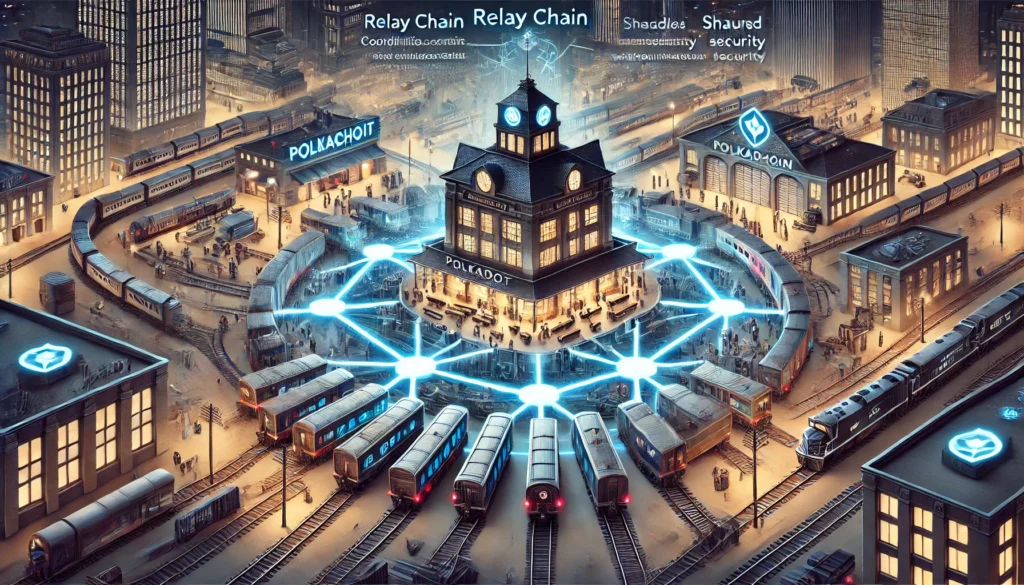
Imagine you’re setting up a new office, but instead of desks and chairs, you’re dealing with digital data and blockchain networks. This is where Polkadot and its native cryptocurrency, DOT, come into play. Polkadot is like the architectural blueprint for a sprawling digital metropolis, enabling different blockchain “buildings” to communicate and share resources efficiently. The Polkadot Network: A Digital Metropolis Polkadot, developed by the Web3 Foundation, is a blockchain platform designed to allow different blockchains to interoperate seamlessly. Think of it as a digital metropolis where various specialized districts (blockchains) are connected by a central hub (the Relay Chain). This design enables each district to maintain its unique features while benefiting from shared security and interoperability. Key Features of Polkadot 1. Relay Chain: The Central Hub The Relay Chain is the heart of the Polkadot network, akin to a central train station in a bustling city. This station coordinates the arrivals and departures of various trains (blockchains), ensuring they can operate simultaneously and share resources without chaos. The Relay Chain provides shared security for all connected blockchains, meaning each one doesn’t need to secure itself independently. It also facilitates communication between different blockchains, much like a station managing train schedules and passenger transfers. To further illustrate, consider how a central station ensures that all trains follow a schedule, share tracks without collisions, and benefit from centralized security and maintenance. The Relay Chain plays a similar role in Polkadot, managing data transfer, validating transactions, and securing the network. 2. Parachains: The Specialized Trains Parachains are like individual trains connected to the Relay Chain. Each train represents a blockchain with its own specific functions and data, tailored to serve different purposes. These parachains allow for parallel processing of transactions, increasing the overall network’s efficiency and scalability. Each parachain is optimized for specific tasks, such as finance, supply chain management, or gaming, and operates independently while relying on the Relay Chain for security and interoperability. Imagine specialized cargo trains, each designed to transport specific goods like coal, electronics, or food. These trains can operate simultaneously without interference, making the overall system more efficient. Parachains work similarly, each handling specific types of transactions or applications, which boosts Polkadot’s capacity and performance. 3. Interoperability: Polkadot facilitates the transfer of any type of data or asset across blockchains, making it a true multi-chain environment. This interoperability is achieved through its unique cross-consensus messaging format (XCM), which acts as a universal translator between different blockchains. For example, if one blockchain is like a Spanish-speaking district and another like an English-speaking district, XCM would be the interpreter that allows them to communicate seamlessly, enabling smooth transactions and data sharing. 4. Security: One of Polkadot’s standout features is pooled security. Instead of each blockchain having to secure itself independently, they all benefit from the shared security provided by the Relay Chain. This makes it easier for new blockchains to launch with robust security from day one. Think of it as a neighborhood watch program where every household contributes to and benefits from collective security. This shared approach enhances the safety of the entire community, making it more difficult for malicious activities to succeed. 5. Governance: Polkadot has a sophisticated on-chain governance system. DOT token holders have a say in protocol upgrades and decisions, making the network highly democratic. This governance model ensures that changes can be made transparently and without hard forks. Imagine a city council where every resident can vote on important issues, propose changes, and help shape the future of their community. Polkadot’s governance system empowers token holders in a similar way, ensuring the network evolves according to the community’s needs and preferences. 6. Staking: To keep the network secure, Polkadot uses a nominated proof-of-stake (NPoS) mechanism. In this system, DOT holders can either run a validator node or nominate others to do so, earning rewards for good behavior while being penalized for bad actions. This ensures the network remains decentralized and secure. Staking is like having citizens volunteer as security guards, with rewards for good service and penalties for negligence. This system maintains order and encourages active participation in keeping the network safe. The DOT Coin: The Lifeblood of Polkadot DOT is the native coin of the Polkadot network, serving several critical functions: 1. Governance: DOT holders participate in the decision-making process regarding network upgrades and changes, making the platform truly community-driven. 2. Staking: DOT coins are used to stake on the network, which helps secure it and process transactions. Stakers are rewarded for their contributions, which encourages active participation in maintaining the network’s health. 3. Bonding: New parachains are added to the network through a process called bonding, which involves locking up DOT tokens. This process ensures that only committed and valuable projects get to join the Polkadot ecosystem. DOT Coin Technical Analysis The all-time high (ATH) for DOT coin is $55, while the all-time low (ATL) is $2.7. DOT reached this ATL in 2020. Subsequently, it soared to its ATH of $55 in 2021. During the 2022 bear market, DOT mostly traded within the $4 to $8 range above its ATL. As of now, the price of DOT is approximately $5.7, which remains within this lower range. On the weekly timeframe, the current point of control is slightly above the present price, still within this range. DOT’s current market cap is $8 billion, a significant drop from a few months ago when it was $14 billion. At its peak in 2021, the market cap reached $55 billion. Despite the market fluctuations, DOT is considered a robust blockchain project with strong services. Based on its performance and potential, it is expected that DOT could perform as well as, if not better than, its previous highs during the next bull run. Key Price Levels: If the price goes up: $7.489 $9.491 $14 $17 $23 $27 $32 $34 $38 $41 $45 If the price goes down: $5 $3 Disclaimer: This is not financial advice (NFA). Always do your own research before making any investment decisions. Why