
4 Important Crypto News: Ethereum ETF Surge, Stablecoin Bill Momentum, Market-Making Scandals & Abu Dhabi’s Bitcoin Bet – Botslash Daily Crypto News Analysis
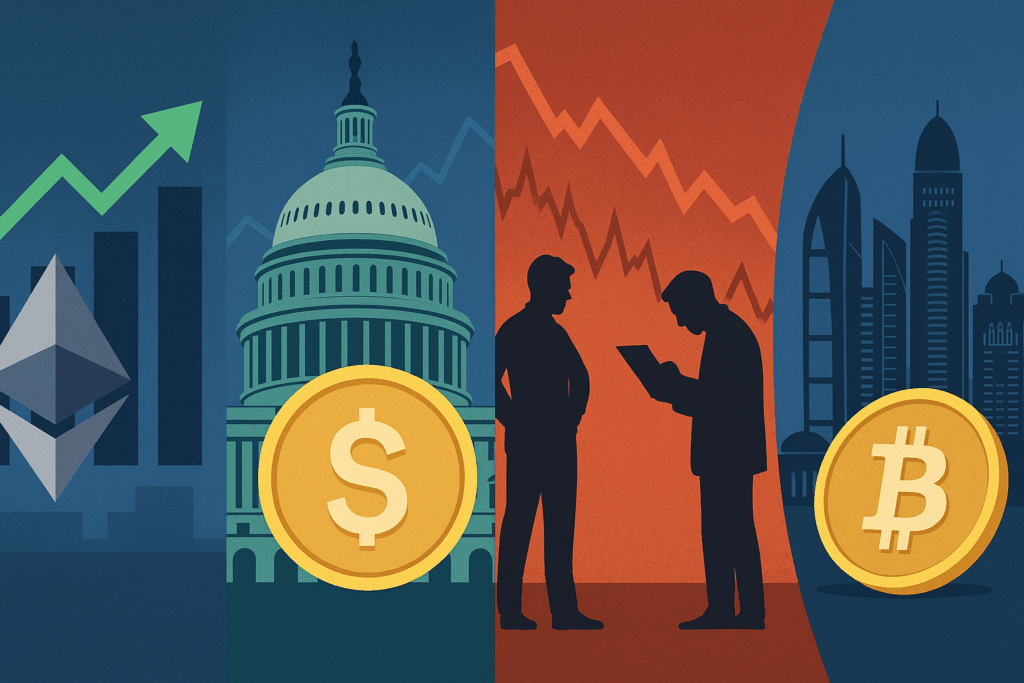
Investor sentiment in crypto is seeing strong momentum across multiple fronts, from Ethereum’s underappreciated value now attracting ETF interest, to a critical U.S. stablecoin regulation bill nearing Senate approval. At the same time, a scandal involving Movement Labs and Mantra is raising concerns about integrity in crypto market-making. In a major institutional move, Abu Dhabi has strengthened its stake in Bitcoin via a $408 million investment in BlackRock’s ETF. These developments underline a shifting landscape driven by both optimism and scrutiny. 🟢 Undervalued Ether Catching Eye of ETF Buyers as Rally Inbound Ethereum (ETH) is experiencing a notable resurgence, drawing increased attention from ETF investors. According to a CryptoQuant report, the ETH/BTC Market Value to Realized Value (MVRV) ratio indicates that ETH is significantly undervalued compared to Bitcoin—a condition not observed since 2019. This undervaluation, coupled with a 38% surge in the ETH/BTC price ratio from a five-year low, suggests a potential bullish trend for ETH. Institutional interest is also on the rise, with ETF holdings of ETH increasing relative to BTC since late April. Additionally, the ETH-to-BTC spot trading volume ratio has reached 0.89, the highest since August 2024, indicating a shift in investor preference towards ETH. These metrics, combined with reduced selling pressure on ETH, point towards a favorable market sentiment. The convergence of these factors suggests that Ethereum may be poised to lead a new ‘Alt season,’ potentially outperforming Bitcoin and driving a broader altcoin rally. 🟢 U.S. Stablecoin Bill Could Clear Senate Next Week, Proponents Say The U.S. Senate is on the verge of passing the Guiding and Establishing National Innovation in U.S. Stablecoins (GENIUS) Act, which aims to establish a regulatory framework for stablecoins. The bill mandates that stablecoins be backed by safe, liquid assets and comply with anti-money laundering and terrorism financing regulations. It also provides bankruptcy protections for holders. Despite facing opposition over provisions that could allow non-financial tech companies to issue stablecoins, the bill has garnered bipartisan support. Proponents argue that regulating stablecoins will reinforce the U.S. dollar’s global standing, as over 99% of stablecoins are pegged to the USD. By providing a clear regulatory framework, the bill could enhance the dollar’s appeal as a ‘safe haven’ asset. The passage of the GENIUS Act could be a significant step towards integrating stablecoins into the mainstream financial system, potentially boosting institutional confidence and accelerating crypto adoption. 🔻 Movement Labs and Mantra Scandal Are Shaking up Crypto Market-Making Recent scandals involving Movement Labs and Mantra have disrupted the crypto market-making landscape. Leaked documents reveal that Movement Labs, a Trump-backed startup, secretly promised up to 10% of its MOVE token supply to shadow advisers through undisclosed agreements. These arrangements were not disclosed to investors, raising concerns about transparency and governance. Additionally, Movement Labs’ co-founder Rushi Manche was fired following a controversial market-making deal involving the sale of 66 million MOVE tokens. This incident, along with similar issues at Mantra, has prompted a reevaluation of liquidity structures and trust in the crypto market-making sector. These events highlight the need for greater transparency and stricter verification processes within the crypto industry to maintain investor confidence and market integrity. 🟢 Abu Dhabi’s Sovereign Wealth Fund Reveals $408 Million Investment In BlackRock’s Bitcoin ETF Abu Dhabi’s sovereign wealth fund, Mubadala, has disclosed a $408.5 million investment in BlackRock’s iShares Bitcoin Trust (IBIT), according to a recent SEC filing. Mubadala’s strategic move into Bitcoin ETFs reflects a growing institutional appetite for crypto assets. By opting for ETF exposure rather than direct Bitcoin purchases, the fund simplifies custody and compliance processes, making it a more manageable investment. This investment also underscores the increasing acceptance of digital assets among sovereign wealth funds. As institutional interest in Bitcoin continues to rise, such significant investments could further legitimize and stabilize the crypto market, potentially attracting more traditional investors. Key Takeaways: Ethereum ETF buying surges as metrics reveal ETH is undervalued compared to BTC; bullish signs point to an incoming altcoin season. U.S. stablecoin legislation (GENIUS Act) is expected to reach the Senate floor next week; this could define global standards and boost dollar dominance. Movement Labs and Mantra scandal shakes investor trust, revealing backroom token deals and poor market-making transparency. Abu Dhabi invests $408M in Bitcoin ETF, signaling sustained institutional confidence and expanding sovereign crypto exposure.
3 Important Crypto News : Trump’s Crypto Reserve Proposal, Bitcoin Reserve Bill Rejections, and BTC Network Surge – Botslash Daily Crypto News Analysis
Donald Trump’s latest stance on cryptocurrency has sent shockwaves through the market as he proposed XRP, Solana (SOL), and Cardano (ADA) as part of a potential U.S. crypto reserve, leaving Bitcoin (BTC) out of the equation. Meanwhile, Bitcoin faced another challenge as several U.S. states rejected bills that would have allowed BTC to be held as a reserve asset, reflecting ongoing regulatory resistance. However, Bitcoin’s network activity tells a different story, as active addresses have surged, indicating renewed market interest and a potential turning point for its price trend. These developments highlight the intersection of politics, regulation, and market sentiment, shaping the future of cryptocurrency adoption. Donald Trump Names XRP, SOL, ADA – But Not BTC – as Part of U.S. Crypto Reserve Former U.S. President Donald Trump’s proposal to include XRP, Solana (SOL), and Cardano (ADA) in a potential U.S. crypto reserve while excluding Bitcoin (BTC) has created waves in the crypto space. His decision reflects a significant shift in political and financial perspectives regarding digital assets. Trump, who once criticized cryptocurrencies, now appears to be embracing blockchain-based assets with strong enterprise applications. XRP’s regulatory clarity after its partial victory against the SEC, Solana’s high-speed transactions, and Cardano’s research-driven approach make them attractive choices for institutional adoption. The exclusion of Bitcoin, however, has raised concerns among BTC supporters, who argue that it remains the most secure and decentralized cryptocurrency. Some speculate that this move is politically motivated, as Trump may be seeking to distance himself from the current administration’s regulatory stance on Bitcoin. Others believe that Trump’s team is prioritizing cryptocurrencies with faster transaction speeds and lower fees over BTC, which is often criticized for its energy consumption. Regardless, his announcement has driven speculation about potential government involvement in specific digital assets, leading to increased trading activity for XRP, SOL, and ADA. This move could have a broader impact on the crypto market, particularly in terms of regulatory developments. If a future administration officially endorses certain digital assets over others, it could reshape the competitive landscape of cryptocurrencies. Investors are now closely watching how regulators respond to Trump’s proposal and whether other political figures follow suit. The market reaction has already been evident, with the named altcoins experiencing temporary price surges. However, long-term sustainability will depend on concrete policy implementations rather than political rhetoric. Market Impact: The announcement that Donald Trump may consider XRP, Solana (SOL), and Cardano (ADA) for a potential U.S. crypto reserve—while excluding Bitcoin—has triggered significant movements in the crypto market. XRP, SOL, and ADA saw an immediate price surge as investors speculated on potential government backing. This shift has also sparked debate about whether political endorsements could influence institutional investment patterns. Bitcoin’s slight volatility in response to its exclusion reflects the ongoing tension between decentralized digital assets and regulatory favoritism. If Trump or other political figures pursue formal policies favoring specific cryptocurrencies, it could reshape market dynamics and investment strategies. Several U.S. States Reject Bitcoin Reserve Bills A series of U.S. states have rejected bills that would have allowed Bitcoin to be used as a reserve asset, signaling ongoing skepticism about integrating BTC into government holdings. Lawmakers cited volatility, environmental concerns, and regulatory uncertainty as primary reasons for dismissing the proposals. The rejection highlights the broader struggle between Bitcoin adoption and traditional financial institutions’ hesitations regarding digital assets. While Bitcoin has proven its resilience and long-term growth potential, some policymakers remain wary of its unpredictable price fluctuations. The decision contrasts with global trends, where some nations have moved towards Bitcoin adoption at the state level. El Salvador remains the most notable example, having integrated BTC as legal tender and holding it as part of its national reserves. However, in the U.S., the decentralized nature of state governance means that each state can independently decide its stance on crypto reserves. Without a unified federal position, states are unlikely to take bold steps toward adopting Bitcoin as a reserve asset. This lack of consensus could slow down broader institutional acceptance in the country. Despite the rejections, Bitcoin advocates remain optimistic that these bills will be revisited in the future as the market matures and regulatory frameworks evolve. Many believe that increased Bitcoin adoption by companies and institutional investors will eventually push states to reconsider. The rejection does not necessarily signal a complete dismissal of Bitcoin but rather a temporary roadblock due to current regulatory and financial uncertainties. As inflation and economic instability continue to be concerns, Bitcoin’s appeal as a hedge against traditional financial risks may grow stronger. Market Impact: The rejection of Bitcoin reserve bills by several U.S. states represents a temporary setback for BTC’s adoption as a recognized financial asset within government holdings. Although Bitcoin remains a popular hedge against inflation and economic instability, policymakers cited its volatility and regulatory concerns as primary reasons for their opposition. While this decision did not significantly impact Bitcoin’s price, it has reignited debates over regulatory clarity and the role of digital assets in public finance. Institutional adoption remains a key factor, and if major corporations continue accumulating BTC, it may push state governments to reconsider their stance in the future. Bitcoin Active Addresses Surge, Signaling Market Turning Point Bitcoin’s network activity has shown a significant increase, with a surge in active addresses pointing to a possible bullish shift in the market. The number of unique addresses engaging in transactions has reached multi-month highs, a trend historically associated with increased investor participation and potential price rallies. This rise in activity suggests renewed interest from both retail and institutional investors, possibly in anticipation of upcoming events such as the next Bitcoin halving. The increase in active addresses indicates that more wallets are interacting with the blockchain, a key metric often used to gauge the overall health of the Bitcoin network. On-chain analysts have pointed out that this trend often precedes bullish momentum, as it signals higher demand and usage. Furthermore, stable transaction fees suggest that the rise in activity is organic rather than being driven by network congestion or