
5 Important Crypto News: Stablecoin Bill Stalls, Bullish Bitcoin Indicator, $13.3B Binance Case, & EU Capital Controls: BotSlash Daily Crypto News Analysis
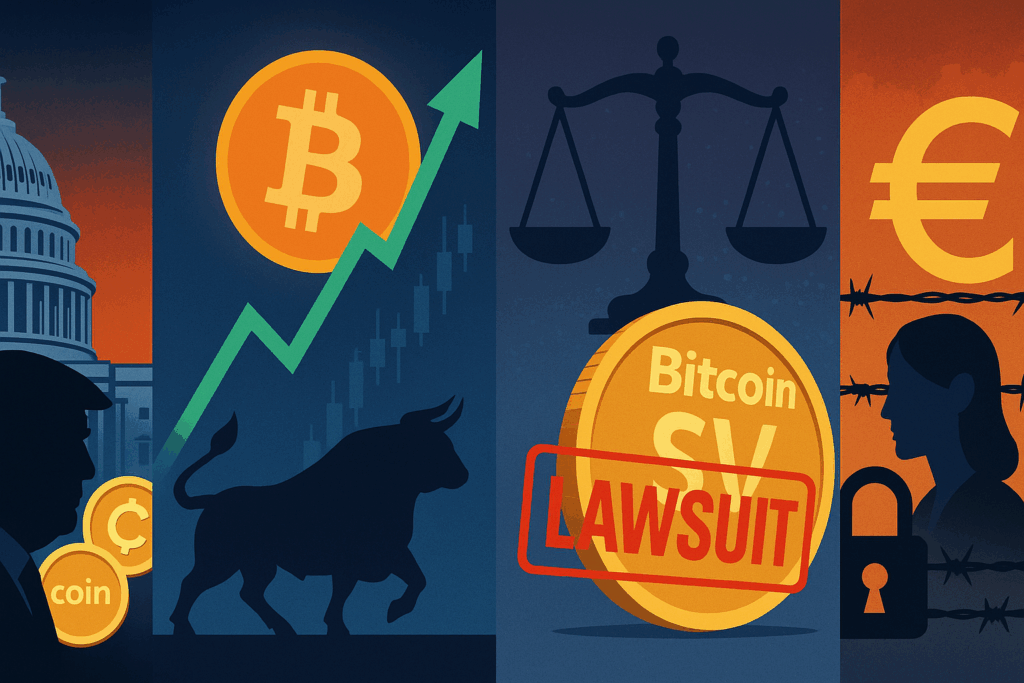
Political scrutiny, legal disputes, and macroeconomic policy shifts are converging with Crypto momentum and institutional behavior to shape the current crypto narrative. While the U.S. Senate battles controversy over the stablecoin framework, Europe tightens monetary policy in the shadow of its digital euro ambitions. Meanwhile, bullish market indicators and whale activity are hinting at renewed optimism in Bitcoin’s trajectory, all while Binance faces a resurrected multibillion-dollar lawsuit from discontented Bitcoin SV investors. 1. Senate Stablecoin Bill Stalls Amid Political Controversy The U.S. Senate’s attempt to pass the GENIUS Act, aimed at establishing a federal regulatory framework for stablecoins, has hit a roadblock. Despite earlier bipartisan support, the bill failed a procedural vote, largely due to concerns over former President Donald Trump’s involvement in cryptocurrency ventures. Democrats expressed apprehension about potential conflicts of interest, citing Trump’s launch of a meme coin and connections to a stablecoin project receiving significant foreign investment. The legislation’s future remains uncertain, with ongoing negotiations attempting to address issues related to money laundering, foreign issuers, and accountability. Senator Mark Warner has indicated a commitment to refining the bill to garner broader support. The crypto industry, which has invested heavily in lobbying for regulatory clarity, views the bill’s failure as a significant setback. The situation underscores the complexities of crafting legislation in a rapidly evolving financial landscape, especially when political interests intersect with regulatory efforts. 2. Bitcoin Bull-Bear Cycle Indicator Signals Potential Uptrend CryptoQuant’s Bull-Bear Market Cycle Indicator has flashed its first bullish signal since February, suggesting a possible shift in Bitcoin’s market dynamics. The indicator, which had consistently signaled bearish conditions, now points to a trend reversal as Bitcoin consolidates around the $103,000 mark. Analysts interpret this development as a sign of renewed investor confidence, with the potential for Bitcoin to challenge its all-time high of $109,000. The current market behavior indicates accumulation, often a precursor to significant price movements. While the bullish signal is promising, market participants remain cautious, acknowledging the need for sustained momentum and external factors that could influence the trajectory. 3. Bitcoin SV Investors Revive $13.3 Billion Claim Against Binance Investors in Bitcoin SV (BSV) are seeking to reinstate a “loss of chance” claim in a UK lawsuit against Binance, alleging that the exchange’s delisting of BSV led to significant financial losses. The claim, valued at approximately $13.3 billion, centers on the argument that Binance’s actions deprived investors of potential gains. A judge previously highlighted a discrepancy in the claimed damages, noting a substantial overstatement. Despite this, the investors are pushing to have their case reconsidered, emphasizing the impact of Binance’s decision on their investment opportunities. The outcome of this legal battle could set a precedent for how exchanges handle token listings and the responsibilities they bear toward investors. 4. Europe Faces Capital Controls Amid Digital Euro Concerns European nations are implementing capital controls in response to growing apprehensions about the digital euro initiative. Critics argue that the central bank digital currency could lead to increased surveillance and reduced financial privacy. Concerns include the potential for the digital euro to limit cash availability and grant authorities greater control over individual spending habits. The European Central Bank maintains that the digital euro aims to modernize the financial system, but public skepticism persists. The debate highlights the challenges central banks face in balancing innovation with privacy and autonomy in the digital age. 5. Institutional Bitcoin Holdings Surge by 41,300 BTC Institutional investors have significantly increased their Bitcoin holdings, with a reported addition of 41,300 BTC. This surge reflects a growing institutional interest in Bitcoin as a hedge against economic uncertainty and a store of value. Analysts attribute this trend to factors such as global economic instability and the search for alternative assets. The accumulation by large-scale investors suggests confidence in Bitcoin’s long-term prospects. This development could influence market dynamics, potentially leading to increased price stability and further adoption of Bitcoin in institutional portfolios. Key Takeaways 1. Senate Stablecoin Bill Stalls Amid Political Controversy The GENIUS Act failed to pass due to political disputes tied to Trump’s crypto involvement. Key issues include foreign issuer oversight, anti-money laundering, and governance structures. A major regulatory setback for stablecoin clarity and institutional crypto expansion in the U.S. 2. Bitcoin Bull-Bear Cycle Indicator Signals Potential Uptrend CryptoQuant’s indicator flipped bullish for the first time since February. Bitcoin hovers around $103K with renewed institutional and retail accumulation signals. A potential trend shift could lead BTC toward retesting its all-time high of $109K. 3. Bitcoin SV Investors Revive $13.3 Billion Claim Against Binance Investors allege Binance’s delisting of BSV caused lost opportunities. The case highlights exchange accountability and risks tied to token removals. A judicial precedent could emerge affecting future token listing decisions globally. 4. Europe Faces Capital Controls Amid Digital Euro Concerns EU capital restrictions raise alarms over surveillance and cash access. Public distrust grows around CBDCs despite ECB’s assurances. The development adds friction to the broader push toward digital financial systems. 5. Institutional Bitcoin Holdings Surge by 41,300 BTC Bitcoin whale wallets saw a sharp spike in holdings, signaling institutional confidence. Motivated by macroeconomic concerns and long-term value positioning. May fuel price stability and boost institutional adoption.
4 Important Crypto News: DeFi Yield Compression, Bitcoin Bull Trends, State Tax Shifts, Trump’s Regulatory Drama, Brazil’s Pension Ban & More — Botslash Daily Crypto News Analysis

Major crypto developments are shaping the global digital asset landscape across policy, innovation, and market sentiment. From Rhode Island’s move to make Bitcoin transactions tax-free to Brazil’s regulatory clampdown on pension funds, and from DeFi’s shifting dynamics to Trump’s controversial involvement, each headline underscores the rapidly evolving state of the crypto world. These stories also reflect rising political interest, global policy divergence, and a maturing market exploring real-world integrations and institutional depth. Yield Compression Challenges DeFi Lending, But Innovation Surges in Q1 2025 The first quarter of 2025 has been marked by a persistent compression of yields in the DeFi lending space, primarily driven by increased capital inflows and heightened competition among platforms. Major protocols like Aave, Compound, and Maker have seen their lending rates shrink, a signal that these platforms are maturing and attracting more liquidity. The decline in returns has led some investors to seek yield elsewhere, notably in riskier DeFi derivatives or cross-chain platforms promising higher APYs. Despite the contraction in yields, the DeFi sector hasn’t stood still. Developers and protocols are pivoting toward innovation to maintain user interest and profitability. Emerging trends include the integration of real-world assets (RWAs) like tokenized treasuries, improved risk modeling, and advanced credit delegation tools. These developments suggest that rather than folding under pressure, the DeFi space is adapting to become more resilient and inclusive. Notably, several new protocols focusing on undercollateralized lending and DeFi-native credit scores are gaining traction, hinting at a broader paradigm shift in how lending will evolve in the space. While the overall sentiment may appear cautious due to lower yields, the long-term outlook remains bullish. As institutional players continue exploring DeFi integrations and regulatory frameworks mature, this yield compression phase could actually catalyze a more stable and sustainable lending ecosystem. Protocols that successfully innovate during this transitional phase are likely to become future leaders in decentralized finance. Market Impact: The shrinking yields may deter some retail investors, potentially shifting liquidity to more volatile or experimental projects. However, the increased focus on protocol development and institutional appeal could ultimately lead to a more robust DeFi environment by mid-2025. Is Bitcoin’s Bull Market Just Hype or Here to Stay? Bitcoin’s resurgence in early 2025 has ignited heated debates across the crypto community, especially following its climb past the $60,000 mark. While short-term corrections have sparked fears of another fakeout rally, long-term metrics suggest the bull market might be more than just hype. Key indicators such as rising exchange outflows, increased institutional wallets, and higher hash rates reflect sustained bullish momentum. The market is also seeing a notable uptick in first-time retail investors, a characteristic of early-stage bull markets. However, some analysts are cautioning against overexuberance. The macroeconomic environment, including Fed rate policies and geopolitical tensions, still casts uncertainty. Moreover, altcoin dominance hasn’t yet followed suit, and many mid-tier tokens remain stagnant despite Bitcoin’s surge. This suggests that while BTC is leading the charge, the broader market may need more time to catch up. Another point of skepticism is the recent emergence of leveraged trading, which could exaggerate price movements in both directions. Nevertheless, seasoned investors highlight that bull markets are rarely linear. Zooming out, BTC has respected historical cycles, often moving in 4-year patterns aligned with halving events. The next halving, set for later this year, is already being priced in, and could act as a major catalyst. If current support levels hold and macro trends don’t drastically shift, Bitcoin’s bull market may indeed be in its early stages, despite short-term corrections. Market Impact: Continued bullish momentum for BTC could spur increased inflows into altcoins, NFTs, and DeFi. However, if volatility spikes, it may invite regulatory scrutiny and short-term pullbacks. Traders should watch support levels closely, especially in the $55K-$57K range. Rhode Island’s Bitcoin Tax-Free Bill Signals Pro-Crypto Shift A new legislative proposal in Rhode Island could allow residents to make Bitcoin transactions of up to $1,000 each—capped at $10,000 per month—without paying state taxes. This is a bold step toward encouraging the use of cryptocurrencies for everyday payments and integrating digital assets into mainstream economic activity. The bill, introduced by Senator Melissa Murray, highlights a growing political shift in favor of crypto adoption at the state level. This initiative is not just symbolic—it holds the potential to transform Rhode Island into a crypto-friendly hub, attracting startups and blockchain developers. The state could benefit from increased financial innovation, job creation, and potential investment inflows from tech-driven entrepreneurs. More importantly, it addresses a long-standing pain point in the U.S. crypto tax regime: the need to report every single transaction, regardless of size. If passed, the bill could pave the way for similar efforts in other progressive states like Colorado or Wyoming. The challenge, however, lies in execution. Ensuring compliance, integrating point-of-sale crypto solutions, and aligning the policy with federal tax frameworks will be essential. Nevertheless, this is a progressive move that could nudge regulators nationwide toward more user-friendly crypto tax policies, especially as digital currencies continue to gain traction as payment methods. Market Impact: This legislation, if enacted, could lead to increased crypto spending and higher transaction volumes in the U.S., boosting demand for merchant adoption platforms like BitPay and Strike. It could also strengthen bullish sentiment around Bitcoin’s use case as a currency rather than just a store of value. Trump’s Crypto Ties Complicate Regulatory Clarity Donald Trump’s increasingly public alignment with the crypto industry has introduced a fresh layer of complexity to the U.S. regulatory landscape. His reported involvement in forming the Strategic Bitcoin Reserve and his endorsement of digital asset policies have raised eyebrows, especially from Democrats concerned about potential conflicts of interest. Critics argue that such actions blur the line between policymaking and financial gain, making objective regulation harder to achieve. House Financial Services Committee Chair Patrick McHenry has voiced concerns that Trump’s political capital may be leveraged to promote crypto regulations that primarily benefit allies or personal interests. At the same time, his stance has created a split in the broader political sentiment