
What is IDO, ICO, and IEO: The Evolution of Cryptocurrency Fundraising

This article will cover everything about what is IDO, ICO, and IEO. Imagine you’re at a bustling marketplace. Vendors are shouting, trying to get your attention, each with a unique product to sell. Now, instead of fruits, clothes, or electronics, these vendors are offering new digital currencies or tokens. This marketplace represents the world of cryptocurrency, and the vendors’ methods of selling their tokens are akin to ICOs, IDOs, and IEOs. Let’s delve into what these terms mean, their origins, differences, history, and impact, and take a look at some notable examples from the past. The Origins: ICO, IDO, and IEO Initial Coin Offering (ICO): Think of an ICO as a digital fundraiser. Companies create a new cryptocurrency or token and sell it to investors to raise money for their projects. This method became popular in 2017 and allowed startups to bypass traditional fundraising methods like banks or venture capital. Initial DEX Offering (IDO): An IDO is similar to an ICO but takes place on a decentralized exchange (DEX). This means the token sale is automated through smart contracts, offering more transparency and accessibility. Initial Exchange Offering (IEO): An IEO, on the other hand, is managed by a cryptocurrency exchange. The exchange acts as a trusted intermediary, conducting the token sale on behalf of the company. This method adds a layer of credibility, as exchanges usually vet the projects before listing them. The Differences: Simplified Platform: ICOs are often hosted on the project’s own website, IDOs on decentralized exchanges, and IEOs on centralized exchanges. Trust Level: ICOs rely heavily on the project’s reputation, IDOs offer some transparency via smart contracts, and IEOs provide additional trust as exchanges vet the projects. Ease of Participation: ICOs can be more accessible to a wider audience, IDOs require some knowledge of using decentralized exchanges, and IEOs are user-friendly but may require account verification on the exchange. A Brief History: The Rise and Fall ICO Boom of 2017: The year 2017 was the golden era for ICOs. Hundreds of projects raised billions of dollars from investors eager to get in on the next big thing in crypto. The allure was high returns on investment, similar to buying shares in a company before it goes public. However, this gold rush had its pitfalls. Many projects either failed to deliver on their promises or turned out to be outright scams. This led to significant financial losses for investors and skepticism towards ICOs. Shift to IDOs and IEOs: In response to the shortcomings of ICOs, the crypto world saw the emergence of IDOs and IEOs. IDOs, with their decentralized nature, provided more transparency, while IEOs offered an additional layer of security through exchange vetting. Impact and Current Usage ICOs: Due to regulatory crackdowns and the high risk of scams, ICOs have become less popular. However, they paved the way for innovative fundraising methods in the crypto space. IDOs: IDOs are gaining traction due to their decentralized and transparent nature. They allow projects to reach a wide audience without relying on a centralized platform. IEOs: IEOs are currently more popular than ICOs, thanks to the added trust from established exchanges. They provide a safer environment for both projects and investors. Failed ICOs of 2017: Lessons Learned Tezos:The Tezos Initial Coin Offering (ICO) in 2017 was one of the most notable in the cryptocurrency space, raising a staggering $232 million. However, this success was marred by significant internal conflicts and legal issues, leading to substantial delays and investor frustration.Initial Success and Vision: Tezos was envisioned as a self-amending blockchain platform, aiming to offer superior governance and upgradeability compared to other blockchain projects. The ICO, which took place in July 2017, was a massive success, accumulating about 66,000 Bitcoins and 361,000 Ethers in just 13 days.Internal Conflicts and Legal Battles: The problems began shortly after the ICO concluded. The relationship between the founders, Arthur and Kathleen Breitman, and the president of the Tezos Foundation, Johann Gevers, became strained. Disputes over the control and management of the funds and the project itself led to significant delays in the token distribution. This internal conflict escalated to the point where both parties accused each other of unethical behavior, further complicating the project’s progress. In addition to internal strife, Tezos faced multiple class-action lawsuits in the United States. The lawsuits claimed that Tezos had conducted an unregistered securities offering, violating SEC regulations. These legal challenges added another layer of complexity and delayed the project’s development further. Sirin Labs: Sirin Labs raised $158 million to create the Finney blockchain smartphone. The ambitious project aimed to revolutionize mobile technology but failed to gain market traction. Production issues and a lack of consumer interest led to substantial losses. Bancor: Bancor launched its Initial Coin Offering (ICO) in June 2017, raising an impressive $153 million within a few hours. The project aimed to create a decentralized liquidity network that allowed users to convert different cryptocurrencies without needing an exchange. This innovative concept quickly garnered attention, positioning Bancor as a pioneer in the decentralized finance (DeFi) space.However, Bancor faced significant challenges shortly after its successful ICO. In 2018, the platform experienced a major security breach where hackers stole approximately $13.5 million worth of tokens. This incident raised serious concerns about the platform’s security and shook investor confidence. Additionally, regulatory issues in 2019 forced Bancor to bar U.S. users from its platform, further complicating its operations and affecting its market presence.Current Status and Innovations: Despite these setbacks, Bancor has managed to adapt and evolve. The project continues to operate and has introduced several innovative features aimed at enhancing its utility and security in the DeFi ecosystem. One of its notable advancements is the Carbon protocol, which enables users to execute automated trading strategies directly on the blockchain. This protocol is designed to resist common DeFi exploits such as Miner Extractable Value (MEV) sandwich attacks, providing a more secure trading environment.Moreover, Bancor’s governance model, operated through the BancorDAO, ensures that changes to the protocol are made transparently and democratically, involving the
DOT coin and Polkadot explained with price analysis

Imagine you’re setting up a new office, but instead of desks and chairs, you’re dealing with digital data and blockchain networks. This is where Polkadot and its native cryptocurrency, DOT, come into play. Polkadot is like the architectural blueprint for a sprawling digital metropolis, enabling different blockchain “buildings” to communicate and share resources efficiently. The Polkadot Network: A Digital Metropolis Polkadot, developed by the Web3 Foundation, is a blockchain platform designed to allow different blockchains to interoperate seamlessly. Think of it as a digital metropolis where various specialized districts (blockchains) are connected by a central hub (the Relay Chain). This design enables each district to maintain its unique features while benefiting from shared security and interoperability. Key Features of Polkadot 1. Relay Chain: The Central Hub The Relay Chain is the heart of the Polkadot network, akin to a central train station in a bustling city. This station coordinates the arrivals and departures of various trains (blockchains), ensuring they can operate simultaneously and share resources without chaos. The Relay Chain provides shared security for all connected blockchains, meaning each one doesn’t need to secure itself independently. It also facilitates communication between different blockchains, much like a station managing train schedules and passenger transfers. To further illustrate, consider how a central station ensures that all trains follow a schedule, share tracks without collisions, and benefit from centralized security and maintenance. The Relay Chain plays a similar role in Polkadot, managing data transfer, validating transactions, and securing the network. 2. Parachains: The Specialized Trains Parachains are like individual trains connected to the Relay Chain. Each train represents a blockchain with its own specific functions and data, tailored to serve different purposes. These parachains allow for parallel processing of transactions, increasing the overall network’s efficiency and scalability. Each parachain is optimized for specific tasks, such as finance, supply chain management, or gaming, and operates independently while relying on the Relay Chain for security and interoperability. Imagine specialized cargo trains, each designed to transport specific goods like coal, electronics, or food. These trains can operate simultaneously without interference, making the overall system more efficient. Parachains work similarly, each handling specific types of transactions or applications, which boosts Polkadot’s capacity and performance. 3. Interoperability: Polkadot facilitates the transfer of any type of data or asset across blockchains, making it a true multi-chain environment. This interoperability is achieved through its unique cross-consensus messaging format (XCM), which acts as a universal translator between different blockchains. For example, if one blockchain is like a Spanish-speaking district and another like an English-speaking district, XCM would be the interpreter that allows them to communicate seamlessly, enabling smooth transactions and data sharing. 4. Security: One of Polkadot’s standout features is pooled security. Instead of each blockchain having to secure itself independently, they all benefit from the shared security provided by the Relay Chain. This makes it easier for new blockchains to launch with robust security from day one. Think of it as a neighborhood watch program where every household contributes to and benefits from collective security. This shared approach enhances the safety of the entire community, making it more difficult for malicious activities to succeed. 5. Governance: Polkadot has a sophisticated on-chain governance system. DOT token holders have a say in protocol upgrades and decisions, making the network highly democratic. This governance model ensures that changes can be made transparently and without hard forks. Imagine a city council where every resident can vote on important issues, propose changes, and help shape the future of their community. Polkadot’s governance system empowers token holders in a similar way, ensuring the network evolves according to the community’s needs and preferences. 6. Staking: To keep the network secure, Polkadot uses a nominated proof-of-stake (NPoS) mechanism. In this system, DOT holders can either run a validator node or nominate others to do so, earning rewards for good behavior while being penalized for bad actions. This ensures the network remains decentralized and secure. Staking is like having citizens volunteer as security guards, with rewards for good service and penalties for negligence. This system maintains order and encourages active participation in keeping the network safe. The DOT Coin: The Lifeblood of Polkadot DOT is the native coin of the Polkadot network, serving several critical functions: 1. Governance: DOT holders participate in the decision-making process regarding network upgrades and changes, making the platform truly community-driven. 2. Staking: DOT coins are used to stake on the network, which helps secure it and process transactions. Stakers are rewarded for their contributions, which encourages active participation in maintaining the network’s health. 3. Bonding: New parachains are added to the network through a process called bonding, which involves locking up DOT tokens. This process ensures that only committed and valuable projects get to join the Polkadot ecosystem. DOT Coin Technical Analysis The all-time high (ATH) for DOT coin is $55, while the all-time low (ATL) is $2.7. DOT reached this ATL in 2020. Subsequently, it soared to its ATH of $55 in 2021. During the 2022 bear market, DOT mostly traded within the $4 to $8 range above its ATL. As of now, the price of DOT is approximately $5.7, which remains within this lower range. On the weekly timeframe, the current point of control is slightly above the present price, still within this range. DOT’s current market cap is $8 billion, a significant drop from a few months ago when it was $14 billion. At its peak in 2021, the market cap reached $55 billion. Despite the market fluctuations, DOT is considered a robust blockchain project with strong services. Based on its performance and potential, it is expected that DOT could perform as well as, if not better than, its previous highs during the next bull run. Key Price Levels: If the price goes up: $7.489 $9.491 $14 $17 $23 $27 $32 $34 $38 $41 $45 If the price goes down: $5 $3 Disclaimer: This is not financial advice (NFA). Always do your own research before making any investment decisions. Why
The Ripple Effect: How News Impacts the Crypto Market

The Impact of News on the Cryptocurrency Market Imagine the cryptocurrency market as a vast ocean, with investors as surfers riding the unpredictable waves. News, in this analogy, acts as the wind—sometimes a gentle breeze, sometimes a violent storm—shaping the size and intensity of the waves. In the cryptocurrency world, where prices can soar or plummet within minutes, understanding how news influences the market is crucial for anyone looking to navigate these turbulent waters. This essay explores the profound impact of news on the crypto market, delving into five significant news events and their repercussions on prices. We will also unpack the phenomenon of “sell the news,” a strategy where large investors, or “whales,” capitalize on market hype. The Double-Edged Sword of News News can be both a boon and a bane for the crypto market. Positive news (like interest rate cut) can drive investor confidence, leading to price surges, while negative news can trigger panic selling and steep declines. The rapid dissemination of information in today’s digital age means that the crypto market is highly sensitive to news events, with prices reacting almost instantaneously. Case Study 1: Tesla’s Bitcoin Investment On 08 February 2021, Tesla announced it had purchased $1.5 billion worth of Bitcoin and planned to accept it as payment for its electric cars. This news was a significant endorsement of Bitcoin’s legitimacy and potential as a mainstream financial asset. Following the announcement, Bitcoin’s price soared from around $38,000 to a peak of nearly $46,700 in a day. This was surge of $8,000 dollar within a day. In next few days it soared to $58,000. Impact on Prices: Before Announcement: ~$38,000 After Announcement: ~$58,000 The news led to a massive influx of retail and institutional investors, driving up demand and prices. However, this surge was also accompanied by increased volatility as traders speculated on future price movements. Case Study 2: China’s Crackdown on Cryptocurrencies In May 2021, China announced a sweeping crackdown on cryptocurrency mining and trading. The news sent shockwaves through the market, leading to a significant sell-off. Bitcoin’s price, which had been hovering around $55,000, plummeted to below $30,000 within weeks. Impact on Prices: Before Announcement: ~$55,000 After Announcement: ~$30,000 China’s announcement underscored the impact that regulatory news can have on the crypto market. The fear of further crackdowns led to a mass exodus of miners from China and significant price volatility. Here, we must note that according to some analysts China never completely banned cryptocurrencies in its main land and that’s why the Chinese trading on Binance is exceeding $90B. Case Study 3: El Salvador Adopts Bitcoin as Legal Tender On June 09, 2021, El Salvador became the first country to adopt Bitcoin as legal tender. This historic decision was hailed as a milestone for Bitcoin’s adoption. The news initially caused Bitcoin’s price to surge from around $33,500 to over $41,000. However, implementation challenges and skepticism from international financial institutions led to a price drop shortly after. Impact on Prices: Before Announcement: ~$33,500 After Initial Surge: ~$41,000 After Implementation Challenges: ~$28,000 This case highlights how positive news can boost prices, but also how subsequent developments and uncertainties can temper initial enthusiasm. Let us tell you something. When El Salvador first bought 200 Bitcoin in September 2021, the IMF’s reaction was harsh, causing the price to drop quickly within an hour. At around $43,000, President Nayib Bukele announced that they had purchased an additional 200 Bitcoin at discounted prices. This move stopped the rapid decline in price. It appears that there was some questionable financial maneuvering against the country for making Bitcoin legal tender instead of the dollar. Case Study 4: SEC’s Approval of Bitcoin Futures ETF In October 2021, the U.S. Securities and Exchange Commission (SEC) approved the first Bitcoin futures ETF (Exchange-Traded Fund). This news was seen as a major step towards mainstream acceptance of Bitcoin and other cryptocurrencies. Bitcoin’s price jumped from around $57,000 to a high of $69,000 (that time’s ATH) following the announcement. Impact on Prices: Before Announcement: ~$57,000 After Announcement: ~$69,000 The approval of the ETF attracted a wave of new investors, reflecting the growing integration of cryptocurrencies into traditional financial markets. Case Study 5: FTX Collapse and Market Crash In November 2022, the collapse of FTX, one of the largest cryptocurrency exchanges, triggered a market-wide crash. The news led to widespread panic and a sharp decline in prices. Bitcoin’s price fell from around $21,000 to below $16,000, with other cryptocurrencies experiencing similar declines. Impact on Prices: Before Collapse: ~$21,000 After Collapse: ~$16,000 The FTX collapse underscored the vulnerabilities in the crypto market and the importance of robust infrastructure and regulatory oversight. The “Sell the News” Phenomenon The concept of “sell the news” is a strategy where large investors, often referred to as “whales,” capitalize on market hype generated by positive news. Whales are investors with substantial holdings, capable of influencing market prices through their trading activities. Here’s how “sell the news” typically plays out: Positive News Announcement: A piece of positive news, such as a major company investing in Bitcoin or a favorable regulatory decision, generates excitement and optimism in the market. Price Surge: Retail investors and smaller traders, motivated by the positive news, start buying, driving up the price. Whales Sell: As the price peaks due to the influx of buyers, whales begin to sell their holdings. Because whales hold large amounts of cryptocurrency, their selling can create significant downward pressure on prices. Market Correction: Once the whales have sold their holdings, the market often experiences a correction, with prices falling from their highs. This strategy leverages the psychological impact of news on retail investors, who often act on emotion and herd behavior. By selling into the hype, whales can secure profits before the market corrects itself. Example of “Sell the News” A notable example of “sell the news” occurred in the aftermath of the Tesla Bitcoin announcement. While the initial news drove prices up significantly, subsequent sales by large investors led to a correction. The price
Profits with Order Blocks: A Guide to Strategic Trading

Imagine you’re at a bustling farmers’ market on a Saturday morning. Each vendor has a unique spot where they sell their goods, and regular customers know exactly where to go to get the best deals. In the world of trading, an “order block” is a bit like these regular vendor spots—it’s a place on a price chart where significant buying or selling activity has taken place. Understanding order blocks can help traders predict where prices might move next, just like knowing which vendors offer the best deals can make your market trip more efficient. What is an Order Block? In simple terms, an order block is a zone on a trading chart where big institutions, like banks or hedge funds, have placed large buy or sell orders. These blocks indicate areas of strong support or resistance. Think of it as a footprint left behind by big players in the market. When these institutions buy or sell in large quantities, they leave a mark on the price chart, which traders can use to their advantage. Order blocks are shown on charts as points with multiple bounce backs (as shown in image below). They are not just random occurrences; they represent a concerted effort by major players to buy or sell at specific price levels. This activity often creates a kind of “memory” in the market. Traders can look at these historical levels to gauge future price movements. In this chart, you can see two boxes: green and red. The green box represents a range from which the price usually bounces. This acts similarly to a support level but covers a wider range. When the price reached this range in the past, buying orders countered the selling pressure, causing the price to rise from this point. It is likely that the same situation will occur when the price reaches this range again, as traders who have observed this level will place buy orders here. The same principle applies to the red box, which indicates a selling point. When the price reached this level previously, numerous selling orders forced it to go back down. It is likely that this scenario will repeat next time. Note that each support, resistance, trend, and order block eventually breaks. If this were not the case, the market would always move sideways and fade away due to squeezing movements. For example, if someone bought at $60,000 and sold at $71,000, they might try to buy at $61,000 the next time to avoid missing out if the price doesn’t drop to $60,000 again, and they might aim to sell at $70,000 to avoid rejection. This behavior squeezes the price, eventually causing it to stop moving. Thus, every block breaks in the end, marking the beginning of a new trend. Why Do Order Blocks Matter? Order blocks matter because they can signal potential price reversals or continuations. For instance, if a large institution buys a significant amount of a stock at a certain price level, that level becomes a strong support area. If the price drops to that level again, other traders might expect it to bounce back up, creating a buying opportunity. Conversely, if a large institution sells a lot at a certain price, that level becomes a resistance area. If the price climbs back to that level, traders might expect it to fall again, creating a selling opportunity. Order blocks provide a sort of roadmap for traders. By recognizing where large orders have previously been placed, traders can anticipate where future support and resistance levels might be. This understanding can lead to more strategic trading decisions and better risk management. Spotting Order Blocks on a Chart Let’s break down how you can spot order blocks on a chart: Identify Strong Price Movements: Look for areas on the chart where the price has moved sharply up or down. These strong moves often indicate the presence of large orders from institutions (see image above). Look for Consolidation Areas: Before a strong move, prices often consolidate or move sideways. This consolidation phase is where institutions might be placing their orders quietly but this is not the case always. Check Volume: High trading volume during these periods of consolidation can be a clue that big players are involved. When volume spikes, it often indicates that significant buying or selling is taking place. This is not necessary for each bounce. Observe Price Reactions: Notice how prices react when they revisit these areas. If prices tend to bounce back up from a specific level repeatedly, it suggests a buy order block. If they fall from a level repeatedly, it indicates a sell order block. Real-World Example: The Farmers’ Market Analogy Imagine you’re at the farmers’ market, and there’s a particular stall that always has fresh apples. One day, you notice that the vendor has put up a big sign saying “Fresh Apples, Limited Stock!” and there’s a rush of customers buying apples. The next week, you come back and see that the vendor has put up the same sign again, and once more, people are rushing to buy. In trading terms, that vendor’s spot is an order block. The vendor (like a big institution) creates significant buying activity at that spot, and the customers (like traders) recognize this and follow suit. They know that when the vendor signals fresh apples, it’s time to buy. Similarly, if another vendor has a surplus of oranges and slashes prices to sell quickly, you’ll notice a surge in buying activity. Next time you see those low prices, you might anticipate another rush. This mirrors how sell order blocks function in trading. How to Use Order Blocks in Trading Now that you understand what order blocks are, here’s how you can use them in your trading strategy: Set Entry and Exit Points: Use order blocks to set your entry and exit points. If you identify a buy order block, you might set a buy order just above this level. Conversely, if you identify a sell order block, you
Trading’s Vital Pause: A most forgotten thing

Do you know what a trader miss most in trading? The importance of trading break. Imagine a car running nonstop, day in and day out, without ever turning off the engine. Over time, that car would start to show signs of wear and tear. The engine might overheat, the tires would wear down, and eventually, the car would break down completely. This scenario is not unlike what happens to our minds and bodies when we don’t take breaks, especially in high-pressure environments like trading. The Trading Treadmill Trading in financial markets is often described as a high-stakes game. The constant need to monitor markets, make quick decisions, and handle significant financial risks can be incredibly stressful. Imagine being on a treadmill that never stops, and every decision you make can lead to substantial gains or losses. The pressure to perform, the uncertainty, and the fear of making mistakes can take a heavy toll on your mental health. Over time, this can lead to burnout, anxiety, and even depression. The Importance of Taking a Break Just like any other high-stress job, the importance of trading break is high to maintain mental health and overall well-being. Taking a holiday or a gap in trading is not just a luxury; it’s a necessity. Here’s why: Mental Recharge: Our brains are not designed to function at full capacity 24/7. They need time to rest and recharge. Continuous trading without breaks can lead to cognitive fatigue, reducing our ability to think clearly and make sound decisions. A holiday allows the brain to relax, recover, and come back refreshed. Stress Reduction: The constant ups and downs of trading can elevate stress levels. Chronic stress is linked to a host of health problems, including heart disease, high blood pressure, and mental health disorders like depression and anxiety. Taking time off helps lower stress levels and provides a mental reset. Perspective and Reflection: Stepping away from the trading desk allows traders to gain perspective. It’s a chance to reflect on their strategies, learn from their experiences, and make improvements. This reflection can lead to better decision-making and more effective trading strategies in the long run. Everyday Examples Consider the example of athletes. They follow rigorous training schedules but also include rest days in their routines. These rest days are crucial for muscle recovery and overall performance enhancement. Without rest, athletes are more prone to injuries and burnout. Similarly, traders need their “rest days” to perform optimally. Another everyday example is students preparing for exams. Continuous studying without breaks can lead to burnout and reduced performance. However, students who take regular breaks, get enough sleep, and relax tend to perform better academically. The same principle applies to trading. The Consequences of Not Taking Breaks Failing to take breaks can have serious consequences. Prolonged periods of stress without respite can lead to depression. Depression is more than just feeling sad; it can severely impact one’s ability to function, affecting decision-making, focus, and overall quality of life. In the context of trading, this can mean poor trading decisions, significant financial losses, and a downward spiral of stress and mental health issues. Conclusion In conclusion, taking a holiday or a gap in trading is vital for maintaining mental health and overall well-being. Continuous trading without breaks can lead to cognitive fatigue, increased stress levels, and serious mental health issues like depression. By taking regular breaks, traders can recharge their minds, reduce stress, gain perspective, and ultimately make better trading decisions. Just as a car needs regular maintenance to keep running smoothly, our minds need regular breaks to function at their best. So, if you’re a trader, remember to step off the treadmill now and then—your mind and health will thank you.
Crypto Trends Unveiled: A Beginner’s Guide to Market Movements

Imagine you’re standing at the edge of a vast, bustling marketplace. This marketplace is unlike any other—it doesn’t sell fruits, clothes, or gadgets. Instead, it’s a marketplace for digital currencies, commonly known as cryptocurrencies. The hustle and bustle here are driven by numbers on screens, fluctuating up and down, indicating the value of these cryptocurrencies like Bitcoin and Ethereum. This dynamic environment is what we call the crypto market, and it’s constantly changing, influenced by various trends. What Are Crypto Market Trends? Just like waves in the ocean, the value of cryptocurrencies (or any other financial market, like stocks, commodities, forex etc) rises and falls, creating trends. These trends are essentially the general direction in which the market moves over a period. If you see prices steadily increasing, that’s an upward trend. Conversely, if prices are falling, that’s a downward trend. Understanding these trends helps investors decide when to buy or sell cryptocurrencies. How Are Trends Measured? To make sense of the seemingly random movements in the crypto market, traders use different tools and techniques. Think of these as different types of glasses that help you see the waves more clearly. Let’s look at a few of these tools: SMA, EMA, HMA, and VWMA. We will discuss them separately too. Simple Moving Average (SMA): Imagine you want to know the average temperature in your city over the last week. You’d add up each day’s temperature and divide by seven. That’s essentially what the SMA does with cryptocurrency prices. It takes the average price over a specific number of days. For example, a 10-day SMA adds up the prices of the last 10 days and divides by 10. This helps smooth out daily fluctuations and shows the overall trend. Exponential Moving Average (EMA): The EMA is like the SMA but gives more importance to recent prices. It’s like if you weighed the temperature of the last three days more heavily than the first four days. This makes the EMA more responsive to recent changes in the market, helping traders catch trends earlier. Hull Moving Average (HMA): The HMA goes a step further, aiming to reduce the lag in moving averages. It’s a bit more complex, but you can think of it as a more agile and responsive version of the SMA and EMA. It reacts quickly to changes in price, helping traders spot trends sooner. In our experience it is more responsive to changes than other three. Volume-Weighted Moving Average (VWMA): The VWMA adds another layer by considering the volume of trades. Imagine you’re tracking the popularity of ice cream flavors by not just counting the number of scoops sold but also noting which flavors sold in bulk. The VWMA takes the average price but gives more weight to prices during high trading volumes, offering a clearer picture of where the most activity is. NOTE THAT: In crypto market Moving Average is a LAGGING indicators which means it indicates trend a little late, normally after one or two days. This is because it comes from stocks and forex which are much slower than crypto. So relying heavily on it can result losses. What Starts Trends? Trends in the crypto market can start due to a variety of factors. Here are a few common ones: News and Events: Just like a rumor can spread quickly in a small town, news about cryptocurrencies can significantly impact their prices. Positive news, like a major company accepting Bitcoin, can start an upward trend. Negative news, such as a country banning crypto trading, can trigger a downward trend. Market Sentiment: The general feeling or mood among traders can influence trends. If traders feel optimistic about the market (bullish), they’re likely to buy more, driving prices up. If they’re pessimistic (bearish), they might sell off, causing prices to drop. Technological Developments: Innovations and improvements in blockchain technology, which underpins cryptocurrencies, can also affect trends. A major upgrade to the Bitcoin network, for example, might make it more efficient and secure, leading to a price increase. Regulatory Changes: Governments around the world are still figuring out how to regulate cryptocurrencies. New regulations can have a big impact. Clear, favorable regulations might boost confidence and drive prices up, while strict regulations might have the opposite effect. Conclusion Understanding trends in the crypto market is like learning to read the waves in our bustling marketplace. Tools like SMA, EMA, HMA, and VWMA help traders see the bigger picture and make informed decisions. Trends can start due to news, market sentiment, technological advancements, and regulatory changes. For anyone venturing into the world of cryptocurrencies, keeping an eye on these trends is essential. So, next time you hear about the rise or fall of Bitcoin, you’ll have a better idea of what’s driving those changes and how traders are navigating the ever-changing tides of the crypto market.
Exchanges: A Beginner’s Guide to Cryptocurrency Trading

Imagine you live in a small town where everyone loves to trade goods. In this town, there are two main marketplaces: one is a big, organized store run by a group of managers, and the other is an open field where people trade freely with each other. These two marketplaces represent centralized and decentralized exchanges in the world of cryptocurrency. Centralized Exchanges: The Organized Store Centralized exchanges (CEX) are like the big, organized store. In this store, a team of managers oversees everything. They set the rules, ensure security, and help you find what you need. When you want to trade, you give your goods (or money) to the store, and they handle the trade for you. How It Works: Account Creation: Just like you’d sign up for a membership at the store, you create an account on a centralized exchange, like Binance, OKex, Kucoin, Bitget, Bybit and MEXC etc. You can create account on Binance here. Depositing Funds: You deposit your money or cryptocurrency into the exchange’s account, similar to how you might put your money in the store’s safe deposit box. Trading: The exchange matches buyers and sellers. If you want to buy some cryptocurrency, the exchange finds someone who wants to sell and completes the trade for you. Withdrawal: Once you’re done trading, you can withdraw your funds back to your personal account. Advantages: User-Friendly: Centralized exchanges are usually very easy to use. They offer customer support, clear interfaces, and help with transactions. Security and Trust: These exchanges invest heavily in security to protect users’ funds and have insurance in case something goes wrong. Liquidity: There are often many people trading on these platforms, making it easier to buy or sell quickly. Disadvantages: Control: You don’t have complete control over your funds because they are held by the exchange. Privacy: You often need to provide personal information to use these platforms. Risk of Hacking: Even with strong security, centralized exchanges can be targets for hackers. Decentralized Exchanges: The Open Field Decentralized exchanges (DEX) are like the open field where people trade directly with each other. There are no managers or middlemen; you handle everything yourself. Some examples are uniswap, 1inch and pancakeswap. How It Works: No Account Needed: You don’t need to create an account. All you need is a digital wallet where you store your cryptocurrency, like trust wallet, exodus etc. Direct Trading: You trade directly with other people. Using smart contracts, which are self-executing agreements coded into the blockchain, trades are done automatically and securely. Maintaining Control: Your funds stay in your wallet until you decide to trade, so you have full control over your assets. Advantages: Control: You always control your funds and don’t have to trust a third party. Privacy: You don’t need to provide personal information to trade. Security: Since your funds aren’t stored on a central server, they are less vulnerable to large-scale hacks. Disadvantages: Complexity: Decentralized exchanges can be harder to use, especially for beginners. Liquidity Issues: There may be fewer people trading, which can make it harder to buy or sell quickly. Lack of Customer Support: If something goes wrong, there’s no customer service to help you. Blockchain relation: You can only trade on provided blockchains. If a token is on Ethereum you can not directly change it to BTC. Summary: Choosing Your Marketplace Both centralized and decentralized exchanges have their strengths and weaknesses. If you prefer ease of use, strong security measures, and customer support, centralized exchanges might be the way to go. Many people use CEX only. If you value privacy, control over your funds, and are comfortable with a bit more complexity, decentralized exchanges could be more appealing. In the end, the choice depends on your personal preferences and comfort level with handling digital assets. By understanding the differences between these two types of exchanges, you can make informed decisions about how to trade and manage your cryptocurrency. Happy trading!
Riding the Market Waves with RSI

Imagine you’re a surfer, standing on the shore, watching the waves crash and recede. You’re looking for the perfect moment to jump in, catch a wave, and ride it all the way to the shore. In the world of trading, the Relative Strength Index (RSI) is like your surfing guide, helping you identify those perfect moments when the market’s waves are just right for making your move. Understanding RSI: Your Market Surfing Guide RSI, or Relative Strength Index, is a popular tool among traders, used to measure the momentum of price changes. Think of it as a thermometer for the market’s fever. It tells you that how much price is strong relative to given number of candles. This nifty indicator oscillates between 0 and 100, providing insights into whether an asset is overbought or oversold, revealing potential reversals, and identifying trends. Let’s break down its three primary uses: Oversold and Overbought Conditions: Picture RSI as a pendulum. When it swings too high, above 70 (or in the case of the volatile crypto market, above 80 which we recommend), it signals that the asset might be overbought. This means the price could be higher than what the market considers fair, suggesting a potential drop ahead. Conversely, when the pendulum swings too low, below 30 (or below 20 for crypto), it indicates the asset might be oversold, meaning the price could be lower than its fair value, hinting at a potential rise. Divergence: Divergence is like noticing the wind changing direction while surfing. When the price of an asset moves in one direction and the RSI moves in another, it signals a potential reversal. For example, if prices are rising but RSI is falling, it might be a clue that the upward trend is losing strength and a downward shift could be imminent. Trend Identification: RSI also helps in spotting trends, much like a seasoned surfer reading the ocean waves. A consistently high RSI in the range of 50-70 (or 50-80 for crypto) during an uptrend or a low RSI in the range of 30-50 (or 20-50) during a downtrend can confirm the strength of the ongoing trend. Note these points again: RSI would be consistently HIGH WHEN overall trend is HIGH is uptrend and vice versa. So only high RSI in overall low trend is not indicating uptrend. Crypto Market: Adjusting the RSI Lens In the wild world of cryptocurrency, prices can change as rapidly as ocean waves during a storm. Because of this volatility, traders often adjust their RSI settings to better navigate these tumultuous waters. Instead of the traditional 70-30 thresholds, many use 80 for overbought and 20 for oversold conditions. This adjustment helps in filtering out the noise and focusing on more significant market signals. However, it’s crucial to remember that prices don’t always bounce immediately from these overbought or oversold regions. Sometimes, just like waiting for the right wave, you may need to exercise patience. The market can linger in these regions longer than anticipated, and immediate reversals are not guaranteed. Results can be better if RSI is used with MFI or Bollinger Bands. The Daily Timeframe: Your Go-To Window Among the various timeframes traders use, the daily timeframe is the most popular for RSI analysis. This period provides a balanced view, capturing enough data to smooth out short-term fluctuations while reflecting broader market trends. It’s akin to looking at the tide cycles rather than individual waves, giving a clearer picture of the overall market momentum. RSI Heatmaps: A Bird’s Eye View For those who like to keep an eye on multiple assets simultaneously, RSI heatmaps are invaluable tools. These heatmaps provide a visual representation of RSI levels across various cryptocurrencies at a glance, much like a weather map showing wave conditions across different beaches. With just a quick look, traders can spot which coins are entering overbought or oversold territories, helping them make more informed decisions quickly. Riding the Market Waves with RSI In summary, the Relative Strength Index is like your trusted surfboard, guiding you through the ups and downs of the trading ocean. By understanding and utilizing RSI, especially with adjusted thresholds for the volatile crypto market, traders can better identify overbought and oversold conditions, spot divergences, and confirm trends. Using the daily timeframe offers a balanced view of market momentum, and RSI heatmaps provide a comprehensive overview of multiple assets. Just as surfing requires practice, patience, and a keen eye on the waves, mastering RSI in trading involves similar dedication. By staying informed and vigilant, you can navigate the market’s waves with confidence and skill, making the most of every opportunity that comes your way. So, grab your surfboard, keep an eye on those RSI signals, and ride the market waves to your trading success.
Navigating the Financial Seas: A Guide to Day Trading, Scalping, and Beyond
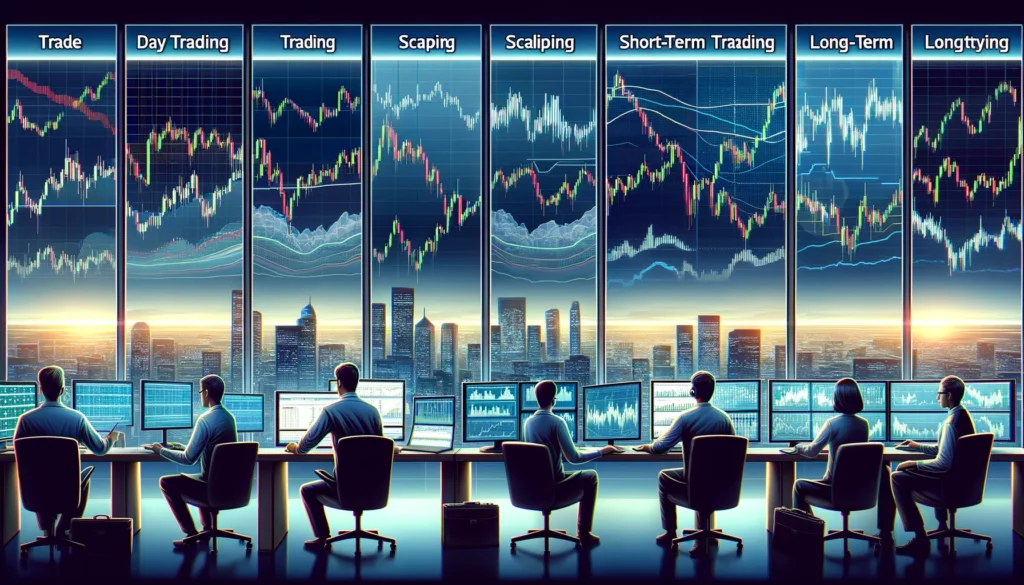
Imagine you’re at a busy farmer’s market. Each vendor and customer is trying to make the best deal possible, whether they’re there for a quick buy or a long-term investment. The world of trading is quite similar, with various strategies tailored to different time frames and market conditions. Understanding these strategies—day trading, scalping, swing trading, short-term trading, mid-term trading, and long-term investing—can help traders make informed decisions based on their goals and market dynamics. Day Trading: Riding the Daily Waves Think of day trading like running a food truck at the market. Each day, you buy fresh ingredients, cook your meals, and sell everything before the day ends. You aim to make a profit within those few hours, and at the end of the day, you close up shop with no leftovers. Day traders buy and sell stocks or other financial instruments within the same trading day. They rely on quick decisions and a constant watch on the market, aiming to capitalize on short-term price movements. It’s fast-paced and can be rewarding, but it also comes with high risks. Scalping: Quick Dips in the Market Scalping is like being a vendor selling small, popular items, such as snacks or drinks, at the market. You make lots of small sales throughout the day, each one contributing to your overall profit. Scalpers make numerous trades in a single day, holding their positions for just a few seconds or minutes to capture tiny price changes. This strategy requires sharp attention and rapid execution, as even minor market shifts can impact profits. Swing Trading: Catching the Market Swings Swing trading is similar to a farmer who plants crops and waits a few weeks to a few months before harvesting. The farmer isn’t concerned with daily weather changes but focuses on the overall growing season. Swing traders hold their positions for several days to weeks, aiming to profit from market trends and patterns. They use a mix of technical and fundamental analysis to identify opportunities and are generally more patient than day traders, waiting for the right moment to buy or sell. Short-Term Trading: Adapting to Market Conditions Short-term trading is like buying seasonal products at the market. For instance, you might buy pumpkins in October or holiday decorations in December, knowing these items will sell well within a few months. Short-term trading typically spans from three to six months. Traders in this category might extend their holding periods when the market is expected to move sideways or temporarily decline. They adapt their strategies based on current market conditions, using both technical and fundamental analysis to guide their decisions. Mid-Term Trading: Balancing Risk and Reward Mid-term trading is akin to investing in a small business at the market, like a new bakery. You’re looking at a time frame of six months to a year, balancing the potential risks and rewards. Mid-term traders aim to benefit from significant market movements without the constant pressure of daily monitoring. They consider broader economic trends, company performance, and industry developments to make their investment decisions. Long-Term Investing: The Patient Path Long-term investing is like owning a stall that sells aged cheese. You buy the cheese, let it mature over several years, and sell it when it reaches its peak quality. Long-term investors hold assets for several years, focusing on the intrinsic value of their investments. They consider factors like company management, competitive advantage, and market potential, with the patience to ride out short-term market volatility for long-term gains. Adjusting Strategies for Market Conditions When the market enters a sideways movement or faces temporary downturns, traders might adjust their strategies. For instance, a fruit vendor might choose to sell preserved jams instead of fresh fruits during the off-season. Similarly, short-term and mid-term traders might extend their holding periods to allow for market recovery, reducing the impact of short-term volatility. Conclusion: Charting Your Course Whether you’re operating a food truck, selling seasonal products, or aging cheese for years, each trading strategy offers unique opportunities and challenges. By understanding these approaches and adapting to market conditions, you can make informed decisions and navigate the financial markets successfully. Choose the strategy that best fits your goals and risk tolerance, and you’ll be well on your way to financial success.
How American Interest Rates Drive the Crypto Rollercoaster

Do you ever think why the price of cryptocurrencies, like Bitcoin, seems to be on a wild rollercoaster ride, going up and down with dizzying speed? To understand this, we need to take a closer look at something that might seem unrelated at first: American interest rates. Yes, those numbers set by the Federal Reserve can have a profound impact on the risky world of crypto markets. Let’s dive into the story of how this works. Setting the Stage: Interest Rates and Risk Interest rates, simply put, are the cost of borrowing money. When the Federal Reserve, often just called the Fed, raises or lowers these rates, it sends ripples through the entire financial world. Imagine you’re standing at the edge of a calm pond and you toss a stone into it. The splash creates waves that spread out in all directions. That’s what changing interest rates do to the economy. The Link Between Interest Rates and Investments When interest rates are low, borrowing money is cheaper. This encourages businesses to take loans for expansion and individuals to take loans for big purchases, like homes or cars. It also means savings accounts and other low-risk investments offer lower returns, nudging investors to look for higher returns elsewhere. This is where riskier investments, like stocks and cryptocurrencies, come into play. In contrast, when interest rates rise, borrowing becomes more expensive. This can slow down spending and borrowing, and suddenly those safe, low-yield investments look more attractive again. Investors might pull their money out of risky markets and put it into safer places. Cryptocurrencies: The High-Risk, High-Reward Frontier Cryptocurrencies are among the riskiest investments out there. They are not tied to any physical assets, governments, or traditional financial systems, which makes them highly volatile. This means their value can skyrocket or plummet in a very short period, driven by market sentiment, news, and, importantly, interest rates. When interest rates are low, as they have been in recent years, people are more willing to take risks. The potential for high returns in the crypto market becomes very attractive compared to the meager returns on safer investments. More money flows into cryptocurrencies, driving their prices up. The Ripple Effect of Rising Rates Now, let’s consider what happens when interest rates start to climb. As the Fed raises rates to control inflation and stabilize the economy, the environment for investments changes. Suddenly, those high-risk, high-reward crypto investments look a bit too risky compared to safer options that are starting to offer better returns. Investors may start to sell off their cryptocurrencies, leading to a drop in prices. This sell-off can create panic, causing even more people to sell and further driving down prices. It’s a cascading effect that can lead to significant declines in the crypto market. Real-World Examples We’ve seen this happen in recent years. For example, during periods when the Fed hinted at or actually increased interest rates, the crypto market experienced sharp declines. Investors moved their money into safer, more stable assets as the relative attractiveness of risky investments waned. On the flip side, when the Fed cut rates to near zero during the COVID-19 pandemic to stimulate the economy, we saw a surge in crypto investments. People were looking for better returns than what they could get from traditional savings accounts or bonds, which were offering very low yields due to the low interest rates. Conclusion: The Dance of Risk and Reward In essence, the relationship between American interest rates and the crypto market is a dance of risk and reward. When interest rates are low, the music favors high-risk, high-reward investments, and cryptocurrencies often take center stage. When rates rise, the music changes, and investors may shift their focus to safer, more predictable returns. Understanding this dynamic helps us make sense of the seemingly chaotic movements in the crypto market. It’s a reminder that in the world of finance, everything is interconnected. The next time you see headlines about interest rate changes, remember that these shifts can have a ripple effect far beyond traditional investments, influencing even the most modern and volatile markets like cryptocurrency. So, whether you’re a seasoned investor or just curious about the financial world, keeping an eye on interest rates is always a good idea.