
4 Important Crypto News: Bitcoin Outlook, Corporate Support, Draper’s Bold Claim & CPI Inflation Update — BotSlash Daily Crypto News Analysis
Today’s updates reveal a fascinating cross-section of crypto’s evolution: from technical momentum in Bitcoin to deep institutional plays across AI, high-performance computing, and stablecoin adoption. Bitcoin’s bullish technical breakout signals a potential leadership rally, while major financial players are aggressively positioning for long-term dominance through strategic ventures and incentives. These developments not only reinforce confidence in crypto markets but also highlight emerging themes of convergence between traditional finance, tech innovation, and digital assets. 1. Bitcoin Market Dynamics: In-Depth Analysis & Forward Outlook Bitcoin’s recent market behavior reflects a complex interplay of macroeconomic factors and investor sentiment. The cryptocurrency has experienced fluctuations influenced by global economic indicators, regulatory developments, and shifts in institutional investment strategies. Analysts have noted that Bitcoin’s price movements are increasingly correlated with traditional financial markets, suggesting a maturation of the asset class. Technical analysis indicates that Bitcoin is navigating critical support and resistance levels, with traders closely monitoring these thresholds for potential breakout or breakdown scenarios. On-chain metrics, such as transaction volumes and active addresses, provide additional insights into market participation and network health. These indicators are essential for understanding the underlying strength of Bitcoin’s market position. Looking forward, the outlook for Bitcoin remains cautiously optimistic. Factors such as potential regulatory clarity, continued institutional adoption, and macroeconomic trends like inflation and currency devaluation could play significant roles in shaping Bitcoin’s trajectory. Investors are advised to stay informed about these developments and consider them in their strategic planning. Market Impact: The evolving dynamics of Bitcoin’s market suggest a period of increased volatility and potential opportunity. Investors should be prepared for rapid changes and consider risk management strategies to navigate this environment effectively. 2. Who Are the Most Fervent Supporters of Bitcoin? Research Indicates Corporations Are at the Forefront of Accumulation Recent research highlights a significant trend: corporations are increasingly becoming major holders of Bitcoin. Companies like MicroStrategy, Tesla, and Square have made substantial investments in Bitcoin, signaling a shift in how corporate treasuries view digital assets. This movement is driven by factors such as the desire for diversification, hedging against inflation, and the pursuit of higher returns. The accumulation of Bitcoin by corporations is not just a financial maneuver but also a strategic positioning in anticipation of a more digital and decentralized financial future. These entities are leveraging Bitcoin’s properties to enhance their balance sheets and align with emerging financial paradigms. This trend also reflects growing confidence in Bitcoin’s long-term value proposition. As corporations continue to adopt Bitcoin, this could lead to increased stability and legitimacy for the cryptocurrency market. It may also prompt further regulatory developments and influence public perception, potentially accelerating mainstream adoption. Stakeholders should monitor this trend as it could have profound implications for the broader financial ecosystem. Market Impact: Corporate accumulation of Bitcoin contributes to reduced circulating supply, potentially exerting upward pressure on prices. This trend underscores the importance of institutional participation in driving market dynamics and could lead to increased investor confidence. 3. Bitcoin Will Replace U.S. Dollar in 10 Years, Says Billionaire VC Tim Draper Billionaire venture capitalist Tim Draper has made a bold prediction: Bitcoin will supplant the U.S. dollar as the world’s primary currency within the next decade. Draper’s assertion is based on Bitcoin’s decentralized nature, limited supply, and resistance to inflation, which he believes make it superior to traditional fiat currencies. He also points to the increasing adoption of Bitcoin by individuals and institutions as evidence of its growing prominence. Draper’s vision reflects a broader discourse on the future of money and the role of cryptocurrencies in the global economy. While some view his prediction as overly optimistic, it underscores the transformative potential that digital assets hold. The idea of Bitcoin replacing the U.S. dollar challenges conventional monetary systems and invites discussions on the evolution of financial sovereignty and trust. Critics argue that significant hurdles remain, including regulatory challenges, technological scalability, and the need for widespread adoption. However, Draper’s perspective contributes to the ongoing debate about the future of currency and the potential for disruptive innovation in the financial sector. His stance encourages stakeholders to consider the long-term implications of digital currencies on global economic structures. Market Impact: While Draper’s prediction may be speculative, such high-profile endorsements can influence market sentiment and investor behavior. They may also prompt policymakers and financial institutions to engage more seriously with the implications of digital currencies. 4. U.S. CPI Rose Less Than Expected: 0.2% in April; Annual Pace Slips to Four-Year Low The U.S. Consumer Price Index (CPI) increased by 0.2% in April, bringing the annual inflation rate down to 2.3%, the lowest in four years. This unexpected moderation in inflation comes amid significant tariff implementations by the Trump administration, including a 145% tariff on Chinese imports. Despite these tariffs, prices for certain goods, such as eggs and apparel, have decreased, contributing to the overall slowdown in inflation. Analysts caution that the full impact of the tariffs may not yet be reflected in the CPI data, suggesting that inflationary pressures could resurface in the coming months. The Federal Reserve has maintained interest rates between 4.25% and 4.5%, adopting a cautious approach in response to the mixed economic signals. Market participants are closely watching for further data to assess the trajectory of inflation and potential monetary policy adjustments. The current inflation dynamics have implications for various asset classes, including cryptocurrencies. Lower inflation may reduce the urgency for investors to seek inflation hedges like Bitcoin. However, ongoing economic uncertainties and policy developments continue to influence investor strategies and market volatility. Market Impact: The unexpected dip in inflation has led to positive movements in equity markets, with the S&P 500 and Nasdaq posting gains. However, the potential for future inflationary pressures due to tariffs remains a concern, which could affect investor sentiment and asset allocation decisions. Key Takeaways Bitcoin Market Dynamics:Bitcoin’s price is closely mirroring traditional markets, with analysts watching technical levels and macroeconomic cues to predict future movements. Corporate Accumulation:Major firms like MicroStrategy and Tesla are leading a trend of corporate Bitcoin accumulation, signaling
6 Important Crypto News: Miners Underperform, UK’s Regulatory Stumble, Bitcoin’s Bullish Signals, and Stablecoin Innovations : Botslash Daily Crypto News Analysis

As the crypto sector continues to evolve, today’s developments offer a balanced mix of market dynamics, global regulatory actions, and strategic innovation. From the struggles of Bitcoin miners with HPC exposure and Kuwait’s energy protection crackdown, to the UK’s fading ambition as a crypto hub and a potential bullish crossover for Bitcoin, the headlines highlight the volatility and growing maturity of the digital assets space. Meanwhile, traditional financial giants like Visa and PayPal are driving forward with stablecoin integration, signaling growing institutional adoption and practical use cases in real-world payments. 1. Bitcoin Miners with HPC Exposure Underperform BTC for Third Straight Month: JPMorgan JPMorgan’s latest report reveals that Bitcoin miners with high-performance computing (HPC) exposure, such as IREN, RIOT, WULF, and HUT, have underperformed BTC for the third consecutive month. In April, mining profitability declined as the network hashrate increased by 6%, intensifying competition and reducing margins. Despite a 12% rise in the total market capitalization of 13 tracked mining stocks, those with significant HPC operations lagged behind. The underperformance is attributed to the increased operational costs associated with HPC activities, which, coupled with the rising hashrate, have squeezed profit margins. Miners focusing solely on Bitcoin mining without diversifying into HPC have fared better in comparison. This trend underscores the challenges faced by miners in balancing diversification with profitability. Market Impact: The continued underperformance of HPC-exposed miners may lead to a reevaluation of business strategies within the mining sector. Investors might shift focus towards miners with streamlined operations concentrating on Bitcoin to mitigate risks associated with HPC ventures. 2. UK’s Delayed Regulation Hurts Plan to Be Global Crypto Hub, Executives Say: CNBC Industry executives express concerns over the UK’s sluggish approach to cryptocurrency regulation, warning that it hampers the country’s ambition to become a global crypto hub. The lack of clear and comprehensive regulatory frameworks has led to uncertainty, discouraging investment and innovation in the sector. Compared to other nations advancing their crypto regulations, the UK risks falling behind in attracting crypto businesses. The Financial Conduct Authority (FCA) has been criticized for its slow progress, with some firms considering relocating to more crypto-friendly jurisdictions. The delay in establishing a robust regulatory environment not only affects existing businesses but also deters new entrants, impacting the UK’s competitiveness in the global crypto market. Market Impact: The regulatory ambiguity may lead to capital flight and talent drain, weakening the UK’s position in the burgeoning crypto industry. To retain and attract crypto enterprises, swift and decisive regulatory action is imperative. 3. Kuwait Cracks Down on Illegal Crypto Mining to Protect National Grid Kuwait has initiated a crackdown on illegal cryptocurrency mining operations to alleviate pressure on its national power grid. The Ministry of Interior reported that unauthorized mining activities have significantly strained electricity resources, leading to power outages. Over 60 individuals are under investigation, and authorities have disconnected power from properties linked to illicit mining. The government’s action highlights the challenges faced by countries with subsidized electricity in managing the energy-intensive nature of crypto mining. While crypto trading is banned in Kuwait, the absence of specific laws addressing mining has allowed such activities to proliferate, exacerbating energy consumption issues. Market Impact: The enforcement measures may deter illegal mining activities, prompting miners to seek operations in regions with clearer regulations and energy policies. This could influence global mining distribution and impact the overall network hashrate. 4. Bitcoin Is Approaching a Golden Cross While the MVRV Ratio Gains Strength: Could This Signal a Potential Breakout? Bitcoin is nearing a ‘Golden Cross’—a bullish technical pattern where a short-term moving average crosses above a long-term moving average. Simultaneously, the Market Value to Realized Value (MVRV) ratio is gaining strength, indicating potential undervaluation and signaling a possible breakout. Historically, such patterns have preceded significant price rallies in Bitcoin. Analysts suggest that if the Golden Cross materializes and the MVRV ratio continues its upward trajectory, Bitcoin could experience a substantial price increase. However, they caution that while these indicators are promising, external factors and market sentiment will also play crucial roles in determining the actual outcome. Market Impact: The convergence of these bullish indicators may attract increased investor interest, potentially driving up demand and price. Traders and investors should monitor these developments closely to capitalize on potential market movements. 5. Visa Is Set to Launch Its Inaugural Stablecoin Cards in the Near Future Visa has announced a partnership with stablecoin infrastructure startup Bridge to launch stablecoin-linked Visa cards. These cards will enable customers in Latin America to make everyday purchases using cryptocurrencies. Initially available in Argentina, Colombia, Ecuador, Mexico, Peru, and Chile, the cards are expected to expand to Europe, Africa, and Asia soon. The initiative allows users to spend stablecoins at any merchant that accepts Visa, with Bridge handling the backend processes to convert stablecoin balances into local currencies during transactions. This move signifies a significant step towards integrating cryptocurrencies into mainstream financial systems, enhancing their utility in daily transactions. Market Impact: Visa’s foray into stablecoin payments could accelerate the adoption of cryptocurrencies in everyday commerce, potentially increasing demand for stablecoins and influencing the broader digital payments landscape. 6. The US SEC Has Concluded Its Investigation into PayPal’s PYUSD Stablecoin Without Taking Any Enforcement Measures The U.S. Securities and Exchange Commission (SEC) has concluded its investigation into PayPal’s USD-backed stablecoin, PYUSD, without taking any enforcement action. The probe, which began in November 2023, examined the launch and structure of PYUSD. PayPal disclosed in a recent filing that the SEC informed the company in February 2025 of the investigation’s conclusion. This development provides regulatory clarity for PayPal and may encourage other financial institutions to explore stablecoin offerings. The SEC’s decision not to pursue enforcement actions suggests a more accommodating stance towards stablecoins, provided they adhere to existing regulatory frameworks. Market Impact: The closure of the investigation removes a significant regulatory hurdle for PayPal, potentially boosting investor confidence and paving the way for broader adoption of PYUSD in digital transactions. Key Takeaways Bitcoin Miners with HPC exposure are facing sustained
4 Important Crypto News: Bitcoin Breaks Out, Galaxy Bets on AI, Tether & SoftBank Form BTC Giant, PayPal Adds Yield to Stablecoin — BotSlash Daily Crypto News Analysis

Today’s updates reveal a fascinating cross-section of crypto’s evolution: from technical momentum in Bitcoin to deep institutional plays across AI, high-performance computing, and stablecoin adoption. Bitcoin’s bullish technical breakout signals a potential leadership rally, while major financial players are aggressively positioning for long-term dominance through strategic ventures and incentives. These developments not only reinforce confidence in crypto markets but also highlight emerging themes of convergence between traditional finance, tech innovation, and digital assets. Bitcoin Breaches ‘Ichimoku Cloud’ to Flash Bullish Signal While Altcoins Lag Bitcoin has surged past the Ichimoku Cloud resistance, a key technical indicator, signaling a bullish trend. The cryptocurrency rose over 5% to $93,500 within 24 hours, marking its first significant breakout above this level in 2025. This movement suggests a potential continuation of the upward momentum, especially as the Ichimoku Cloud is often used to identify support and resistance levels, as well as trend direction. Despite Bitcoin’s rally, major altcoins like Ethereum (ETH), XRP, Cardano (ADA), and Dogecoin (DOGE) have not mirrored this performance. Their lag indicates a possible market divergence, where Bitcoin leads the charge while altcoins consolidate. This scenario is not uncommon and often reflects investor confidence consolidating around Bitcoin before spreading to other cryptocurrencies. The current market dynamics suggest that Bitcoin’s dominance may continue to grow in the short term. Investors and traders might focus more on Bitcoin, especially with technical indicators supporting a bullish outlook. However, the altcoin market’s response in the coming days will be crucial to determine if a broader market rally is on the horizon. Market Impact: Bitcoin’s breakout above the Ichimoku Cloud has reinforced bullish sentiment among traders, potentially attracting more institutional and retail investors. This could lead to increased capital inflow into Bitcoin, further driving its price upward. Galaxy Digital Deepens AI and HPC Pivot with Expanded CoreWeave Deal; Shares Surge Galaxy Digital has announced an expansion of its partnership with CoreWeave, focusing on artificial intelligence (AI) and high-performance computing (HPC). The agreement will see CoreWeave accessing an additional 260 megawatts (MW) of IT capacity at Galaxy’s Helios data center in West Texas, bringing the total to 393 MW. This move signifies Galaxy Digital’s strategic shift from traditional crypto mining to AI and HPC services. The expanded deal reflects the growing demand for AI and HPC infrastructure, with Galaxy positioning itself to capitalize on this trend. By repurposing its facilities to support AI workloads, Galaxy aims to diversify its revenue streams and reduce reliance on the volatile cryptocurrency market. This strategic pivot aligns with broader industry movements where tech companies are investing heavily in AI capabilities. Investor response has been positive, with Galaxy Digital’s shares experiencing a notable surge following the announcement. The market perceives this diversification as a forward-thinking approach, potentially offering more stable and sustainable growth prospects compared to the unpredictable nature of crypto markets. Market Impact: Galaxy Digital’s transition into AI and HPC services could set a precedent for other crypto-focused firms seeking diversification. This move may attract a new class of investors interested in AI infrastructure, potentially leading to increased investment and innovation in the sector. Tether, Bitfinex, Cantor, and SoftBank to Launch Bitcoin Company with $3.9 Billion Treasury A consortium comprising Tether, Bitfinex, Cantor Fitzgerald, and SoftBank has announced the formation of Twenty One Capital, a Bitcoin-centric company. The venture will launch with over 42,000 BTC, valued at approximately $3.9 billion, positioning it as the third-largest corporate holder of Bitcoin globally. This initiative underscores the growing institutional interest in Bitcoin as a strategic asset. Twenty One Capital aims to provide investors with a vehicle for Bitcoin exposure, pro-Bitcoin advocacy, and related financial products. The company plans to raise an additional $585 million through convertible notes and private equity to purchase more Bitcoin and fund operations. Jack Mallers, known for his work with Strike, will lead the company as CEO, bringing significant industry experience to the venture. The involvement of major players like Tether and SoftBank signals a strong vote of confidence in Bitcoin’s long-term value proposition. This move could influence other institutional investors to consider similar strategies, potentially leading to increased demand and price appreciation for Bitcoin. Market Impact: The establishment of Twenty One Capital with a substantial Bitcoin treasury may contribute to reduced market liquidity, potentially driving up prices. Additionally, this development could encourage other institutions to allocate more resources to Bitcoin, further legitimizing it as a mainstream investment asset. PayPal to Pay 3.7% Annual Yield on Stablecoin PYUSD to Encourage Broader Use PayPal has announced that it will offer a 3.7% annual yield on its stablecoin, PayPal USD (PYUSD), to U.S. users. This initiative aims to increase the adoption of PYUSD by providing users with a financial incentive to hold and use the stablecoin within the PayPal ecosystem. The yield will be available through both PayPal and Venmo platforms, integrating seamlessly into users’ existing financial activities. The move positions PayPal competitively within the stablecoin market, which is currently dominated by players like Tether and Circle. By offering a yield, PayPal not only incentivizes usage but also introduces a novel approach to stablecoin utility, blending traditional financial returns with digital currency convenience. This strategy could attract users who are interested in earning passive income while engaging in everyday transactions. However, offering yields on stablecoins may invite regulatory scrutiny, as it blurs the lines between traditional banking products and digital assets. PayPal will need to navigate these regulatory challenges carefully to ensure compliance and maintain user trust. If successful, this initiative could set a new standard for stablecoin offerings, influencing how digital currencies are integrated into mainstream financial services. Market Impact: PayPal’s yield offering on PYUSD could accelerate the adoption of stablecoins for everyday transactions, potentially reducing reliance on traditional banking systems. This development might prompt other fintech companies to explore similar incentives, fostering increased competition and innovation in the digital payments space. Key Takeaways Bitcoin’s Bullish Momentum: Bitcoin has broken above the Ichimoku Cloud, triggering a bullish signal that could mark the start of a new upward trend, even as
4 Important Crypto News: Miners Expand, Google Tightens Ads, Nvidia Shifts AI Production, Visa Backs Stablecoins – BotSlash Daily Crypto News Analysis

Confidence across multiple layers of the crypto ecosystem is evolving. From major financial giants joining stablecoin ventures to hardware and regulatory shifts shaping miners’ futures, each development reveals the rapidly growing interconnection between crypto, tech, and traditional finance. Whether through stricter ad policies, increased hardware manufacturing, or new consortiums, these headlines reflect pivotal moments that are reshaping how crypto operates on a global scale. Bitcoin Miners Are Doubling Down Bitcoin miners are significantly increasing their investments, signaling strong confidence in the cryptocurrency’s future. This surge is likely driven by the recent halving event, which reduced block rewards and intensified competition among miners. To maintain profitability, miners are upgrading to more efficient hardware and expanding operations. Additionally, the growing institutional interest in Bitcoin and the anticipation of favorable regulatory developments are contributing factors. This trend underscores the resilience of the mining sector and its pivotal role in supporting the Bitcoin network. Market Impact: The increased investment by miners may lead to a more secure and robust Bitcoin network, potentially boosting investor confidence. However, the heightened competition could also result in centralization concerns and increased energy consumption, attracting regulatory scrutiny. Google to Restrict Crypto Ads in EU to MiCA-Licensed Firms Google’s decision to limit cryptocurrency advertisements in the European Union to firms licensed under the Markets in Crypto-Assets (MiCA) regulation marks a significant shift towards regulatory compliance. This move aims to protect consumers from fraudulent schemes and ensure that only vetted entities can promote crypto-related products. By aligning with MiCA, Google is setting a precedent for other tech giants to follow suit, potentially leading to a more secure and transparent crypto advertising ecosystem. This policy change may also encourage crypto firms to seek proper licensing, fostering a more regulated market environment. Market Impact: The restriction could lead to reduced visibility for unlicensed crypto projects, potentially impacting their growth and fundraising efforts. Conversely, licensed firms may benefit from increased trust and legitimacy, attracting more users and investors. Nvidia Moves AI Supercomputer Production to U.S., Opening New Avenues for Crypto Miners Nvidia’s announcement to manufacture AI supercomputers in the United States represents a strategic shift in its production strategy. Collaborating with partners like TSMC, Foxconn, and Wistron, Nvidia plans to invest up to $500 billion over the next four years in U.S.-based AI infrastructure. This move aims to strengthen supply chains, meet growing demand, and enhance economic resilience. For crypto miners, this development could provide access to advanced hardware domestically, reducing reliance on overseas suppliers and potentially lowering costs. Moreover, the increased availability of high-performance computing resources may spur innovation and efficiency within the mining sector. Market Impact: Nvidia’s investment is likely to boost the U.S. tech manufacturing sector, creating jobs and fostering innovation. For the cryptocurrency industry, improved access to cutting-edge hardware could enhance mining operations, potentially leading to increased network security and stability. Visa Is Joining the Paxos-Robinhood Stablecoin Consortium: Sources Visa’s reported involvement in the Paxos-Robinhood stablecoin consortium signifies a notable development in the integration of traditional finance with the cryptocurrency space. By aligning with established crypto entities, Visa aims to explore the potential of stablecoins in facilitating seamless, low-cost transactions. This collaboration could lead to the development of new payment solutions that leverage blockchain technology, offering users faster and more efficient financial services. Furthermore, Visa’s participation may encourage other financial institutions to explore similar partnerships, accelerating the adoption of digital currencies in mainstream finance. Market Impact: Visa’s entry into the stablecoin arena could enhance the credibility and acceptance of digital currencies, potentially leading to increased adoption among consumers and merchants. This move may also stimulate competition and innovation within the payment industry, driving further advancements in financial technology. Key Takeaways 1. Bitcoin Miners Are Doubling Down Miners are significantly increasing investments post-halving. Focus is on high-efficiency hardware and expansion. Reflects rising confidence in Bitcoin’s long-term potential. 2. Google to Restrict Crypto Ads in EU to MiCA-Licensed Firms Only MiCA-compliant crypto firms can advertise in the EU. Aims to reduce fraud and promote legitimate players. Encourages broader regulatory compliance across the industry. 3. Nvidia Moves AI Supercomputer Production to U.S. AI hardware production now shifting to domestic factories. Could offer crypto miners better access to advanced computing tools. Signals strengthening of local supply chains and innovation hubs. 4. Visa Is Joining the Paxos-Robinhood Stablecoin Consortium Visa steps further into crypto by aligning with Paxos and Robinhood. Could accelerate the adoption of stablecoins in mainstream payments. Promotes convergence between traditional finance and blockchain systems.
4 Important Crypto News: Bitcoin Volatility, Institutional Concerns, Ripple’s Stablecoin Surge & Token Listing Boom – BotSlash Daily Crypto News Analysis

A series of impactful developments are shaking up the crypto world. From a sharp Bitcoin drop triggered by U.S. tariff tensions to Jack Dorsey’s warning about the growing power of institutional players in the Bitcoin space, the balance between decentralization and mainstream adoption remains a hot topic. Meanwhile, Ripple is making aggressive moves with its RLUSD stablecoin, signaling stablecoins’ expanding role in global payments. Lastly, data highlighting the exceptional returns from crypto token listings brings fresh excitement and opportunity into the market conversation. Bitcoin Slides to $83K as U.S. Tariffs Rattle Stocks and Currencies On April 3, 2025, Bitcoin’s price fell below $83,000 following President Donald Trump’s announcement of new reciprocal tariffs aimed at U.S. trading partners. The tariffs, set to begin on April 5, include a minimum 10% import tariff on all U.S. trading partners, with higher, country-specific tariffs for about 60 countries starting April 9. This policy shift led to a sell-off in riskier assets, including cryptocurrencies. The broader financial markets also reacted negatively, with significant declines in crypto-related stocks. Strategy (formerly MicroStrategy) dropped over 7%, Coinbase Global fell nearly 7%, Robinhood Markets slipped about 9%, and crypto miner MARA Holdings plummeted more than 8%. These losses highlight the sensitivity of both traditional and digital asset markets to geopolitical developments and economic policies. Market Impact The imposition of tariffs has heightened global trade tensions, leading to increased market volatility. Investors are shifting away from riskier assets like cryptocurrencies, resulting in price declines across the crypto market. This scenario underscores the interconnectedness of global economic policies and the cryptocurrency market’s response to macroeconomic uncertainties. Jack Dorsey Warns of Institutional Monopoly Threat in Bitcoin In a recent interview at San Francisco’s Presidio Bitcoin workspace, Jack Dorsey, CEO of Block and former Twitter chief, expressed concerns about Bitcoin’s increasing adoption by major financial institutions. He cautioned that this trend could threaten the open and decentralized ethos that underpins Bitcoin. Dorsey acknowledged that while institutional involvement is inevitable, it’s crucial for participants to uphold the principles that contributed to Bitcoin’s success. Dorsey highlighted the permissionless nature of Bitcoin, emphasizing that it allows development without the need for approval from traditional financial entities. He pointed out the irony of institutions like BlackRock turning their attention to Bitcoin, a technology that was initially positioned as an alternative to centralized financial systems. Dorsey stressed the importance of maintaining Bitcoin’s relevance through its use as a payment method, rather than solely as a store of value. Market Impact Dorsey’s remarks bring attention to the ongoing debate about the role of institutional investors in the cryptocurrency space. While their involvement can bring legitimacy and liquidity, there’s a risk of centralization, which could undermine the foundational principles of cryptocurrencies like Bitcoin. This discussion may influence regulatory approaches and the strategic direction of crypto projects aiming to balance decentralization with mainstream adoption. Ripple’s RLUSD Stablecoin Sees Significant Issuance Amid Growing Demand Since April 1, over $100 million in Ripple USD (RLUSD) has been issued, reflecting a surge in demand for this stablecoin. This issuance coincides with Ripple’s integration of RLUSD into its official payments product, with payment providers such as BKK Forex and iSend reportedly utilizing the stablecoin. Industry experts suggest that RLUSD could challenge established stablecoins like Tether (USDT) and USD Coin (USDC). RLUSD is pegged 1:1 to the U.S. dollar and is available on both the XRP Ledger and Ethereum blockchain. It’s fully backed by U.S. dollar deposits, short-term U.S. Treasuries, and cash equivalents, ensuring its stability. The stablecoin employs a 1:1 reserve system, allowing users to mint RLUSD by depositing dollars with authorized partners or burn RLUSD to redeem cash. Security features, including a “clawback” mechanism, enhance its appeal to institutional users by enabling the recovery of assets in cases of fraud or illegal activities. Market Impact The significant issuance and integration of RLUSD into Ripple’s payment ecosystem indicate a growing acceptance of stablecoins in mainstream financial transactions. This development could increase competition among stablecoin providers and potentially boost the adoption of the XRP Ledger in decentralized finance (DeFi) applications. Crypto Token Listings Outperform Stocks with 80% Average Returns A recent report reveals that over the past 180 days, cryptocurrency exchange (CEX) listings have achieved an average return of over 80%, outperforming traditional stock exchanges like the Nasdaq and Dow Jones. Specifically, 68% of crypto exchange listings boasted a positive return on investment (ROI), surpassing the New York Stock Exchange’s (NYSE) 54% and the Nasdaq’s 51%. This data suggests that crypto exchanges have made progress in refining their listing processes. Despite recent criticism regarding the manipulation potential of token listings on centralized exchanges, the high demand from investors and the significant new liquidity provided by these platforms have contributed to the impressive performance of listed tokens. However, it’s important to note that the returns of a cryptocurrency after listing depend on broader market conditions. Market Impact The strong performance of crypto token listings highlights the growing investor interest in the cryptocurrency market. This trend may encourage more projects to seek listings on centralized exchanges, further fueling the expansion and maturation of the crypto ecosystem. However, it also underscores the need for investors to conduct thorough due diligence, given the volatility and risks associated with the crypto market. Key Takeaways: Bitcoin dropped to $83K following U.S. tariff announcements, triggering a sell-off across stocks and crypto-related assets. Jack Dorsey raised decentralization concerns, warning that institutional dominance in Bitcoin could contradict its founding ethos. Ripple’s RLUSD stablecoin saw over $100M issued as integration into RippleNet drives utility and adoption. Stablecoins continue evolving, with RLUSD competing against heavyweights like USDT and USDC, backed by strong compliance and transparency. Crypto token listings on CEXs delivered over 80% ROI, outperforming major stock markets and signaling a robust investor appetite. Market volatility is tied closely to geopolitical and macroeconomic shifts, including global trade policies and U.S. fiscal moves. The tension between adoption and decentralization is increasingly shaping discussions on the future of Bitcoin and broader blockchain utility.
6 Important Crypto News : Stablecoin Expansion, RWAs in Mastercard, PayPal’s PYUSD Push & Bitcoin Trends – BotSlash Daily Crypto News Analysis
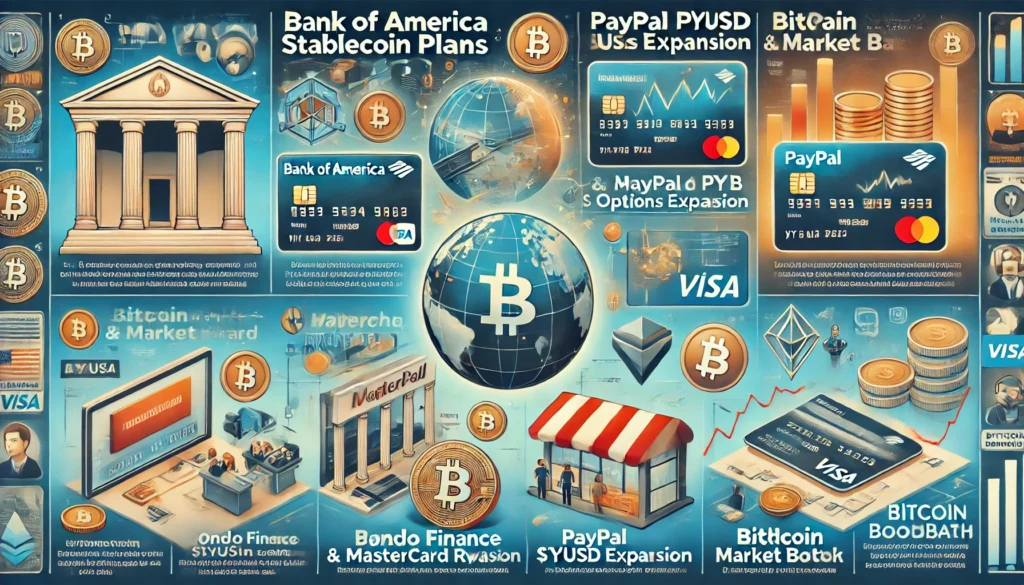
As financial giants continue integrating blockchain into their operations, Bank of America is exploring the possibility of launching a stablecoin, pending regulatory clarity. Meanwhile, Ondo Finance is set to bring real-world assets (RWAs) to the Mastercard network, reinforcing the growing institutional interest in asset tokenization. PayPal has set a bold target of onboarding 20 million merchants to accept PYUSD by 2025, a move that could redefine stablecoin adoption in mainstream commerce. In another push for mass adoption, Avalanche has introduced a Visa card, allowing AVAX holders to spend their tokens seamlessly. On the Bitcoin front, a $5 billion options expiry could impact BTC prices, while analysts suggest the recent Bitcoin “bloodbath” may have marked the market bottom. These developments reflect the increasing convergence of traditional finance and crypto, signaling major shifts in adoption and market sentiment. Bank of America CEO Hints at Stablecoin Launch, Pending Regulatory Clarity Bank of America CEO Brian Moynihan has indicated the bank’s willingness to explore stablecoin issuance, provided that regulatory clarity is achieved. This statement marks a potential shift in how major U.S. financial institutions approach blockchain-based payment solutions. Unlike JPMorgan, which launched its own digital token (JPM Coin) for internal settlements, Bank of America has been cautious about direct crypto involvement. However, with growing demand for stablecoins in global transactions, a trusted banking giant entering the space could significantly impact adoption. Regulatory uncertainty remains the primary obstacle. The U.S. government has been divided over stablecoin regulation, with proposals ranging from Federal Reserve oversight to state-level frameworks. If Bank of America proceeds with a stablecoin, it would require strict compliance with anti-money laundering (AML) and know-your-customer (KYC) regulations. This could set a precedent for other financial institutions looking to enter the space, pushing for clearer rules that balance innovation with consumer protection. A stablecoin issued by Bank of America would compete directly with PayPal’s PYUSD and Circle’s USDC, potentially giving traditional banks an edge in the rapidly expanding digital payments industry. While execution depends on regulatory approvals, this development highlights the increasing convergence of traditional banking and blockchain-based finance. If greenlit, Bank of America’s stablecoin could drive wider adoption of digital assets among mainstream financial institutions. Market Impact: Positive: If Bank of America launches a stablecoin, it could boost institutional adoption and regulatory clarity. Neutral to Negative: Delay due to regulatory hurdles could slow down stablecoin innovation in the U.S. Ondo Finance to Bring RWAs to Mastercard Network Ondo Finance has announced a strategic partnership with Mastercard to integrate real-world assets (RWAs) into its network. This move is part of a broader trend where financial institutions are embracing tokenization to improve efficiency, liquidity, and accessibility of traditional assets. RWAs, which include tokenized U.S. Treasuries, bonds, and other financial instruments, have been gaining traction as institutions seek blockchain-based alternatives to legacy financial systems. By leveraging Mastercard’s global payments infrastructure, Ondo Finance can offer institutional and retail investors access to tokenized yield-bearing assets. This is significant because Mastercard’s vast reach could provide legitimacy and scale to the RWA sector, making it easier for businesses and individuals to access these assets. The move follows similar initiatives by BlackRock and JPMorgan, both of which are experimenting with blockchain-based financial instruments. The integration of RWAs into a mainstream payments network like Mastercard could lead to increased demand for tokenized assets, providing better liquidity and lower transaction costs. However, regulatory uncertainty and compliance requirements remain challenges for full-scale implementation. If successful, this could set a precedent for other payment processors to explore blockchain-based asset management. Market Impact: Positive: Strengthens the case for tokenized RWAs, increasing institutional adoption. Neutral: Regulatory uncertainty could limit immediate large-scale deployment. PayPal Targets 20 Million Merchants for PYUSD Adoption by 2025 PayPal has outlined an ambitious goal of onboarding 20 million merchants to accept PYUSD, its stablecoin, by the end of 2025. Since launching in mid-2023, PYUSD has seen steady growth but faces competition from USDT and USDC, which dominate the stablecoin market. PayPal’s strategy hinges on leveraging its existing merchant network to make PYUSD a mainstream payment method. The company is promoting stablecoins as a superior alternative to traditional fiat transactions, offering lower fees and instant settlements. PayPal’s vast network could significantly boost stablecoin adoption if merchants and consumers embrace PYUSD as a viable payment option. However, the challenge remains in convincing businesses to integrate and actively promote crypto payments. Many merchants still perceive stablecoins as niche financial tools rather than essential components of digital commerce. If successful, this initiative could pave the way for stablecoins to be widely used in e-commerce, remittances, and business-to-business payments. However, regulatory scrutiny, particularly in the U.S., could impact adoption rates. The next two years will be crucial in determining whether PayPal’s vision for PYUSD materializes. Market Impact: Positive: Increased adoption of PYUSD could drive stablecoin transactions in mainstream commerce. Neutral to Negative: Regulatory roadblocks could slow PayPal’s expansion plans. Avalanche Visa Card Launches to Drive Crypto Mass Adoption Avalanche has introduced a Visa card to facilitate crypto payments, allowing users to spend AVAX tokens like traditional fiat currency. This move aligns with the broader push to integrate cryptocurrencies into mainstream financial systems. The Avalanche Visa card offers a seamless user experience, making it easier for individuals to transact with digital assets without needing complex wallet interactions. Visa has been expanding its crypto offerings, partnering with multiple blockchain projects to enable crypto-to-fiat transactions. By supporting Avalanche, Visa is further solidifying its role in the digital payments revolution. Unlike previous crypto debit cards, which often faced issues with usability and merchant adoption, Avalanche’s integration focuses on creating a frictionless experience for everyday transactions. However, widespread adoption of crypto payments remains an ongoing challenge. While the Avalanche Visa card could attract early adopters, its success depends on merchant acceptance and user demand. Nonetheless, this launch represents another step toward making cryptocurrencies a practical alternative to traditional banking systems. Market Impact: Positive: Enhances the usability of AVAX, potentially increasing adoption. Neutral: Merchant adoption remains uncertain, affecting overall impact. Bitcoin’s $5 Billion Options