
Crypto 2025: Regulation, Accumulation Trends, Privacy Battles, Public Listings, and Political Ties Redefine the Industry

The cryptocurrency landscape is undergoing significant transformations as regulation tighten, institutional investors accumulate digital assets, privacy-focused platforms fight for legitimacy, and companies seek public listings to gain trust and capital. In parallel, politics plays a pivotal role, with the U.S. SEC introducing task forces to regulate crypto markets and controversial links between high-profile figures and blockchain platforms emerging. From Bitcoin whales doubling down on accumulation to Ethereum giants navigating speculative claims, this article examines key developments shaping the industry’s future. 1. Regulation and Compliance Are Key to Building Crypto Derivatives Analysis and Market Impact: The growing crypto derivatives market is becoming a central focus for Regulation, and compliance is emerging as the critical pathway for sustained growth. This news underscores the tension between the rapid expansion of crypto derivatives trading and the need for accountability. With trading volumes in derivatives markets now competing with traditional financial instruments, the stakes are higher than ever. Institutional players, eager to enter the space, are demanding clear regulation to ensure trust and mitigate risks like market manipulation. Exchanges that adopt compliance-focused strategies, such as implementing Know Your Customer (KYC) standards and regular audits, are positioning themselves as leaders in a maturing market. These proactive steps could attract more institutional investment, which is critical for long-term adoption. However, the lack of global regulatory uniformity complicates efforts to create standardized compliance frameworks. Jurisdictions such as the U.S., Europe, and Asia are adopting varying approaches, which might slow progress in harmonizing crypto derivative markets. For the broader crypto market, increased scrutiny and compliance could pave the way for greater legitimacy. However, the same regulation could marginalize smaller players who lack the resources to meet stringent requirements, leading to further centralization of the industry. While compliance might temporarily slow innovation, it is ultimately a catalyst for mass adoption, particularly among institutional investors. The crypto derivatives market, if well-regulated, could serve as a bridge between decentralized finance (DeFi) and traditional finance, transforming the global financial ecosystem. 2. Bitcoin Whales and Sharks Continue Significant Accumulation After Trump’s Inauguration Analysis and Market Impact: The ongoing accumulation of Bitcoin by whales and sharks (large holders of 100–1,000+ BTC) is a bullish signal for the cryptocurrency market. This behavior indicates confidence in Bitcoin’s long-term value, particularly during times of macroeconomic uncertainty. The news reveals that despite political and market volatility, influential investors continue to add Bitcoin to their holdings, potentially as a hedge against inflation, currency devaluation, or geopolitical instability. This trend is significant because it suggests a shift in how institutional and wealthy investors view Bitcoin. Unlike retail investors who are prone to panic selling, whales and sharks tend to buy during market dips. Historically, such accumulation phases have been precursors to major price rallies. Analysts have noted that these large-scale purchases can reduce Bitcoin’s circulating supply, creating a supply-demand imbalance that often drives prices upward. However, there are risks associated with this concentration of ownership. If these large holders suddenly decide to liquidate their holdings, it could trigger massive volatility, shaking retail investors’ confidence. On the flip side, the increased activity from whales suggests Bitcoin’s growing status as a “digital gold” reserve for influential players. While the short-term impact on Bitcoin prices may be muted, this accumulation trend supports the narrative of Bitcoin as a resilient asset class in the long run. 3. Another Court Orders Treasury to Lift Tornado Cash Sanctions Analysis and Market Impact: The court’s decision to challenge the U.S. Treasury’s sanctions on Tornado Cash is a landmark moment for the crypto industry, particularly for privacy-focused projects. Tornado Cash, a decentralized mixing service, has been at the center of a fierce debate between those advocating for financial privacy and governments concerned about its misuse in illegal activities like money laundering. This ruling highlights the judiciary’s willingness to scrutinize sanctions and explore the delicate balance between privacy rights and regulatory oversight. For the crypto community, this ruling could be seen as a win, potentially setting a precedent for how decentralized platforms are treated under U.S. law. If the sanctions are lifted, it may bolster the case for privacy tools being considered legitimate under certain conditions, as opposed to outright banned. However, the Treasury’s initial blacklisting of Tornado Cash came in response to concerns that the platform had been used by bad actors, including state-sponsored hackers. Any easing of restrictions might prompt critics to argue that it opens the door for misuse. In the broader market, this ruling could embolden other privacy-focused projects and potentially increase interest in decentralized applications (dApps) that emphasize user anonymity. Still, the unresolved tensions between privacy and security could lead to tighter, more specific guidelines for such platforms in the future. While this decision reflects positively on the crypto sector’s pushback against overly restrictive regulations, the long-term implications will depend on how lawmakers respond. 4. Interest in Public Listings Grows Among Cryptocurrency Firms Analysis and Market Impact: The growing trend of cryptocurrency firms exploring public listings represents a pivotal shift in the industry’s evolution. For years, crypto companies have operated largely outside traditional financial systems. However, the move toward initial public offerings (IPOs) and direct listings signals a desire for legitimacy, transparency, and increased access to capital. Going public forces companies to adhere to stricter regulatory and governance standards, which can enhance trust among investors and regulators. This trend aligns with the maturing nature of the crypto market, particularly as institutional interest continues to rise. By listing on stock exchanges, crypto firms can attract a broader range of investors, including those who are hesitant to invest directly in digital assets. Binance and other major players have reportedly encouraged this development by supporting projects that comply with regional regulations. For startups, public listings could offer a viable path to growth and scaling, especially in an environment where venture capital funding is becoming more competitive. However, the challenges are significant. Public markets are highly regulated, and volatility in crypto valuations could pose risks to firms once listed. Additionally, companies may face scrutiny from shareholders and regulators,
Bull Market Peak, Institutional Inflows, MiCA’s Impact, and Bitcoin Ambitions in 2025
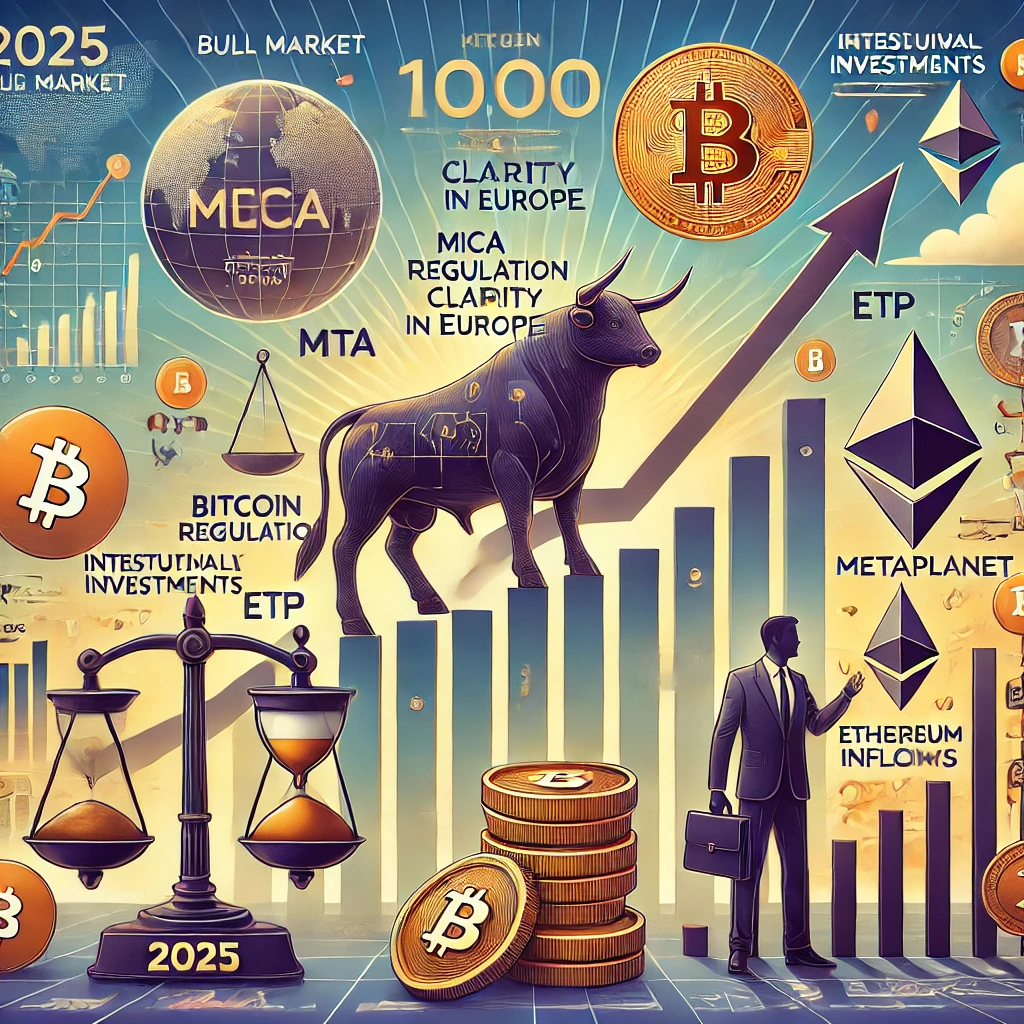
The cryptocurrency landscape in 2025 is dynamic and multifaceted, driven by predictions of Bull Market peaks, surging institutional investments, regulatory clarity through MiCA, and ambitious Bitcoin acquisition strategies by major players. From CryptoQuant’s cautious warnings to Metaplanet’s bold Bitcoin goals, the interplay of optimism, caution, and regulation is shaping a complex narrative. This analysis unpacks the key stories, market implications, and investor insights for the year ahead. 1. CryptoQuant: Bull Market in Final Stage, Peaks Expected in 2025 Analysis: CryptoQuant’s analysis suggests that the cryptocurrency market is in the latter phases of its current bull cycle, which began in early 2023. This phase is characterized by significant inflows from both new investors and reinvestments by existing players, signaling that a cyclical market peak may occur by Q2 2025. A key indicator of this maturation is the percentage of Bitcoin held for less than one month, which has risen to 36%—a figure reminiscent of trends seen during previous bull market peaks. However, CryptoQuant’s caution contrasts with other analysts’ forecasts. While CryptoQuant sees the potential for a market correction shortly after the peak, firms like VanEck and Steno Research anticipate continued strength throughout 2025. VanEck, for example, predicts Bitcoin could surpass $180,000 by year-end, with Ethereum breaching $6,000. This divergence reflects the speculative nature of the crypto markets, where sentiment and macroeconomic factors can create widely varying scenarios. Impact: The CryptoQuant report serves as a reminder for investors to balance optimism with prudent risk management. While high returns remain possible in the short term, the anticipation of a peak within a specific timeframe introduces uncertainty. This outlook might lead to increased market volatility as investors weigh the risks of holding positions versus cashing out near the predicted top. 2. Crypto ETPs See $585 Million Inflows as 2025 Begins: CoinShares Report Analysis: The crypto exchange-traded products (ETPs) market has started 2025 with impressive inflows, marking a continuation of the bullish trend observed in 2024. With $585 million invested in the first three days of the year, the data suggests sustained interest in these instruments, which gained traction after the introduction of U.S. spot Bitcoin ETFs in January 2024. Bitcoin-focused ETPs dominate the inflows, reflecting investor confidence in the leading cryptocurrency. In 2024 alone, Bitcoin ETPs attracted $38 billion, cementing their position as a preferred vehicle for institutional and retail investors. Ether-based ETPs also gained attention, adding $4.8 billion in 2024. Regional disparities, however, highlight differing investor sentiments, with the U.S. leading inflows while Canada and parts of Europe saw notable outflows. Impact: These figures underscore the growing mainstream adoption of crypto assets, particularly through structured products like ETPs. The inflows at the start of 2025 suggest that institutions and individuals view these products as both a hedge and an opportunity for substantial returns. For Bitcoin, increased AUM (assets under management) solidifies its role as the flagship digital asset, potentially boosting its price in the months ahead. 3. MiCA: Regulatory Clarity for European Crypto Markets Analysis: The implementation of the Markets in Crypto-Assets (MiCA) regulation marks a pivotal moment for cryptocurrency markets in Europe. By setting clear guidelines for compliance, licensing, and taxation, MiCA addresses concerns over the “Wild West” nature of the crypto industry. While critics warn of potential overregulation, proponents argue that MiCA will enhance investor confidence and attract more significant institutional participation. Key developments under MiCA include increased scrutiny on retail investors, requiring them to disclose detailed financial and personal data. This regulatory demand, while cumbersome, could pave the way for future crypto taxation and streamlined compliance frameworks. Institutions like Société Générale and MoonPay have already aligned with MiCA, signaling a shift towards legitimacy in the sector. Impact: MiCA’s comprehensive approach has the potential to position Europe as a leader in crypto innovation. However, the immediate impact may be mixed. While institutional investors are likely to embrace the regulatory clarity, retail participation could temporarily decline due to heightened compliance requirements. Over time, MiCA could set a precedent for other regions seeking to balance innovation with investor protection. 4. Bitcoin Price Rally Faces Uncertainty Ahead of Trump Inauguration Analysis: Bitcoin’s price surge in early 2025, fueled by optimism surrounding Donald Trump’s return to the White House, faces potential obstacles. Positive inflation data expected mid-January may provide a short-term boost, but caution prevails as the Federal Reserve’s Federal Open Market Committee (FOMC) meeting approaches on January 29. The meeting is likely to influence interest rate decisions, which have historically impacted Bitcoin’s price volatility. Market analysts have mixed views on Bitcoin’s trajectory. While Markus Thielen of 10x Research predicts Bitcoin could stabilize in the $97,000–$98,000 range by January’s end, others like John Glover anticipate a more volatile pattern. The role of institutional inflows via Bitcoin ETFs and stablecoins will be critical in determining the market’s direction. Impact: The interplay between macroeconomic indicators and political developments creates a complex environment for Bitcoin investors. While the inaugural optimism may spur temporary gains, the looming FOMC meeting could introduce downward pressure, emphasizing the importance of staying attuned to policy shifts and market dynamics. 5. Metaplanet’s Ambitious Plan to Hold 10,000 BTC by 2025 Analysis: Japanese venture capital firm Metaplanet has set an ambitious target to expand its Bitcoin holdings from 1,762 BTC to 10,000 BTC by the end of 2025. This aggressive accumulation plan is fueled by predictions of Bitcoin reaching $200,000 in the current bull cycle. Metaplanet intends to use a mix of loans, equity, and convertible bonds to finance the purchases, reflecting its bullish outlook on Bitcoin’s long-term potential. The firm’s strategy aligns with the growing trend of institutional adoption. Metaplanet’s stock performance, which has risen by 950% since it began acquiring Bitcoin in April 2024, demonstrates strong investor confidence. Additionally, the company projects an operating profit for the first time since 2017, driven partly by its crypto investments. Impact: Metaplanet’s move could inspire other institutional players to increase their exposure to Bitcoin, further driving demand and price appreciation. By positioning itself as a leader in crypto investment, the firm underscores the growing institutional
Ripple Lawsuit Breakthrough, FTX’s $16B Repayments, South Korea’s ETF Revolution, and Solana’s Quantum Leap

Ripple ongoing legal battle with the SEC is nearing a pivotal moment, FTX has begun repaying $16 billion to creditors, South Korea is rethinking its stance on crypto ETFs, and Solana has introduced groundbreaking quantum-resistant security. These developments underscore the sector’s resilience, innovation, and regulatory evolution as it continues to shape the future of finance. 1. Ripple-SEC Lawsuit Nearing Conclusion The long-running XRP-SEC lawsuit is approaching a critical deadline. In July 2023, Judge Analisa Torres ruled that XRP, Ripple’s cryptocurrency, was not a security when sold to retail investors, though it was deemed a security in institutional sales. The SEC must decide by January 15, 2025, whether to appeal this decision or request an extension. Meanwhile, SEC Chair Gary Gensler’s anticipated departure adds uncertainty to the agency’s direction. Pro-XRP attorney Jeremy Hogan predicts a resolution as early as spring or summer 2025, with significant implications for the crypto industry. This lawsuit has become a landmark case for cryptocurrency regulation. The dual ruling on XRP—security in institutional sales but not retail sales—provides clarity while raising questions about broader enforcement policies. Ripple’s partial victory has been celebrated by the crypto community as a step towards fairer regulatory standards. However, the SEC’s potential appeal could prolong uncertainty for XRP holders and the market. Gensler’s likely departure may signal a shift in the SEC’s crypto stance. New leadership might adopt a more collaborative approach, emphasizing clarity over litigation. The lawsuit’s outcome will be pivotal in shaping U.S. crypto regulations and influencing how other nations approach blockchain technology. Impact A final resolution could lead to increased adoption of XRP and bolster investor confidence. Conversely, prolonged litigation may deter institutional investments. The outcome may also prompt Congress to prioritize comprehensive crypto legislation, addressing inconsistencies highlighted by this case. 2. FTX Initiates $16 Billion Repayment FTX, the infamous cryptocurrency exchange, has commenced its $16 billion repayment process. Approved in October 2024, this plan aims to return 98% of customer losses, with smaller claims prioritized initially. The company, under CEO John J. Ray III, has recovered approximately $14.7-$16.5 billion to fund the repayments. This milestone is expected to restore trust in the crypto ecosystem after the significant damage caused by FTX’s collapse in 2022. The repayment process marks a turning point for FTX and the broader crypto sector. The company’s ability to recover significant funds and prioritize smaller creditors demonstrates progress in addressing the fallout from one of the industry’s largest scandals. By returning funds to users, FTX is setting a precedent for accountability, which could improve trust in crypto exchanges. This development may also signal a shift in regulatory attitudes. Authorities may intensify scrutiny of exchanges to prevent similar collapses. Investors, too, are likely to demand greater transparency and custodial safeguards. However, questions remain about how recovered funds will impact market dynamics if reinvested. Impact The potential reinvestment of recovered funds into major cryptocurrencies could lead to increased demand, potentially boosting prices of assets like Bitcoin and Ethereum. Additionally, FTX’s actions may encourage other troubled platforms to expedite customer repayments, promoting a culture of restitution and accountability. 3. South Korea to Reevaluate Crypto ETFs South Korea’s Financial Services Commission (FSC) has announced plans to reevaluate its ban on spot cryptocurrency exchange-traded funds (ETFs) in response to global trends. Following the U.S. approval of spot Bitcoin ETFs, South Korea is exploring ways to permit institutional access to crypto markets. The FSC is also investigating market dominance by local exchange Upbit, as part of efforts to ensure fair competition. The FSC’s decision to reconsider spot crypto ETFs reflects a significant policy shift. Historically cautious, South Korea has been slow to embrace crypto innovations due to concerns about market volatility. The move suggests a growing recognition of the sector’s legitimacy, driven by international developments like the U.S.’s acceptance of spot Bitcoin ETFs. Allowing ETFs could increase accessibility for retail and institutional investors, fostering growth in South Korea’s crypto market. At the same time, FSC’s investigation into Upbit’s dominance underscores the regulator’s commitment to market fairness. Ensuring competitive conditions is essential as the market matures and attracts more participants. Impact Approval of crypto ETFs could lead to a surge in investment, as ETFs are often seen as safer, regulated entry points. Additionally, this may prompt neighboring nations to reconsider their crypto policies, accelerating global adoption. If the FSC permits institutional trading, it could significantly expand South Korea’s market liquidity. 4. Solana Introduces Quantum-Resistant Security Solana developers have unveiled the “Solana Winternitz Vault,” a quantum-resistant security feature. The system uses hash-based cryptographic signatures, generating new keys for every transaction to protect user funds from potential quantum computer attacks. However, this feature is optional, requiring users to store their assets in specialized vaults to benefit from enhanced security. The introduction of the Winternitz Vault underscores Solana’s forward-looking approach to emerging threats. Quantum computing, while not an immediate danger, poses a long-term challenge to blockchain security. By preemptively addressing this issue, Solana positions itself as a leader in blockchain resilience. The optional nature of this feature, however, raises concerns about user adoption. Many users may overlook or misunderstand the importance of quantum resistance, limiting the feature’s impact. Educational efforts will be crucial in encouraging users to transition to these vaults. Solana’s innovation also sets a benchmark for other blockchains to explore quantum-resistant solutions, potentially sparking a wave of similar advancements. Impact The vault’s adoption could bolster Solana’s reputation as a secure and innovative platform, attracting developers and investors. Long-term, the move could drive industry-wide upgrades, ensuring that blockchain technology remains robust against evolving computational threats. Key Takeaways Ripple-SEC Lawsuit The Ripple lawsuit, a significant legal battle, has the potential to conclude by mid-2025. The resolution of this case could set a major precedent for how cryptocurrencies are regulated in the United States. With the SEC’s deadline looming and the possible departure of SEC Chair Gary Gensler, the case is a turning point in clarifying the distinction between securities and cryptocurrencies. If Ripple secures a favorable outcome, it could lead to a surge