
4 Important Crypto News: Recession Predictions, XRP’s Rise, Bitcoin Futures Optimism & Trump’s Gold Effect – BotSlash Daily Crypto News Analysis

Investor sentiment is shifting as key indicators point to a higher risk of a U.S. recession in 2025, spurring market activity across traditional and crypto assets. Bitcoin futures are heating up with growing open interest and positive funding rates, signaling bullish momentum. Meanwhile, XRP has taken the lead as the top choice in Latin America’s crypto market, outpacing Ethereum and Solana. However, Donald Trump’s trade-centric policies are pushing investors toward gold, highlighting a cautious tone for Bitcoin. Polymarket Predicts 58% Chance of U.S. Economic Recession in 2025 Prediction market Polymarket has raised its estimated probability of a U.S. recession in 2025 to 58%, reflecting growing investor concerns over economic instability. This uptick follows the implementation of aggressive trade tariffs by President Donald Trump’s administration, which have introduced significant volatility into global markets. The heightened recession odds are indicative of the market’s apprehension about the potential negative impact of these policies on economic growth. The increased likelihood of a recession has prompted investors to reassess their portfolios, with many seeking refuge in safer assets. This shift in sentiment is evident in the rising demand for gold and other traditional safe-haven investments. The anticipation of economic downturn is also influencing corporate strategies, with companies adopting more cautious financial outlooks and contingency planning. For the cryptocurrency market, the prospect of a recession presents both challenges and opportunities. While economic uncertainty can lead to increased volatility, it may also drive interest in decentralized assets like Bitcoin as alternatives to traditional financial systems. However, the overall impact will depend on various factors, including regulatory responses and investor confidence. Market Impact: The elevated recession risk is likely to contribute to increased market volatility, influencing investment strategies across asset classes, including cryptocurrencies. 🟢 Bitcoin Futures Market Shows Increased Activity and Positive Funding Rates The Bitcoin futures market is experiencing heightened activity, marked by rising open interest and consistently positive funding rates. These indicators suggest a growing optimism among investors regarding Bitcoin’s near-term performance. The increased open interest reflects a surge in leveraged long positions, indicating that traders are anticipating upward price movements. The positive funding rates further reinforce this bullish sentiment, as traders are willing to pay a premium to maintain their long positions. This trend is often associated with expectations of price appreciation. The combination of these factors points to a strong demand for Bitcoin in the derivatives market, potentially signaling a broader market rally. However, it’s important to note that while these metrics are encouraging, they also warrant caution. High levels of leverage can lead to increased volatility, and sudden market shifts could result in significant liquidations. Investors should remain vigilant and consider risk management strategies to navigate potential market fluctuations. Market Impact: The bullish indicators in the Bitcoin futures market may attract additional investment, potentially driving up spot prices. However, the associated risks of leverage-induced volatility should not be overlooked. 🟢 XRP Emerges as Top Choice in Latin America’s Cryptocurrency Market A recent report by Bitso, a leading cryptocurrency exchange in Latin America, reveals that XRP has become the most purchased altcoin in the region, surpassing Ethereum and Solana. In 2024, XRP accounted for 9% of all crypto purchases on the platform, indicating a significant shift in investor preferences. This surge in popularity is attributed to XRP’s strong performance and its utility in cross-border transactions. The increased adoption of XRP is particularly notable in countries like Mexico, where remittances play a crucial role in the economy. XRP’s efficiency in facilitating fast and cost-effective international payments has made it an attractive option for users seeking alternatives to traditional banking systems. Additionally, the approval of a spot XRP ETF in Brazil underscores the growing institutional interest in the asset. This trend reflects a broader movement towards cryptocurrencies that offer practical use cases, especially in regions with high demand for remittance services. As regulatory clarity improves and infrastructure develops, XRP’s position in the Latin American market is likely to strengthen further. Market Impact: The rising adoption of XRP in Latin America could lead to increased liquidity and price stability for the asset, potentially attracting more investors and fostering greater integration into financial systems. 🔻 Trump’s Policies Drive Investors Toward Gold; Bitcoin Faces Challenges President Donald Trump’s recent economic policies, including the imposition of sweeping tariffs, have led investors to seek refuge in traditional safe-haven assets like gold. Gold prices have surged, reaching record highs, as market participants respond to the increased economic uncertainty. In contrast, Bitcoin has faced challenges, with its performance lagging amid the shifting investment landscape. The divergence between gold and Bitcoin highlights the differing perceptions of these assets during times of economic stress. While gold is widely regarded as a stable store of value, Bitcoin’s volatility and regulatory uncertainties have made some investors cautious. Additionally, the administration’s mixed signals on cryptocurrency regulation have contributed to the market’s apprehension. Despite these challenges, some investors continue to view Bitcoin as a hedge against traditional financial systems, especially in the context of increasing government intervention. However, the asset’s future performance will depend on various factors, including regulatory developments and broader market sentiment. Market Impact: The current economic policies are influencing asset allocation decisions, with a noticeable shift towards gold. Bitcoin’s performance may remain subdued until greater regulatory clarity and market confidence are restored. Key Takeaways: U.S. Recession Probability Rises: Polymarket now predicts a 58% chance of a U.S. recession in 2025, driving investors toward safer assets and increasing market volatility. Bitcoin Futures Turn Bullish: Increasing open interest and sustained positive funding rates show growing optimism in the Bitcoin derivatives market. XRP Dominates Latin America: Bitso reports XRP is now the most purchased altcoin in the region, reflecting a demand for cross-border payment efficiency. Gold Surges on Trump’s Policies: Investors are favoring gold over Bitcoin amid policy-driven uncertainty, causing Bitcoin to underperform.
4 Important Crypto News: Dogecoin Open Interest Plummets, Bitcoin Correction Signals, and Gold-Backed Crypto Dips – Botslash Daily Crypto News Analysis
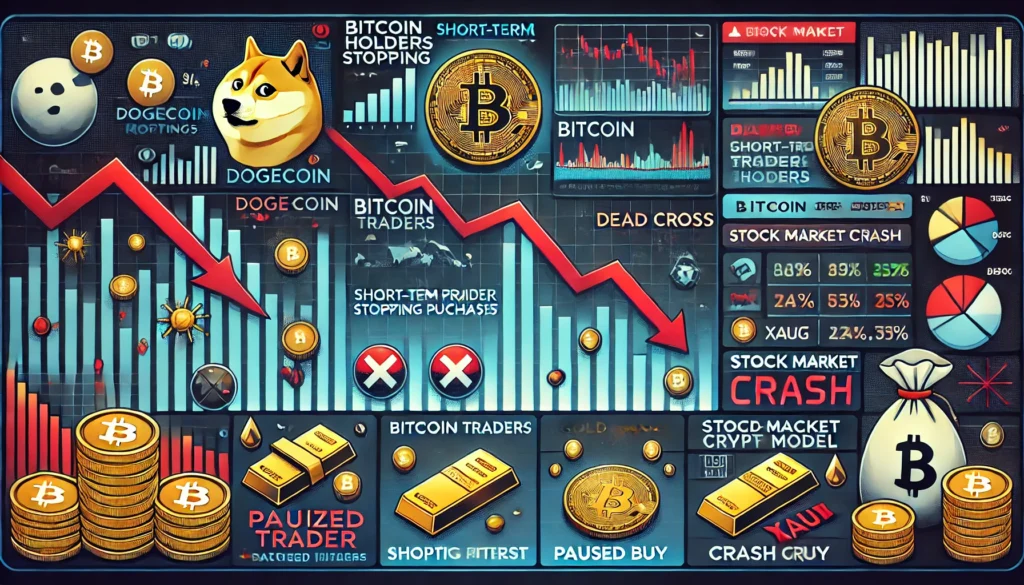
Shifts in trader behavior, technical correction signals, and broader macroeconomic ripples are defining the latest moves in the crypto landscape. From Dogecoin’s massive open interest drop to cautious moves by Bitcoin short-term holders, the signs point to a more conservative market sentiment in the short term. Meanwhile, even gold-backed cryptocurrencies—typically viewed as safe havens—are experiencing declines amid global market turbulence, reflecting the far-reaching impact of current financial conditions. Dogecoin Faces Sharp Decline in Open Interest, Signaling Waning Speculator Enthusiasm Dogecoin’s open interest has experienced a staggering 70.5% drop since mid-January, marking a significant shift in trader behavior. Open interest reflects the total number of outstanding derivative contracts—futures and options—that haven’t been settled. A sharp decline in this metric often points to a retreat of speculative capital. For Dogecoin, a meme coin heavily reliant on community buzz and retail speculation, this decline could be a harbinger of reduced liquidity and slower price movement in the near term. This drop aligns with a broader cooling-off period for altcoins, as capital rotates toward safer or more fundamentally supported assets. Dogecoin, with its meme-driven momentum and limited fundamental utility, has always been more vulnerable to sudden shifts in trader sentiment. Leveraged traders may be exiting due to increased volatility or lower expected returns, further weakening DOGE’s price stability. Notably, social media activity and meme coin hype have also seen a downtick, removing a key driver of demand. The technical indicators for DOGE suggest a lack of immediate recovery signals. Without new speculative inflows or a fresh wave of hype, Dogecoin may continue trading sideways or trend lower. Long-term holders may not be swayed by these short-term changes, but the absence of new capital and trader activity is a red flag for short- to mid-term price action. Market Impact: The decline in open interest for Dogecoin could reduce its short-term volatility but also limits upside momentum. For traders, it signifies reduced speculative opportunities, while for investors, it signals a period of consolidation or potential weakness in meme coin narratives. Short-Term Bitcoin Holders Pause Accumulation, Hinting at Sentiment Weakness Recent data shows that short-term Bitcoin holders (STHs) have stopped increasing their BTC exposure, a move interpreted as a growing lack of confidence in the asset’s near-term prospects. These investors, who typically hold BTC for less than 155 days, often act as sentiment bellwethers. When STHs start accumulating, it usually signals optimism. Conversely, when they stall or sell, it hints at market uncertainty or expectations of lower prices. This behavioral shift comes as Bitcoin faces macroeconomic headwinds and uncertainty around upcoming monetary policies. STHs may be positioning themselves conservatively due to the potential for short-term corrections or lack of bullish catalysts. Historically, such pauses in accumulation have preceded consolidation phases or mild corrections. While this does not necessarily predict a market crash, it emphasizes a cautious sentiment prevailing in the market. Moreover, this stagnation could also reduce buying pressure, making Bitcoin more vulnerable to downward moves triggered by broader market sentiment or external shocks. If long-term holders (LTHs) also begin reducing their positions, the bearish narrative could gain traction. On the other hand, if institutional inflows or bullish news emerge, sidelined STHs could re-enter, potentially reigniting momentum. Market Impact: The stalling of STH accumulation introduces short-term bearish pressure on BTC. While not catastrophic, it may delay bullish momentum and encourage a period of sideways or downward movement, especially if not counterbalanced by institutional or long-term holder activity. Bitcoin Realized Price Model Warns of Extended Correction Period The Realized Price model—especially the Inter-Cycle Cohort Age (ICCA) version—has signaled a “Dead Cross,” which historically indicates the onset of a correction phase within Bitcoin bull cycles. This technical signal emerges when short-term investor cost basis moves above the long-term cohort’s, implying short-term traders are underwater, often leading to selling pressure and reduced confidence. Based on past cycles, such correction phases average about 85 days. This model’s current prediction places the correction at roughly 28 days in, suggesting nearly two months more of potential consolidation or downward movement. Though this doesn’t negate the larger bull market narrative, it does call for caution. The Dead Cross represents a cooling-off period as speculative froth is reduced, and market fundamentals regain focus. It also suggests that the cycle’s emotional highs may have peaked temporarily, and market maturity is taking precedence. Investors and traders are advised to brace for lower volatility and potentially stagnant prices. This phase can also act as a healthy reset, allowing stronger hands to accumulate while weaker hands exit. Monitoring this model helps in adjusting strategy—whether to stay sidelined, accumulate on dips, or hedge existing positions. If external factors like macroeconomic easing or ETF inflows arise, they could shorten the predicted correction duration. Market Impact: While not immediately alarming, the Dead Cross and predicted correction period imply continued choppiness in BTC markets. Long-term investors may view it as a buying opportunity, but traders should remain cautious and manage risk tightly. Gold-Backed Cryptocurrencies Retreat Amid Broader Market Chaos Gold-backed cryptocurrencies like Paxos Gold (PAXG) and Tether Gold (XAUT) have seen sharp pullbacks from recent highs, correlating with global stock market turbulence. These digital assets, typically seen as hedges against fiat instability and equity volatility, initially rallied following political developments like tariff announcements. However, their recent retreat underscores that even “safe-haven” cryptos are not entirely immune to macroeconomic shocks. The initial surge was driven by fear-based demand—investors looking for alternatives to traditional assets amid rising inflation and geopolitical risks. However, the pullback reflects either profit-taking or a shift in broader risk-off sentiment, where investors liquidate across the board to raise cash. It also indicates that while gold-backed cryptos mimic the price of physical gold, they still operate within the broader, more volatile crypto ecosystem. This correction does not necessarily undermine their long-term utility but calls for better education around their behavior during market stress. Institutional interest in tokenized commodities remains high, and such retracements could offer entry points for those with a long-term thesis. That said, the interconnectedness of all asset classes