
7 Important Daily Crypto News: Market Resilience, Bitcoin’s Bull Run, Crypto-to-Debit Services, Memecoin Legislation, Futures Correction Risks, Bitcoin Reserve Plans, and Pakistan’s Regulatory Council… Botslash Daily Crypto News Analysis
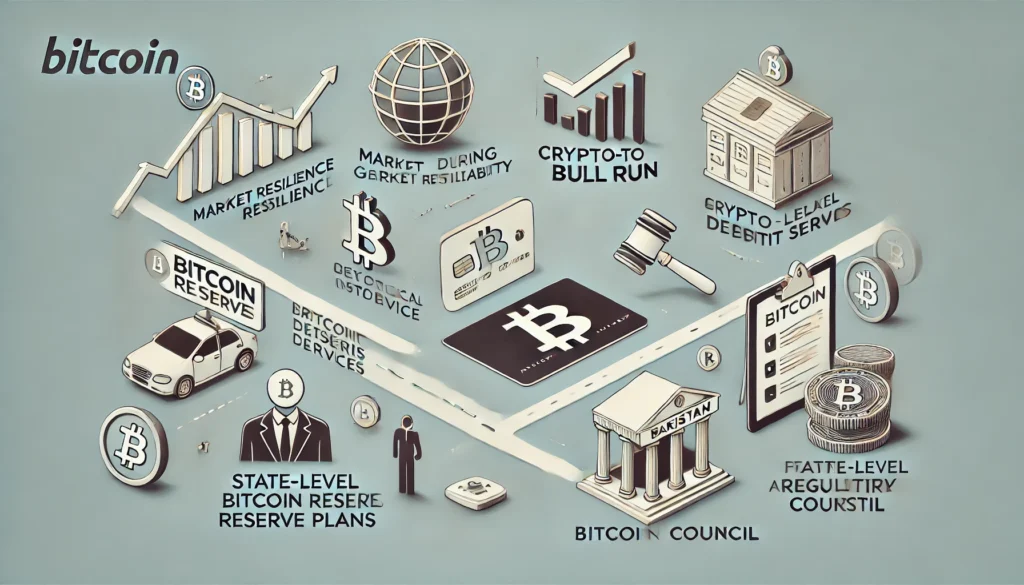
The latest developments in the crypto world underscore the sector’s resilience amid global financial uncertainties. From regulatory actions to new market features, the crypto ecosystem continues to evolve rapidly. Institutional demand for Bitcoin remains strong, even as governments propose new legislation targeting memecoins and the integration of Bitcoin into state reserves faces hurdles. Meanwhile, innovation in crypto payments and partnerships, such as the collaboration between Cronos and Crypto.com, highlights the growing use case for digital currencies in everyday transactions. Let’s dive into these key updates: Crypto Holds Firm as Traditional Markets Struggle with Trump’s Tariff Threat The cryptocurrency market has shown resilience amid a downturn in traditional finance triggered by Donald Trump’s latest tariff threats. Major stock indices, including the S&P 500 and Dow Jones, suffered losses as investors grew wary of potential economic repercussions. However, Bitcoin and other leading cryptocurrencies remained stable, demonstrating their role as alternative assets during economic uncertainty. This divergence between TradFi and crypto highlights the growing perception of digital assets as a hedge against geopolitical risks and macroeconomic instability. A key factor behind crypto’s stability is institutional demand, with many investors turning to Bitcoin as a digital store of value. Historically, Bitcoin has performed well in times of financial distress, and its decentralized nature shields it from direct government policies like tariffs. Furthermore, growing adoption in emerging markets and increasing utility in payment systems continue to strengthen crypto’s long-term outlook. Despite concerns over regulatory challenges, the sustained demand for digital assets suggests they are becoming more integrated into the global financial ecosystem. While Bitcoin’s price action remains relatively steady, altcoins like Ethereum and Solana are also seeing interest from investors seeking diversification. If economic uncertainty persists, crypto markets may continue to decouple from traditional assets, further reinforcing their role as an independent financial system. However, regulatory scrutiny and potential policy shifts remain risks that could impact market sentiment. Market Impact: The market impact of this development suggests that digital assets, particularly Bitcoin, are increasingly seen as a safe-haven investment during times of geopolitical and financial uncertainty. As traditional markets react negatively to Trump’s tariff threats, cryptocurrencies are holding steady, potentially attracting institutional investors who seek protection from external macroeconomic pressures. This trend could further solidify Bitcoin’s role as a store of value, separate from traditional assets, especially if geopolitical tensions continue to rise. CryptoQuant CEO: Bitcoin’s Bull Run Still Has Momentum CryptoQuant CEO Ki Young Ju remains confident that Bitcoin’s bull market is far from over, citing strong on-chain data as evidence. He highlights that long-term holders continue to accumulate Bitcoin while exchange reserves remain low, indicating that investors are not eager to sell. Historically, bull markets end when a “blow-off top” occurs, marked by excessive retail euphoria and large-scale profit-taking—something Ju believes has not yet happened. One key metric supporting his argument is Bitcoin’s realized cap, which is approaching all-time highs. This suggests that new capital is entering the market rather than old money exiting. Additionally, institutional adoption continues to grow, with major financial firms integrating Bitcoin into their offerings, further solidifying its position as a legitimate asset class. The approval of spot Bitcoin ETFs has introduced a new wave of demand, which could sustain the bull cycle for longer than previous market cycles. Despite short-term corrections, Ju sees Bitcoin’s fundamentals as strong, with supply-side dynamics favoring further price appreciation. The reduced availability of BTC on exchanges, coupled with strong holding patterns, indicates that any dips could be buying opportunities rather than signs of a market top. However, investors should remain cautious of external macroeconomic factors that could trigger temporary downturns. Market Impact: The market impact of this news suggests that Bitcoin’s bullish trend is likely to persist in the medium to long term. Strong on-chain metrics and low exchange reserves point to continued accumulation, especially by long-term holders and institutional investors. As Bitcoin’s realized cap approaches all-time highs, there may be more upward pressure on its price, which could lead to more institutional interest and stronger demand, even in the face of short-term volatility or corrections. Cronos Enables Crypto-to-Debit Card Transfers in Partnership with Crypto.com Cronos has introduced a seamless crypto-to-debit card transfer service in partnership with Crypto.com, allowing users to spend digital assets directly. This initiative simplifies the crypto payment process by eliminating the need for complex conversions. Users can now load their debit cards with cryptocurrencies and use them for everyday purchases, marking a step toward mainstream adoption. The partnership between Cronos and Crypto.com aims to bridge the gap between digital assets and traditional finance. One of the biggest barriers to crypto adoption is the difficulty of using it in real-world transactions. By offering a direct conversion service, Cronos enhances the usability of its ecosystem, positioning itself as a key player in crypto payments. Additionally, this service may encourage greater adoption of stablecoins and other digital currencies as everyday payment methods. As crypto regulation continues to evolve, services like these could influence how authorities perceive and regulate digital payments. The ability to seamlessly use crypto for daily spending may accelerate regulatory discussions, potentially leading to clearer policies. If successful, this initiative could set a precedent for other crypto platforms to follow, pushing digital assets closer to mass adoption. Market Impact: This development is expected to drive further adoption of cryptocurrency for everyday transactions. The ability to load debit cards directly with crypto makes it more practical for users to use digital assets for purchases, thereby increasing their utility in real-world applications. This could lead to increased demand for Cronos’ platform and Crypto.com services, while also creating a more mainstream pathway for crypto integration in traditional financial systems. Over time, this could reduce barriers to entry for those unfamiliar with crypto exchanges or wallets, promoting further mass adoption. U.S. House Democrats Propose Law to Ban Presidential-Themed Memecoins A group of U.S. House Democrats has introduced a bill seeking to ban presidential-themed memecoins, citing concerns over financial scams and misinformation. The rise of politically charged tokens, including those based on Donald Trump
6 latest cryptomarket Rollercoaster : Record DEX Volumes, Policy Shifts, and Bitcoin’s Sentiment Fluctuations

December 2024 latest marked a pivotal moment in the cryptomarket, showcasing dramatic shifts, record-breaking achievements, and forward-looking policy changes. Decentralized exchanges (DEXs) hit unprecedented heights with $462 billion in monthly volume, underscoring the growing dominance of DeFi platforms. Meanwhile, the U.S. and Hong Kong unveiled bold plans, with President-elect Trump promising a crypto-friendly administration and Hong Kong proposing Bitcoin as part of its national reserves. Amidst these highlights, market sentiment took a turn as Bitcoin’s price faced corrections, accompanied by a dip in the Fear & Greed Index. Ethereum stood out with a surge in long-term holders, reflecting growing confidence in its ecosystem, while Bitcoin investors opted for profit-taking, leading to contrasting trends for the two leading assets. This period encapsulated the dynamism of the crypto industry, setting the stage for an eventful 2025. 1. DEXs Hit Record $462 Billion Monthly Volume In December 2024, decentralized exchanges (DEXs) recorded their highest-ever monthly trading volume, reaching $462 billion. This milestone surpassed the previous high of $374 billion set in November, reflecting the growing popularity of decentralized finance (DeFi). Platforms like Uniswap, PancakeSwap, and Raydium led this surge, with $106 billion, $96 billion, and $58 billion in respective volumes. The rise in DEX activity underscores a shift toward decentralized platforms, offering transparency and user control over assets. Interestingly, while DEX volumes flourished, the memecoin market faced a sharp correction, with market capitalization dropping from $137 billion to $92 billion in December. This shift suggests traders are pivoting toward established protocols and away from speculative assets, further solidifying DeFi’s growth trajectory in the crypto ecosystem. 2. Donald Trump’s Pro-Crypto Stance Signals Market Transformation President-elect Donald Trump has vowed to make the U.S. the “crypto capital of the planet,” promising a favorable regulatory environment for cryptocurrencies. His administration plans to appoint crypto-friendly officials, including David Sacks as “AI & Crypto Czar,” aiming to attract institutional investment and foster innovation. Analysts predict this could drive Bitcoin prices near $200,000 and bolster the cryptocurrency market in 2025. However, concerns about increased market volatility remain. While Trump’s agenda may accelerate adoption, it could also intensify speculative activity. Still, his supportive stance is expected to pave the way for significant advancements in blockchain technologies and heightened investor confidence. 3. Hong Kong Proposes Bitcoin as a National Reserve Hong Kong legislator Wu Jiezhuang has proposed adding Bitcoin to the region’s national reserves to strengthen financial security and stability. Inspired by El Salvador and Bhutan, Wu believes such a move could attract global talent and investment while positioning Hong Kong as a digital asset leader. Wu advocates for an incremental approach, starting with Bitcoin ETFs before expanding holdings. This proposal aligns with Hong Kong’s broader strategy of creating a secure and innovative digital asset framework. As the region embraces Bitcoin’s potential as “digital gold,” it aims to enhance its status as a forward-thinking financial hub. 4. Bitcoin’s Fear & Greed Index Falls Amidst Year-End Decline In late December, Bitcoin’s price dropped by 13.7%, landing around $93,000. This correction coincided with a decline in the Crypto Fear & Greed Index to a two-month low of 65, marking a significant shift in market sentiment from extreme greed to caution. Despite short-term volatility, Bitcoin remains the best-performing asset of 2024, with a 129% return compared to traditional investments like gold. cryptomarket analysts are divided on what’s next. While some foresee increased volatility, others maintain a bullish outlook for Bitcoin, citing strong fundamentals and institutional support. As the market digests these fluctuations, the long-term trajectory of Bitcoin remains optimistic. 5. Ethereum Long-Term Holders Surge as Bitcoin Investors Take Profits Throughout 2024, Ethereum (ETH) witnessed a significant rise in long-term holders, climbing from 59% to 75%. This trend contrasts with Bitcoin, where long-term holders decreased from 70% to 62%, likely due to profit-taking during Bitcoin’s recent price rally. Ethereum’s increased adoption is further highlighted by doubling ETF inflows, which reached $2.1 billion in December. The data reflects growing confidence in Ethereum’s ecosystem, driven by advancements in DeFi, scalability, and institutional adoption. Meanwhile, Bitcoin’s correction suggests a natural market adjustment, as investors rebalance portfolios after substantial gains. 6. Bitcoin Dips Below $94,000, Bears Take Charge? Bitcoin’s price slipped below $94,000 on December 29, raising concerns about bearish market control. The Taker-Buy-Sell Ratio fell below 1, signaling heightened selling pressure. Additionally, the rising dominance of Tether (USDT) indicates a flight to stability among investors. Despite bearish signals, some traders remain optimistic, as Bitcoin’s funding rates for perpetual contracts stay positive, showing confidence in long positions. Moreover, Bitcoin continues to hold above its 200-day exponential moving average (EMA), hinting at underlying support. While the market braces for potential short-term volatility, Bitcoin’s long-term bullish case remains strong. Key Insights 1. DEXs Break Records While Memecoins Decline Decentralized exchanges achieved a record $462 billion in trading volume, led by platforms like Uniswap and PancakeSwap. This growth underscores the increasing shift toward decentralized platforms for transparency and control. Memecoins, however, saw a sharp decline, losing 20% of their market capitalization in December. Key Insight: The DeFi sector continues to gain momentum, while speculative assets face a reality check. 2. Trump’s Crypto Push Sets Bullish Expectations President-elect Trump’s pro-crypto stance aims to make the U.S. a global crypto leader. Policies include appointing crypto-friendly officials and fostering institutional investment. Analysts predict these moves could drive Bitcoin toward $200,000 in 2025 but warn of potential market bubbles. Key Insight: U.S. policy shifts could catalyze adoption but introduce volatility risks. 3. Hong Kong’s Bitcoin Reserve Proposal Highlights Regional Ambitions Hong Kong explores adding Bitcoin to national reserves, inspired by El Salvador’s example. Legislators propose starting with ETFs before direct integration into reserves. This move could solidify Hong Kong’s reputation as a forward-thinking financial hub. Key Insight: Regional players are increasingly leveraging Bitcoin as a strategic asset. 4. Bitcoin Sentiment Weakens as Fear & Greed Index Drops Bitcoin fell to $93,000 amid a market sentiment shift from extreme greed to caution. Despite short-term corrections, Bitcoin outperformed other assets in