4 Important Crypto News: Bitcoin Whales Rise, South Korea Eyes Blockchain, Hong Kong Embraces Staking, and Global Tariffs Shake Markets – BotSlash Daily Crypto News Analysis
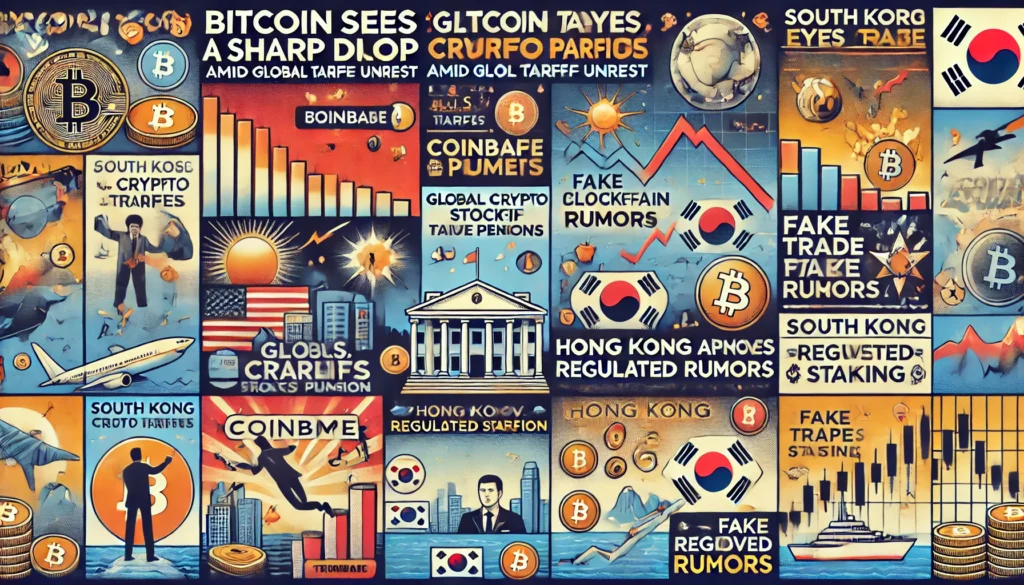
April 7 brought a whirlwind of developments in the crypto space, with global economic policies shaking Bitcoin’s price, while institutional momentum continues to push the blockchain industry forward. From major pension funds eyeing blockchain to new staking permissions from regulators and growing whale activity in Bitcoin, the market finds itself at the crossroads of volatility and innovation. Let’s dive into the key takeaways and understand the bigger picture. Bitcoin’s Volatility Amid Tariff-Induced Market Turbulence The recent imposition of sweeping tariffs by President Donald Trump has led to significant volatility across global financial markets, with Bitcoin experiencing notable price fluctuations. On April 7, 2025, Bitcoin’s price fell below the $80,000 mark, reaching approximately $79,000, a 5% decline. This downturn aligns with investor concerns over escalating trade tensions and the potential for a global recession. Additionally, the cryptocurrency market faced $250 million in long liquidations over a 24-hour period, indicating forced exits from bullish positions amid declining prices. Technical analysis reveals bearish momentum, highlighted by the formation of a “death cross,” where the 50-day moving average crosses below the 200-day moving average. This pattern suggests the possibility of further declines. Key support levels to monitor include $74,000, $65,000, and $57,000, each corresponding to previous performance benchmarks. Conversely, resistance is anticipated around $87,000, where significant moving averages converge. Investors are advised to closely observe these technical levels amid ongoing market instability linked to macroeconomic tensions. Market Impact: The tariff-induced market volatility has not only affected traditional financial markets but also significantly impacted the cryptocurrency sector. The decline in Bitcoin’s price and the broader crypto market underscores the interconnectedness of global economic policies and digital asset valuations. Investors should remain vigilant, as continued trade tensions may lead to further market fluctuations and influence investment strategies in both traditional and digital asset markets. South Korea’s National Pension Service Explores Blockchain for $890 Billion Fund Transactions South Korea’s National Pension Service (NPS), managing assets worth approximately $890 billion, is evaluating the integration of blockchain technology into its fund transaction processes. The primary objective is to leverage blockchain’s shared ledger capabilities to prevent tampering of fund records, thereby enhancing the security and transparency of its accounting systems. This initiative underscores NPS’s commitment to adopting innovative technologies to safeguard the retirement funds of millions. To assess the feasibility of this integration, NPS has initiated a pre-standardization process, seeking feedback from industry experts, including those in the blockchain sector. This collaborative approach aims to gather diverse insights to inform a comprehensive research study on the potential implementation of blockchain within NPS’s operations. Notably, NPS has prior experience with blockchain, having utilized it to track overseas pension recipients, indicating a foundational understanding of the technology’s applications. While NPS is not currently considering direct investments in cryptocurrencies like Bitcoin, it holds indirect exposure through investments in companies such as Coinbase. This strategic move aligns with broader trends in South Korea, where entities like 7-Eleven have begun accepting the Bank of Korea’s central bank digital currency as part of significant trials, reflecting the nation’s progressive stance on digital financial innovations. NPS’s exploration of blockchain technology signifies a substantial endorsement of blockchain’s potential in institutional finance. Such initiatives by major pension funds can catalyze broader adoption of blockchain solutions across the financial sector, potentially leading to increased investments in blockchain infrastructure and related technologies. This development may also influence regulatory perspectives and encourage other institutional investors to consider blockchain’s benefits, thereby impacting the broader financial ecosystem. Hong Kong Regulator Permits Licensed Firms to Offer Crypto Staking Services Hong Kong’s Securities and Futures Commission (SFC) has issued new guidance allowing licensed virtual asset trading platforms (VATPs) and authorized virtual asset funds to offer staking services. Staking involves investors locking their virtual assets to support blockchain networks and, in return, earning rewards. This move is part of Hong Kong’s broader strategy to position itself as a leading hub for Web3 and digital asset innovations. Under the new framework, licensed platforms must obtain SFC approval before offering staking services and are required to maintain full control over client assets, explicitly prohibiting the outsourcing of staking to third parties. Additionally, platforms must transparently disclose all associated risks, including potential vulnerabilities like blockchain errors, hacking, or validator inactivity. These stringent measures aim to enhance investor protection and ensure the integrity of staking operations within the regulated environment. This regulatory development contrasts with approaches in other jurisdictions; for instance, Singapore has banned retail staking, and the U.S. Securities and Exchange Commission has taken a restrictive stance. Hong Kong’s decision reflects its commitment to fostering a progressive yet secure environment for digital asset services, potentially attracting more crypto-related businesses to its market. Market Impact: The SFC’s approval for licensed firms to offer staking services is likely to bolster investor confidence and attract more participants to Hong Kong’s crypto market. By providing a clear regulatory framework, Hong Kong positions itself as a favorable destination for crypto enterprises seeking a supportive yet regulated environment. This move may also influence regional regulatory approaches, potentially setting a precedent for other jurisdictions considering the integration of staking services within their financial ecosystems. Institutional Demand for Bitcoin Rises with Increase in Large Holders Recent data indicates a significant uptick in institutional interest in Bitcoin, evidenced by the addition of 76 new entities holding over 1,000 BTC each in the past two months—a 4.6% increase. This trend suggests that institutional investors are increasingly viewing Bitcoin as a viable asset class, even amid recent market volatility. The growing institutional appetite is further highlighted by similar trends in other cryptocurrencies. For instance, XRP has experienced heightened demand, leading to optimistic price projections. This pattern of accumulation by large holders, often referred to as “whales,” typically signals bullish sentiment and can contribute to upward price momentum. Despite recent price corrections in the crypto market, the sustained interest from institutional investors underscores a broader acceptance and integration of digital assets into traditional financial portfolios. This development reflects a maturation of the cryptocurrency market,
3 Important Crypto News : Trump’s Crypto Reserve Proposal, Bitcoin Reserve Bill Rejections, and BTC Network Surge – Botslash Daily Crypto News Analysis
Donald Trump’s latest stance on cryptocurrency has sent shockwaves through the market as he proposed XRP, Solana (SOL), and Cardano (ADA) as part of a potential U.S. crypto reserve, leaving Bitcoin (BTC) out of the equation. Meanwhile, Bitcoin faced another challenge as several U.S. states rejected bills that would have allowed BTC to be held as a reserve asset, reflecting ongoing regulatory resistance. However, Bitcoin’s network activity tells a different story, as active addresses have surged, indicating renewed market interest and a potential turning point for its price trend. These developments highlight the intersection of politics, regulation, and market sentiment, shaping the future of cryptocurrency adoption. Donald Trump Names XRP, SOL, ADA – But Not BTC – as Part of U.S. Crypto Reserve Former U.S. President Donald Trump’s proposal to include XRP, Solana (SOL), and Cardano (ADA) in a potential U.S. crypto reserve while excluding Bitcoin (BTC) has created waves in the crypto space. His decision reflects a significant shift in political and financial perspectives regarding digital assets. Trump, who once criticized cryptocurrencies, now appears to be embracing blockchain-based assets with strong enterprise applications. XRP’s regulatory clarity after its partial victory against the SEC, Solana’s high-speed transactions, and Cardano’s research-driven approach make them attractive choices for institutional adoption. The exclusion of Bitcoin, however, has raised concerns among BTC supporters, who argue that it remains the most secure and decentralized cryptocurrency. Some speculate that this move is politically motivated, as Trump may be seeking to distance himself from the current administration’s regulatory stance on Bitcoin. Others believe that Trump’s team is prioritizing cryptocurrencies with faster transaction speeds and lower fees over BTC, which is often criticized for its energy consumption. Regardless, his announcement has driven speculation about potential government involvement in specific digital assets, leading to increased trading activity for XRP, SOL, and ADA. This move could have a broader impact on the crypto market, particularly in terms of regulatory developments. If a future administration officially endorses certain digital assets over others, it could reshape the competitive landscape of cryptocurrencies. Investors are now closely watching how regulators respond to Trump’s proposal and whether other political figures follow suit. The market reaction has already been evident, with the named altcoins experiencing temporary price surges. However, long-term sustainability will depend on concrete policy implementations rather than political rhetoric. Market Impact: The announcement that Donald Trump may consider XRP, Solana (SOL), and Cardano (ADA) for a potential U.S. crypto reserve—while excluding Bitcoin—has triggered significant movements in the crypto market. XRP, SOL, and ADA saw an immediate price surge as investors speculated on potential government backing. This shift has also sparked debate about whether political endorsements could influence institutional investment patterns. Bitcoin’s slight volatility in response to its exclusion reflects the ongoing tension between decentralized digital assets and regulatory favoritism. If Trump or other political figures pursue formal policies favoring specific cryptocurrencies, it could reshape market dynamics and investment strategies. Several U.S. States Reject Bitcoin Reserve Bills A series of U.S. states have rejected bills that would have allowed Bitcoin to be used as a reserve asset, signaling ongoing skepticism about integrating BTC into government holdings. Lawmakers cited volatility, environmental concerns, and regulatory uncertainty as primary reasons for dismissing the proposals. The rejection highlights the broader struggle between Bitcoin adoption and traditional financial institutions’ hesitations regarding digital assets. While Bitcoin has proven its resilience and long-term growth potential, some policymakers remain wary of its unpredictable price fluctuations. The decision contrasts with global trends, where some nations have moved towards Bitcoin adoption at the state level. El Salvador remains the most notable example, having integrated BTC as legal tender and holding it as part of its national reserves. However, in the U.S., the decentralized nature of state governance means that each state can independently decide its stance on crypto reserves. Without a unified federal position, states are unlikely to take bold steps toward adopting Bitcoin as a reserve asset. This lack of consensus could slow down broader institutional acceptance in the country. Despite the rejections, Bitcoin advocates remain optimistic that these bills will be revisited in the future as the market matures and regulatory frameworks evolve. Many believe that increased Bitcoin adoption by companies and institutional investors will eventually push states to reconsider. The rejection does not necessarily signal a complete dismissal of Bitcoin but rather a temporary roadblock due to current regulatory and financial uncertainties. As inflation and economic instability continue to be concerns, Bitcoin’s appeal as a hedge against traditional financial risks may grow stronger. Market Impact: The rejection of Bitcoin reserve bills by several U.S. states represents a temporary setback for BTC’s adoption as a recognized financial asset within government holdings. Although Bitcoin remains a popular hedge against inflation and economic instability, policymakers cited its volatility and regulatory concerns as primary reasons for their opposition. While this decision did not significantly impact Bitcoin’s price, it has reignited debates over regulatory clarity and the role of digital assets in public finance. Institutional adoption remains a key factor, and if major corporations continue accumulating BTC, it may push state governments to reconsider their stance in the future. Bitcoin Active Addresses Surge, Signaling Market Turning Point Bitcoin’s network activity has shown a significant increase, with a surge in active addresses pointing to a possible bullish shift in the market. The number of unique addresses engaging in transactions has reached multi-month highs, a trend historically associated with increased investor participation and potential price rallies. This rise in activity suggests renewed interest from both retail and institutional investors, possibly in anticipation of upcoming events such as the next Bitcoin halving. The increase in active addresses indicates that more wallets are interacting with the blockchain, a key metric often used to gauge the overall health of the Bitcoin network. On-chain analysts have pointed out that this trend often precedes bullish momentum, as it signals higher demand and usage. Furthermore, stable transaction fees suggest that the rise in activity is organic rather than being driven by network congestion or
8 Important Crypto News: Binance, Ethereum ETFs, Hong Kong’s Crypto Roadmap, and More: Botslash Daily Crypto News Analysis

The cryptocurrency market has seen various shifts over the past few days, marked by regulatory actions, institutional movements, and notable product launches. From Binance US navigating regulatory hurdles to Ethereum’s success with spot ETFs in the U.S., the landscape continues to evolve. As institutions gear up to invest in crypto, and jurisdictions like Hong Kong chart regulatory paths to support the ecosystem, the market is adapting. At the same time, lawsuits and legal challenges, such as Nigeria’s legal action against Binance, continue to stir debates about compliance. Meanwhile, firms like Fold and Mantra are attempting to carve a global presence, demonstrating that despite volatility, there is forward momentum for crypto adoption worldwide. Binance US Restores US Dollar Deposits & Withdrawals After Surviving “Chokepoint 2.0” The resumption of USD deposits and withdrawals on Binance US marks a significant recovery for the exchange, following months of regulatory pressure and operational disruptions. The “Chokepoint 2.0” initiative, a broader government-led effort to tighten financial flows within the crypto space, had caused massive challenges for Binance US in maintaining its liquidity and offering services. However, this development signals a possible resolution to these challenges, with the exchange working more closely with US regulators to ensure compliance moving forward. By restoring essential functions like USD deposits and withdrawals, Binance US is looking to regain user trust and regain its position as a leading crypto exchange in the region. This recovery also highlights a growing trend of exchanges becoming more attuned to the regulatory environment, which has been a long-standing concern for regulators in the US. As a part of its recovery strategy, Binance US has doubled down on compliance initiatives, improving transparency and working with banks to mitigate previous regulatory challenges. The decision to restore these essential services signals confidence in the exchange’s ability to navigate legal obstacles while providing essential services to its users. The market impact of this news is potentially positive, especially for investors who rely on Binance US as a liquidity hub. With the return of USD deposit and withdrawal functionalities, Binance US can expect to see a boost in transaction volumes and an increase in market activity, which could lead to renewed confidence in the platform. However, Binance US will still face ongoing scrutiny from regulators, and the success of this recovery will ultimately depend on how well it can maintain compliance with US regulations moving forward. Bitcoin Rewards App Fold Faces Volatility in Wall Street Debut The debut of Fold, the Bitcoin rewards app, on Wall Street revealed the inherent volatility of crypto-linked stocks. While Fold’s unique proposition—allowing users to earn Bitcoin as cashback from purchases—has attracted attention in the cryptocurrency space, its performance in the stock market showed that public investor sentiment toward crypto is still wary. Despite the app’s growing popularity and a strong user base, the fluctuating stock price on its debut day signals a lack of confidence from traditional investors, particularly those skeptical about crypto assets. Fold’s volatility highlights the broader skepticism surrounding crypto companies going public. The market for crypto stocks, although showing some promise, remains highly unpredictable, driven not only by the performance of the app itself but also by external factors such as regulatory changes and broader market sentiment. With the crypto market still volatile, investors may find it difficult to assess the true value of companies that are deeply intertwined with digital assets. This has led to higher-than-expected fluctuations in Fold’s stock price, as investors struggle to determine whether the app can scale its business in a sustainable way. The immediate market impact has been mixed, with Fold’s stock experiencing wild fluctuations. However, in the long term, its performance will be a key indicator of how well the cryptocurrency sector can transition into the mainstream financial markets. If Fold can stabilize and prove its business model, it could serve as a case study for other crypto-based platforms attempting to go public. The success of such ventures is critical for the future of cryptocurrency adoption, especially as more companies seek to offer blockchain-based rewards or similar services to mainstream consumers. Hashdex Secures Approval to Launch First XRP ETF in Brazil Hashdex’s approval to launch the first-ever XRP ETF in Brazil is a monumental step for both the company and the broader crypto industry in Latin America. The approval is significant not just for Brazilian investors, but also for global crypto markets, as it signals growing institutional interest in the XRP token and the wider potential of decentralized finance (DeFi) and blockchain ecosystems. The launch of this ETF comes at a critical moment when the crypto market is under close scrutiny from regulators in multiple countries, and the approval indicates that Brazilian authorities are open to embracing crypto innovation, as long as regulatory guidelines are followed. This move could also pave the way for other nations in Latin America to follow Brazil’s example, potentially opening up crypto-based financial products to a broader retail and institutional investor base. XRP’s inclusion in the ETF is particularly notable as it comes amid ongoing legal battles in the United States, where Ripple (XRP’s parent company) is facing scrutiny from the SEC. By gaining regulatory approval in Brazil, Hashdex’s ETF could enhance XRP’s legitimacy and serve as a counterpoint to ongoing legal uncertainties in the US. Market-wise, this could lead to increased inflows into XRP-based financial products, as institutional investors gain easier access to the token without needing to directly purchase or manage it themselves. The ETF could further drive up demand for XRP as an asset, potentially increasing its value and market liquidity. This development also provides more evidence of the crypto industry’s maturation, as it becomes more integrated into traditional financial markets in regulated forms, appealing to both institutional and retail investors. Nigeria Sues Binance for $79.5 Billion in Losses, $2 Billion Tax Nigeria’s lawsuit against Binance, seeking $79.5 billion in damages and $2 billion in unpaid taxes, marks a major escalation in the government’s regulatory actions against global crypto exchanges. The lawsuit alleges that Binance
Crypto Daily News Analysis: Bitcoin’s $100K Struggle, India’s Brutal Tax Crackdown, ETF Boom & Market Volatility

Bitcoin and the broader crypto market are experiencing significant turbulence due to global economic concerns, strict regulations, and shifting investor sentiment. The possibility of new U.S. tariffs under Donald Trump’s leadership has triggered fears of a stronger dollar, which historically puts downward pressure on Bitcoin. At the same time, India is tightening its tax grip on crypto holders, imposing a 70% penalty on undisclosed gains, making the country’s regulatory landscape one of the toughest globally. Meanwhile, institutional interest in Bitcoin is rising, as spot Bitcoin ETFs recorded a $318 million net inflow, signaling renewed confidence in digital assets. Despite this, market volatility remains high, with concerns over a potential trade war and profit-taking from recent rallies weighing on prices. LUNC’s burning mechanism has crossed the 400 billion milestone, but questions remain about its long-term value. Looking ahead, India’s 2025 crypto regulatory review could bring major shifts, either improving the investment environment or pushing more users toward decentralized platforms. With macroeconomic conditions playing a crucial role, traders and investors will be closely watching how Bitcoin reacts to inflation, interest rates, and institutional demand in the coming months. 1. Bitcoin’s $100K Target at Risk as Trump’s Tariff Plans Stir Market Fears Bitcoin’s path to $100,000 may face obstacles as former U.S. President Donald Trump proposes a new wave of import tariffs if re-elected. The potential tariffs, aimed at reshaping global trade policies, could strengthen the U.S. dollar while increasing inflationary pressure on consumer goods. A stronger dollar historically leads to a decline in Bitcoin and other risk assets, as investors shift their capital toward more stable investments. If trade restrictions lead to increased inflation, the Federal Reserve may be forced to maintain high interest rates for a longer period. This would be a bearish scenario for Bitcoin since higher interest rates make traditional investments like bonds and cash savings more attractive than speculative assets. Analysts caution that despite bullish sentiment in the crypto space, Bitcoin might struggle to maintain momentum if macroeconomic conditions turn unfavorable. On the flip side, some investors argue that economic instability could increase Bitcoin’s appeal as a hedge against inflation and monetary policies. This was seen during past economic crises, where Bitcoin gained traction as a “digital gold” alternative. However, the short-term reaction to trade war concerns has leaned bearish, with Bitcoin’s price showing signs of struggle. If global trade tensions escalate further, the crypto market could see heightened volatility, delaying Bitcoin’s push past the psychological $100,000 barrier. Market Impact: Short-Term: Bearish pressure due to macroeconomic uncertainty. Long-Term: Could be neutral or bullish if Bitcoin is viewed as an inflation hedge. 2. India’s Crypto Regulations Could See Major Changes in 2025 India is preparing to reevaluate its cryptocurrency regulations in 2025, potentially bringing major shifts to the country’s digital asset industry. For years, India has maintained a cautious stance on crypto, imposing a 30% tax on gains and a 1% tax deducted at source (TDS) on transactions. These harsh measures have driven many Indian traders and businesses to foreign platforms or decentralized exchanges. However, with global crypto adoption on the rise, the Indian government is signaling a possible policy shift. Key areas under review include taxation, exchange regulations, and the potential for a clearer legal framework. The current high tax rates have slowed industry growth and discouraged innovation. A reduction in crypto taxes could revitalize the Indian crypto market by encouraging more domestic investment. Additionally, regulators may introduce more structured compliance rules for exchanges, which would bring more legitimacy to the sector and protect investors. Another major point of interest is how India will integrate its central bank digital currency (CBDC), the digital rupee, into the financial system. While the government has been cautious about private cryptocurrencies, a well-structured framework could allow both the digital rupee and decentralized crypto assets to coexist. If regulations become more favorable, India’s massive population could become one of the largest crypto markets globally. Market Impact: Short-Term: Neutral, as regulatory decisions will take time. Long-Term: Bullish if India adopts friendlier policies, attracting investors and companies. 3. Spot Bitcoin ETFs See $318M Inflow as Institutional Interest Surges Spot Bitcoin ETFs are regaining traction, with a massive $318 million inflow recorded recently. This marks a reversal in sentiment after periods of declining interest. The renewed institutional demand highlights Bitcoin’s growing appeal as a mainstream investment asset, especially among hedge funds, wealth managers, and traditional finance firms. Institutional investors favor ETFs because they provide exposure to Bitcoin without requiring direct custody of the asset. This recent increase in inflows suggests that many investors view Bitcoin as a long-term store of value rather than a speculative trade. Additionally, market analysts believe that growing interest in ETFs could drive Bitcoin’s price higher by reducing available supply on exchanges. However, ETF inflows have been inconsistent in the past, with sudden outflows sometimes following large investments. While the current trend is positive, market participants are watching closely to see if this momentum sustains or fades. If inflows continue, Bitcoin could see strong price support and further institutional adoption in the coming months. Market Impact: Short-Term: Bullish as ETF inflows signal strong demand. Long-Term: Bullish if institutional adoption continues. 4. Terra Luna Classic Burn Hits 400 Billion as Binance Contributes 700M LUNC The Terra Luna Classic (LUNC) token burn initiative has reached a significant milestone, with 400 billion tokens removed from circulation. Binance has played a major role in this effort, recently burning over 700 million LUNC tokens. Token burns are designed to reduce supply and create scarcity, theoretically boosting the asset’s value. Despite the large burn, LUNC’s price remains volatile. While some investors are optimistic about long-term price appreciation, others argue that LUNC’s fundamental challenges, including low developer activity and lingering trust issues, could prevent major gains. The project has struggled to rebuild confidence after the Terra ecosystem collapse in 2022, and without significant development progress, the burn alone may not be enough to drive sustainable price increases. Still, Binance’s continued support signals that there is at least some
Crypto Daily News Analysis: Bitcoin at $105K, Grayscale’s Doge coin Trust, Tether’s $13B Profit, Stablecoin Surge, UBS Explores zkSync, and More : 8 Important News

Institutional interest in crypto continues to grow, with Grayscale launching a Dogecoin Trust and UBS exploring zkSync’s Layer-2 technology for blockchain integration with Bitcoin’s recent climb past $105,000 is fueling excitement, but rising open interest in derivatives markets is raising caution. Meanwhile, Tether’s $13 billion profit highlights the dominance of stablecoins, which now exceed $200 billion in market capitalization. However, on-chain data shows a 48% decline in Bitcoin retail transactions, signaling reduced small investor activity. Macroeconomic factors, including U.S. labor market data and potential Fed rate cuts, are also influencing Bitcoin’s short-term price action. 1. Grayscale Unveils New Doge coin Trust Grayscale, one of the largest digital asset management firms, has launched a new Dogecoin Trust, marking a significant step in institutional adoption of the popular meme coin. The trust allows accredited investors to gain exposure to Dogecoin without directly holding or managing the asset. Grayscale has previously introduced similar trusts for Bitcoin, Ethereum, and even lesser-known assets like Filecoin and Chainlink. The move indicates that institutional players see long-term value in Dogecoin beyond its meme status. Dogecoin has been one of the most speculative assets in the crypto market, often driven by retail enthusiasm and high-profile endorsements, including from Elon Musk. With Grayscale’s involvement, DOGE gains legitimacy as a viable investment product. However, the broader question remains: Can Dogecoin sustain institutional interest, or will this trust remain a niche product like some of Grayscale’s less popular offerings? The success of this trust will depend on demand from serious investors who traditionally favor assets with stronger fundamentals. Market Impact: The announcement led to a modest increase in DOGE’s price, but the reaction remains muted compared to previous hype cycles. If the trust sees significant inflows, it could help stabilize Dogecoin’s price and reduce its historically high volatility. However, given DOGE’s meme-driven nature, the impact may be short-lived unless institutional adoption continues to grow. 2. Tether Reports $13B Profit for 2024 as Bitcoin & Gold Prices Rise Tether, the company behind USDT, reported a massive $13 billion profit in 2024, primarily driven by rising Bitcoin and gold prices. The company, which earns revenue from U.S. Treasury holdings and other assets backing USDT, has benefited significantly from the current macroeconomic environment. With Bitcoin breaking new all-time highs and gold reaching record levels, Tether’s reserves have appreciated considerably, boosting its profits. This profitability highlights Tether’s dominance in the stablecoin sector, but it also raises concerns about its lack of transparency. While Tether has increased its disclosures over the years, critics still question the true backing of USDT and the company’s ability to withstand extreme market volatility. Additionally, Tether’s expanding profits show that it is not just a stablecoin issuer but a major financial player with significant market influence. Market Impact: The increase in Tether’s profitability reassures investors about the stability of USDT, the most used stablecoin in crypto trading. However, any concerns about Tether’s transparency or regulatory issues could cause panic in the market. If Bitcoin and gold continue their upward trajectory, Tether’s profits could keep rising, further solidifying its dominance in the crypto economy. 3. UBS Tests zkSync’s Layer-2 Technology, Signaling TradFi Interest in Crypto UBS, one of the world’s largest banks, is exploring zkSync’s Layer-2 technology, marking another step toward traditional finance (TradFi) integrating with blockchain infrastructure. zkSync, a zero-knowledge rollup scaling solution for Ethereum, offers faster transactions and lower fees while maintaining security. UBS’s involvement suggests that major financial institutions are actively looking at blockchain-based solutions to enhance their operations. Traditional banks have historically been skeptical of cryptocurrencies, but the benefits of blockchain technology—particularly in terms of transaction speed, cost savings, and security—are becoming impossible to ignore. With UBS testing zkSync, it’s possible that more banks will start adopting Layer-2 solutions for payments, settlements, or even tokenized assets. This move aligns with a broader trend where financial giants like JPMorgan and Citibank are exploring similar blockchain integrations. Market Impact: Institutional adoption of Layer-2 technology could significantly boost Ethereum’s long-term value proposition. If more banks follow UBS’s lead, we might see increased demand for Ethereum-based solutions, leading to greater use of ETH itself. While this news is bullish for Ethereum and Layer-2 networks, widespread TradFi adoption could still take time due to regulatory and compliance hurdles. 4. Bitcoin Bounces Back to $105K, But Open Interest Raises Caution Bitcoin has surged past $105,000, recovering from a recent dip, but analysts warn that excessive open interest in futures markets could lead to volatility. High open interest means a large number of active derivative contracts, which can amplify price swings if traders get liquidated. This situation often leads to sudden price corrections as leveraged positions get wiped out. While Bitcoin’s strength remains intact, traders should remain cautious, as a crowded derivatives market has historically preceded sharp price pullbacks. Many analysts believe that if open interest continues to rise without sufficient spot buying, a sudden price drop is likely. On the other hand, if Bitcoin maintains this level with strong demand, we could see another leg up in price discovery. Market Impact: Short-term volatility is expected, but Bitcoin’s long-term trend remains bullish. Traders should watch for liquidation events that could trigger price swings, especially if leverage continues to build up. If Bitcoin sustains $105K with strong spot buying, it could set the stage for a push toward new all-time highs. 5. Stablecoin Market Surges Past $200B, Signaling Potential Crypto Price Upswing The total market capitalization of stablecoins has surpassed $200 billion, marking a significant milestone that could indicate a broader crypto market upswing. Stablecoins act as a key liquidity provider for the cryptocurrency market, and their expansion often precedes bullish movements in Bitcoin and altcoins. This surge is largely driven by increased demand for USDT and USDC, as traders and institutions use them for trading, hedging, and on-chain settlements. A growing stablecoin market suggests that new capital is entering the crypto space, as stablecoins are often the first step before investors deploy funds into Bitcoin, Ethereum, or other assets. Historically, when the stablecoin supply
Trump Memecoins, Telegram’s Exciting Crypto Revolution, and Musk’s DOGE Controversy: Defining Moments Shaping the Crypto Market in 2025
The cryptocurrency market is buzzing with major developments that are shaping the industry’s future. From the SEC’s crackdown on Donald Trump-themed memecoins to the TON Foundation’s integration with Telegram, we’re witnessing innovation colliding with regulation. Meanwhile, Bank of America is optimistic about the U.S. banking industry adopting crypto payments, while Elon Musk’s Dogecoin-related lawsuit is sparking debates on celebrity influence in crypto markets. Adding to the complexity, global macroeconomic moves, like the Bank of Japan’s potential interest rate hike, and political shifts such as Trump’s proposed deregulation of AI, are sending ripples across the blockchain landscape. Each of these stories highlights the growing intersection between technology, politics, and finance, making 2025 a pivotal year for crypto investors and innovators alike. 1. Trump Memecoins Face SEC Regulatory Challenges The rise of Donald Trump-themed memecoins, such as $TRUMP, has caught the attention of the U.S. Securities and Exchange Commission (SEC). These tokens, which gained popularity by leveraging Trump’s public persona and political influence, are now under scrutiny for potentially operating as unregistered securities. The SEC has been intensifying its focus on memecoins and other speculative tokens, citing their lack of clear use cases and potential for harm to retail investors. From a market perspective, this development could set a precedent for how regulators handle personality-based or event-themed tokens. Many memecoins rely on hype cycles rather than utility, making them inherently volatile and risky investments. If the SEC takes strong action against $TRUMP, other tokens operating in this gray area may face similar challenges. This could lead to decreased investor interest in speculative assets, potentially shrinking the memecoin sector. For the broader crypto market, this highlights the importance of regulatory clarity. While some argue that memecoins are “just for fun,” their financial impact on retail investors can be significant. If regulatory crackdowns become the norm, investors may gravitate toward assets with clearer compliance and utility, such as DeFi protocols or blockchain infrastructure projects. However, memecoin enthusiasts might continue to flock to these tokens as a form of digital expression, keeping the sector alive despite regulatory hurdles. 2. TON Foundation Expands Network With Telegram Mini-Apps The Open Network (TON) Foundation has made a significant leap in its ecosystem expansion by introducing mini-apps within Telegram. These apps, built on the TON blockchain, enable users to engage in cryptocurrency-related activities such as wallet transfers and decentralized finance (DeFi) services directly within Telegram’s interface. By leveraging Telegram’s global user base, TON aims to bring crypto services to millions without the need for standalone wallets or external platforms. This integration is a game-changer for crypto adoption. By removing traditional barriers like complex wallet setups, the TON Foundation is making blockchain technology more accessible. For new users, the simplicity of using crypto within a familiar messaging app could significantly lower the learning curve. This strategy might set a new trend for integrating blockchain into communication apps, further blurring the lines between mainstream tech platforms and decentralized networks. From a market standpoint, this development could make TON one of the most user-friendly blockchain ecosystems. By offering seamless integration into daily communication, TON has a unique value proposition compared to other networks. However, it also faces competition from similar projects that might follow this model. If successful, TON’s move could encourage other messaging platforms to adopt similar strategies, potentially sparking a wave of new users into crypto ecosystems. 3. US Banking Industry May Embrace Crypto Payments, Says Bank of America Bank of America (BofA) recently expressed optimism about the U.S. banking sector integrating cryptocurrency payments into its services. According to analysts, crypto-based payment systems offer significant advantages, such as reduced costs, faster settlement times, and improved efficiency in cross-border transfers. While adoption might take years, the banking industry’s acknowledgment of crypto’s utility marks a significant step toward mainstream integration. The implications of this trend could be profound. If traditional banks adopt blockchain payment rails, it would lend immense credibility to the crypto industry. Institutional players often drive market confidence, and their involvement could encourage more retail investors to explore digital assets. Furthermore, this would create opportunities for blockchain projects that specialize in payment systems, potentially leading to a surge in demand for infrastructure tokens like XRP or Stellar (XLM). However, challenges remain. Banks must navigate regulatory hurdles and educate their customers on how these systems work. Furthermore, concerns about security and scalability need to be addressed for large-scale implementation. Still, Bank of America’s analysis suggests that the long-term trajectory for crypto adoption in finance is positive, signaling bullish sentiment for the industry’s future. 4. Trump Eliminates Biden’s AI Regulations, Potential Benefit for AI Coins Former President Donald Trump has promised to remove artificial intelligence (AI) regulations implemented during Joe Biden’s administration if he wins reelection. While the focus is on reducing barriers for innovation in AI, this policy shift could also benefit blockchain projects that integrate AI into their ecosystems. Tokens like “Mind of Pepe,” which emphasize AI-based capabilities, might gain traction in a deregulated environment. For blockchain developers working on AI integration, deregulation could mean easier access to funding, reduced compliance costs, and a more welcoming innovation landscape. Investors looking for the next big trend might flock to AI-integrated crypto projects, creating upward momentum for coins in this niche. However, this scenario also comes with risks. Critics argue that a lack of oversight could result in ethical concerns or even misuse of AI, potentially impacting public perception of such projects. On a broader scale, the intersection of blockchain and AI is a growing frontier, and political decisions like this could significantly influence its trajectory. Whether this policy materializes or not, the discussion alone brings attention to AI-crypto projects, positioning them as a potential area of growth in the blockchain space. 5. Trump Meme Coin Crash: Will Official $TRUMP Price Drop to $10? $TRUMP, a Donald Trump-themed memecoin, has seen its value plummet by over 70% from its all-time high. The coin, which initially rallied due to speculative hype and Trump’s political influence, is now facing dwindling investor interest.
Crypto’s 2025 Leap: X Money , Institutional Moves, and Regulatory Wins

From X’s ambitious “X Money” payment system launch and KuCoin’s QR-based payment innovation to Bitcoin ETFs nearing $110 billion in assets, the ecosystem is rapidly evolving. Additionally, Binance’s broker-dealer license in Brazil highlights the increasing regulatory recognition of crypto platforms, while analysts project Bitcoin’s meteoric rise to $200,000 within two years. These developments showcase the crypto industry’s blend of technological growth, institutional acceptance, and global regulatory alignment. 1. X Money Payment System Set to Launch in 2025 Linda Yaccarino, CEO of X (formerly Twitter), recently announced that the platform plans to introduce “X Money” in 2025. This system is part of X’s broader vision to evolve into an all-encompassing platform, integrating financial transactions with social media functionality. While details about X Money remain sparse, speculation surrounds potential use cases like cryptocurrency transactions, subscription payments, and boosting social media visibility. Notably, X Payments LLC has already secured money transmission licenses across 14 states, a critical regulatory step. This announcement aligns with X’s transformation into an “everything app,” a concept heavily promoted by Elon Musk. Musk’s known affinity for cryptocurrency suggests that X Money might incorporate digital assets, although Yaccarino refrained from confirming this in her statement. As X continues integrating features such as X TV and AI tools like Grok, its ecosystem appears designed to blur the boundaries between social, financial, and content platforms. Market Impact: If successful, X Money could set a new standard for mainstream cryptocurrency adoption, further integrating digital currencies into daily life. For crypto markets, the anticipation of integration with a global social media giant could spark speculative interest, particularly in Bitcoin and Dogecoin. 2. Bitcoin ETFs Near $110 Billion Milestone; Analyst Predicts $200,000 BTC by 2025 The combined holdings of Bitcoin exchange-traded funds (ETFs) are nearing $110 billion, reflecting growing institutional interest. Currently, these ETFs hold more than 5.7% of the total Bitcoin supply. BlackRock’s iShares Bitcoin Trust ETF leads the pack, with nearly 542,000 BTC under management, signaling a dominant market presence. Analysts believe this trend contributes significantly to Bitcoin’s price momentum, pushing it past the $100,000 threshold in 2024. Ryan Lee, a research analyst, projects that Bitcoin’s value could reach $200,000 by 2025. However, he cautions that factors like regulatory challenges, market dynamics, and global economic conditions could influence this trajectory. The burgeoning ETF market also underscores a shift in the narrative from retail-driven speculation to institutional adoption, marking a maturation of the cryptocurrency ecosystem. Market Impact: Bitcoin’s bullish outlook could stimulate inflows into related crypto assets. ETFs also pave the way for risk-averse investors to gain exposure, potentially stabilizing market voatility while boosting liquidity. 3. KuCoin Pay Introduces QR-Based Crypto Payments KuCoin has launched KuCoin Pay, a QR-based crypto payment system supporting over 50 cryptocurrencies. This innovation allows users to transact directly using their crypto balances, simplifying purchases for merchants and consumers alike. By scanning a QR code or using the KuCoin app, users can instantly complete transactions. The feature supports prominent tokens like Bitcoin, Ether, and Tether, enabling businesses to tap into the growing crypto-savvy demographic. This development reflects broader trends in the crypto payments ecosystem. Recently, companies like Stripe and Wirex have also ventured into stablecoin and crypto payment services, demonstrating increasing demand for alternative financial solutions. KuCoin’s foray into this space enhances the accessibility of digital currencies for everyday transactions, which could promote greater adoption across retail sectors. Market Impact: KuCoin Pay may lead to increased transaction volumes on its platform while incentivizing merchant partnerships. For the broader crypto market, innovations like these signify the gradual shift from speculative trading to utility-driven adoption. 4. Binance Secures Broker-Dealer License in Brazil Binance has made a significant leap in Latin America by acquiring a broker-dealer license in Brazil. This approval from Banco Central do Brasil enables Binance to offer securities and electronic money services through its acquisition of Sim;paul, a São Paulo-based investment platform. As the first crypto exchange to secure such a license in Brazil, Binance strengthens its foothold in a region witnessing rapid crypto adoption. Brazil has embraced cryptocurrency regulation, evident in its comprehensive public consultations and forward-thinking policies. The nation has also approved innovative financial products, such as a spot Solana ETF, showcasing its openness to crypto-based innovations. Binance’s achievement aligns with Brazil’s regulatory vision and underscores its intent to create a robust ecosystem for digital finance. Market Impact: This license positions Binance as a leading player in one of the world’s most dynamic crypto markets. The exchange’s expanding influence in Brazil could spur competitive moves by other players, potentially boosting regional market activity. 5 Important Crypto Events To Watch in January 2025 US Consumer Price Index (CPI) Release: The upcoming CPI data will provide insights into inflationary pressures within the United States. This information is crucial for the Federal Reserve’s monetary policy decisions, which can significantly impact financial markets, including cryptocurrencies. Federal Reserve Chair Jerome Powell’s Speech: Scheduled for January 14, 2025, Chair Powell’s address is anticipated to offer guidance on the Fed’s future policy direction. Any indications of changes in interest rates or monetary policy could affect investor sentiment in the crypto market. US Federal Budget Announcement: The release of the monthly federal budget will shed light on the government’s fiscal health. Significant budgetary changes can influence economic conditions, potentially affecting cryptocurrency markets. Federal Reserve Officials’ Speeches: Throughout January, various Federal Reserve officials, including Governor Christopher Waller and Presidents Tom Barkin and Patrick Harker, are scheduled to speak. Their comments may provide additional insights into the Fed’s policy outlook, influencing market dynamics. Weekly Initial Jobless Claims Reports: These reports offer a snapshot of the labor market’s health. Labor market trends can impact economic policy decisions, indirectly affecting the cryptocurrency sector. Key Takeaways X Money Payment System: X, formerly Twitter, is gearing up to launch its payment system, X Money, in 2025. This move reflects the platform’s ambition to become an “everything app,” integrating social media, financial services, and content platforms into one cohesive ecosystem. With regulatory groundwork already underway—14 U.S. state money transmission licenses secured—X is