Daily Crypto News Analysis – 8 latest News : Bitcoin ETFs See Outflows, Tether Claps Back at JPMorgan, and Regulatory Shifts Unfold

The cryptocurrency market continues to navigate a mix of institutional developments, regulatory shifts, and macroeconomic influences. Today’s headlines highlight key movements, from Tether’s sharp response to JPMorgan’s Bitcoin sell-off speculation to Coinbase’s renewed push for entry into India’s regulated market. Meanwhile, U.S. Bitcoin ETFs have recorded three consecutive days of outflows, raising questions about investor sentiment, while Wyoming’s Highway Patrol Association considers Bitcoin as an investment asset. Additionally, New York state is re-evaluating its approach to crypto regulation, and the SEC is signaling a less adversarial stance toward the industry. These events reflect a dynamic landscape where regulatory clarity, institutional moves, and macroeconomic factors continue to shape market trends. 1. Tether Slams JPMorgan Analysts Over Bitcoin Sell-Off Speculation JPMorgan analysts recently suggested that new U.S. stablecoin regulations might compel issuers like Tether to sell off Bitcoin holdings in favor of compliant assets such as U.S. Treasury bills. This claim was met with a strong response from Tether, which dismissed the analysis as lacking an understanding of both Bitcoin and Tether’s financial position. A company spokesperson argued that the proposed stablecoin legislation remains in its early stages and has not been finalized. Tether further highlighted its substantial equity holdings and profitability, which stand at over $20 billion in liquid assets and quarterly profits exceeding $1.2 billion. The criticism from Tether also touched on what it perceives as a bias among traditional financial institutions, particularly banks, against Bitcoin. The spokesperson accused JPMorgan of expressing resentment over missing Bitcoin’s early investment opportunities, arguing that such analysts have repeatedly underestimated the resilience and financial strength of Tether. With its continued dominance in the stablecoin market, Tether reaffirmed that its Bitcoin holdings remain secure and that its financial strategy is robust enough to withstand potential regulatory shifts. Market Impact: While JPMorgan’s analysis reflects growing regulatory scrutiny, Tether’s strong stance reassures market participants that it has sufficient liquidity and reserves to counter any forced Bitcoin sell-off scenarios. The response from Tether signals confidence in Bitcoin as a reserve asset, likely mitigating immediate market fears. However, if U.S. lawmakers implement strict stablecoin regulations, the situation could evolve, impacting Bitcoin’s price stability. 2. El Salvador’s Bitcoin City – A Modern El Dorado or a Distant Dream? El Salvador’s ambitious Bitcoin City project, envisioned as a tax-free, eco-friendly haven powered by geothermal energy, remains a topic of interest. Announced in 2021 by President Nayib Bukele, the city aims to become a crypto-financial hub with no income, property, or procurement taxes. However, the plan, which relies heavily on Bitcoin-backed bonds to fund infrastructure and mining, has faced delays and growing skepticism. Environmentalists and financial experts question the feasibility of geothermal energy as a sole power source and the broader risks associated with Bitcoin’s price volatility. Despite the grand vision, tangible progress has been slow. The project’s success hinges on whether the Bitcoin bonds can raise sufficient funds while maintaining investor confidence. With Bitcoin’s unpredictable price swings and concerns over whether the Salvadoran government can manage large-scale financial projects effectively, doubts persist. Many observers view Bitcoin City as an ambitious but speculative endeavor that may take years to materialize fully. Market Impact: While El Salvador’s Bitcoin adoption sets a global precedent, Bitcoin City’s uncertain timeline dampens immediate market enthusiasm. The project’s success could bolster Bitcoin’s reputation as a tool for economic transformation, but delays and feasibility concerns keep investors cautious. If funding issues persist, it may serve as a cautionary example of over-reliance on Bitcoin-backed financing for national projects. 3. Wyoming Highway Patrol Association Considers Bitcoin Investment The Wyoming Highway Patrol Association (WHPA) is reportedly evaluating Bitcoin as an investment asset. This aligns with Wyoming’s broader pro-crypto stance, as the state has been a leader in blockchain-friendly legislation. Proponents within the WHPA argue that adding Bitcoin to its investment portfolio could provide long-term financial stability, considering Bitcoin’s historical price appreciation and increasing institutional adoption. Despite the enthusiasm, there is internal debate over the risks. Bitcoin’s volatility remains a key concern, with critics arguing that a sudden downturn could negatively impact WHPA’s financial stability. Additionally, regulatory uncertainties surrounding Bitcoin investments by public associations add another layer of complexity. While Wyoming has one of the most favorable crypto regulatory environments in the U.S., broader federal policies remain a factor. The WHPA is currently engaging with financial experts to assess Bitcoin’s viability within its portfolio before making a final decision. Market Impact: If WHPA proceeds with Bitcoin investment, it could encourage other public organizations to explore similar allocations, reinforcing Bitcoin’s legitimacy as a reserve asset. Wyoming’s continued embrace of cryptocurrency further strengthens its position as a leading blockchain-friendly jurisdiction in the U.S. However, concerns over potential financial losses could influence risk-averse organizations to remain cautious. 4. Altcoin Season Index Rises to 43, Indicating Gradual Shift The Altcoin Season Index, which measures the performance of altcoins relative to Bitcoin, has climbed to 43, reflecting a 3-point increase. While this figure signals some improvement, it remains well below the threshold of 75, which officially marks the start of an altcoin season. The index tracks the top 50 cryptocurrencies, comparing their gains against Bitcoin’s performance over a defined period. A rising index suggests that altcoins are beginning to regain momentum, but Bitcoin still dominates market movement. A gradual shift towards altcoins may indicate improving sentiment among investors seeking diversification beyond Bitcoin. However, analysts caution that the market remains highly Bitcoin-centric, particularly with recent ETF-driven demand. For a full-fledged altcoin season, a higher index reading would be necessary, along with sustained capital inflows into alternative cryptocurrencies. Market Impact: The modest rise in the Altcoin Season Index suggests cautious optimism for altcoin investors. If the trend continues, it could lead to increased liquidity and interest in altcoin projects. However, Bitcoin’s market dominance means that altcoins are unlikely to see explosive gains unless Bitcoin stabilizes or consolidates at higher price levels. 5. SEC No Longer Adversarial Toward Crypto, Says Commissioner Hester Peirce U.S. SEC Commissioner Hester Peirce has suggested that the regulatory body is shifting its stance on cryptocurrencies,
DeepSeek Scams, Bitcoin ETFs, Market Crashes, ATM Shifts, and Bearish Funding Trends : 6 Stories Shaping Crypto Today

Solana faces security concerns as scammers circulate fake DeepSeek tokens, highlighting the persistent risks for users. Meanwhile, Nasdaq’s proposed in-kind Bitcoin ETF presents an opportunity to drive institutional adoption, but regulatory uncertainties remain a challenge. The U.S. stock market crash has further exposed Bitcoin’s correlation with equities, fueling bearish trends, as negative funding rates and dropping Nasdaq futures dominate headlines. On the adoption front, Poland has overtaken El Salvador in Bitcoin ATM rankings, while AI-related tokens lose investor favor as blockchain innovation pivots toward real-world tools like DeepSeek. 1. Fake “DeepSeek” Tokens Surge on Solana The proliferation of fraudulent “DeepSeek” tokens on the Solana blockchain demonstrates the ongoing vulnerabilities in the crypto space. Scammers are exploiting the legitimate DeepSeek project’s reputation to trick unsuspecting users into engaging with counterfeit assets. These fake tokens, often distributed through airdrops or listed on decentralized exchanges (DEXs), create confusion and highlight gaps in blockchain security and user awareness. The fake token surge is reflective of a broader pattern in the cryptocurrency market, where bad actors exploit moments of hype around promising projects. Solana, despite its high-speed blockchain technology, has seen its fair share of exploits and phishing scams, indicating that security concerns persist even in advanced ecosystems. This incident underscores the importance of verifying project legitimacy through official channels. For the Solana ecosystem, incidents like these can negatively impact user trust, especially as the network works to position itself as a leading blockchain for decentralized applications (dApps). On the other hand, it also points to the need for more robust protections within the ecosystem, such as enhanced wallet-level phishing warnings or stricter token-listing criteria on DEXs. As awareness grows, there is potential for long-term improvements in Solana’s security posture. 2. Nasdaq Seeks SEC Approval for In-Kind Bitcoin ETF Creation Nasdaq’s application for an in-kind Bitcoin ETF could mark a turning point for cryptocurrency adoption in traditional finance. This proposed ETF would hold actual Bitcoin as collateral, rather than relying on cash-settled futures contracts, providing a more transparent and direct investment vehicle for institutions and retail investors alike. An approval of this proposal would not only represent a milestone for Nasdaq but would also signal that the U.S. Securities and Exchange Commission (SEC) is warming up to crypto-backed financial products. This would encourage broader institutional participation, as ETFs are a familiar and regulated financial product. However, it’s important to note that the SEC has historically been reluctant to approve spot Bitcoin ETFs due to concerns about market manipulation and custody risks. The outcome of this proposal could significantly influence market sentiment. Approval could trigger a wave of optimism, as it would validate Bitcoin as a mainstream asset class. Conversely, another denial could lead to short-term bearish sentiment, as it would highlight the regulatory challenges that continue to plague the crypto industry. In either case, Nasdaq’s move reflects the increasing pressure on the SEC to provide clarity in crypto regulation. 3. Why the US Stock Market is Crashing The recent decline in the U.S. stock market, driven by rising interest rates and weak corporate earnings, has created ripples across global financial markets, including cryptocurrencies. The Federal Reserve’s aggressive monetary tightening has increased borrowing costs, stifling economic growth and creating uncertainty about the future of corporate profitability. The tech-heavy Nasdaq index has been particularly affected, with major companies like Amazon and Meta posting disappointing earnings. These results suggest weakening consumer confidence and cautious corporate spending, creating a ripple effect in riskier asset classes like cryptocurrency. Historically, Bitcoin and other digital assets have shown a high correlation with U.S. equities during periods of market turbulence. For the cryptocurrency market, this crash serves as a reminder of its sensitivity to macroeconomic forces. While Bitcoin has been praised as a hedge against inflation, its performance in times of economic uncertainty has often mirrored traditional risk assets. Investors should continue to watch Federal Reserve policy and earnings reports for signs of market direction, as these factors will likely drive short- to medium-term sentiment in both equities and crypto. 4. Poland Overtakes El Salvador in Bitcoin ATM Rankings Poland’s rise to prominence in the Bitcoin ATM market, overtaking El Salvador, reflects shifting dynamics in global crypto adoption. With over 270 Bitcoin ATMs, Poland is becoming a hub for crypto accessibility in Central Europe, signaling strong grassroots interest in digital assets. The slowdown in Bitcoin ATM growth in El Salvador, a country that adopted Bitcoin as legal tender, reflects a shift in its priorities. The government appears to be focusing on large-scale Bitcoin-backed projects, like “Bitcoin Bonds” and infrastructure investments, rather than expanding ATM networks. Poland, on the other hand, is capitalizing on localized adoption, likely driven by growing regulatory clarity and increasing public awareness of cryptocurrency. This development highlights the diversity of strategies employed by different nations in fostering crypto adoption. While El Salvador’s Bitcoin policy has been transformative on a global scale, Poland’s approach of enabling everyday access to crypto through ATMs may resonate more effectively with retail users in the long term. This divergence underscores the different stages of adoption and experimentation in the global crypto landscape. 5. Bitcoin Funding Rates Flip Negative as Nasdaq Futures Tank 700 Points Negative Bitcoin funding rates combined with a sharp drop in Nasdaq futures underscore the growing risk-averse sentiment among investors. This bearish environment suggests that traders are positioning themselves for continued price declines in both the stock and crypto markets, driven by fears of a prolonged economic downturn. The decline in Nasdaq futures by 700 points has further emphasized Bitcoin’s strong correlation with traditional markets, especially during periods of volatility. Investors treating Bitcoin as a high-risk asset often withdraw or short their positions in response to macroeconomic uncertainties. Negative funding rates also indicate that the market is predominantly short, potentially paving the way for a short squeeze if bullish sentiment re-emerges. This trend raises questions about Bitcoin’s narrative as a “safe haven” asset, as it continues to behave like a risk-on asset in turbulent times. However, the current bearish positioning could
The Crypto Renaissance: Solana’s AI Push, Bitcoin’s Turbulence, El Salvador’s Bold Moves, and Trump’s Crypto Vision : 7 Latest news
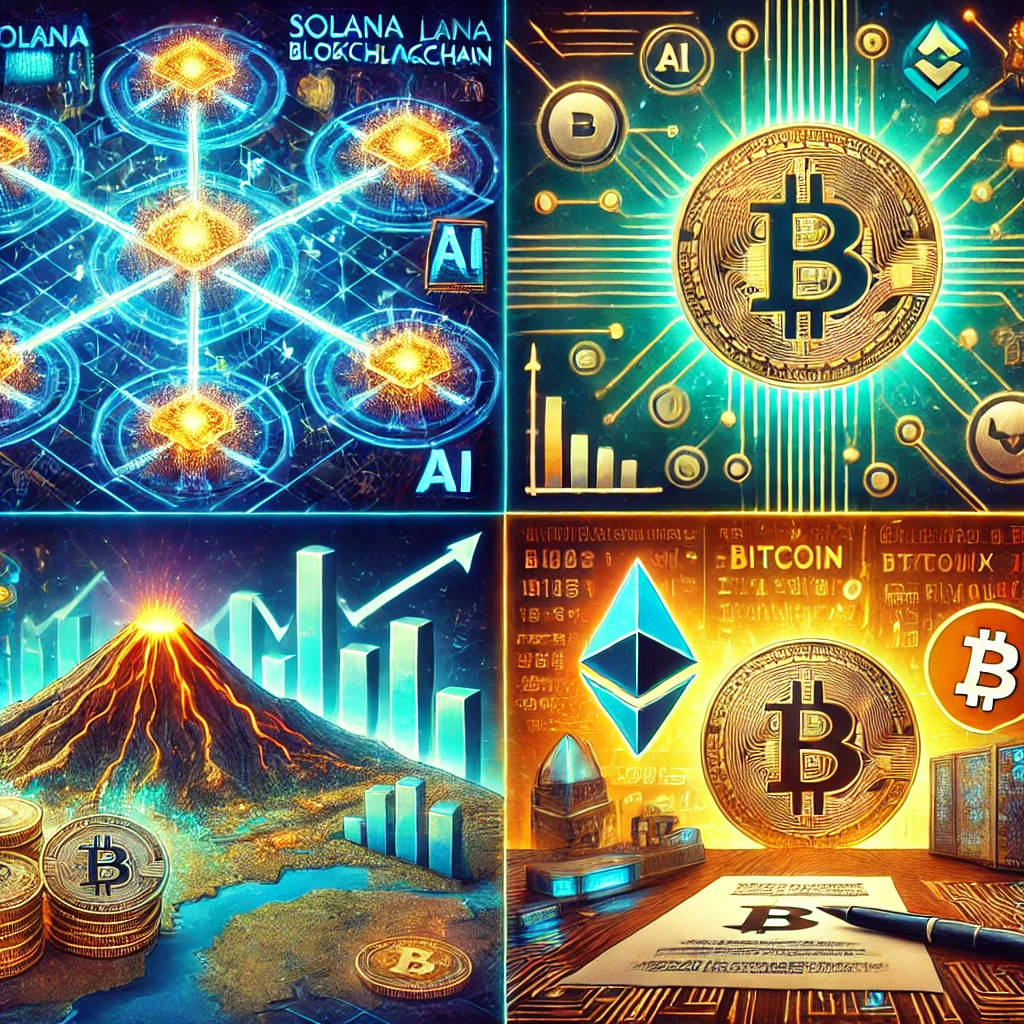
The cryptocurrency space is witnessing transformative developments, from technological integration with AI on Solana’s blockchain to institutional investments reshaping Bitcoin’s market dynamics. El Salvador emerges as a crypto powerhouse, attracting global attention with groundbreaking policies and investments, while Donald Trump’s crypto-friendly executive orders could redefine the U.S. regulatory landscape. This confluence of events signals an era of innovation, adoption, and renewed focus on blockchain technologies. 1. Solana’s Blockchain Becomes a Foundation for Decentralized AI Solana is emerging as a pivotal player in integrating blockchain technology with artificial intelligence (AI), driven by its fast transaction speeds and innovative Proof-of-History (PoH) consensus mechanism. The network’s efficiency has made it attractive for developers aiming to enhance decentralized applications (dApps) with AI functionalities. Notable projects like Nosana and Synesis One leverage Solana to create decentralized GPU grids and data marketplaces, respectively, addressing critical needs for AI training and inference workloads. These advancements are fostering a new era of AI-driven decentralized ecosystems, firmly positioning Solana at the forefront of blockchain innovation. Moreover, platforms like Lightchain AI demonstrate the growing synergy between AI and Solana’s blockchain. By integrating AI to enhance decision-making processes, these projects highlight blockchain’s potential to disrupt traditional industry practices. Solana’s robust infrastructure ensures that decentralized AI applications can operate seamlessly, catering to a wide range of industries, from finance to healthcare. Impact: Solana’s collaboration with AI technologies is likely to amplify its relevance in the blockchain space, encouraging developers and investors to explore its ecosystem further. This integration could enhance Solana’s market positioning, solidifying its role in shaping the future of decentralized technologies and potentially driving increased adoption of its blockchain. 2. Bitcoin Traders Brace for Major Market Moves Amid Volatility Bitcoin’s price has been volatile, recently nearing the $100,000 milestone before retreating sharply to $91,377. This fluctuation has led to a shift in options trading, with traders prioritizing downside protection. The call-put skew index for December 27 saw a notable decline, indicating growing caution among market participants. This trend highlights the uncertainty surrounding Bitcoin’s near-term price trajectory, even as it remains a lucrative asset for speculators. Despite a strong annual performance with a 120% increase in value, Bitcoin’s November rally was tempered by profit-taking from long-term holders. This selling activity, coupled with macroeconomic concerns, has created a challenging environment for bullish traders. As $11.8 billion in options are set to expire on December 27, market watchers anticipate heightened volatility and potential shifts in market sentiment. Impact: Bitcoin’s fluctuating performance underscores the asset’s speculative nature and its sensitivity to macroeconomic and investor behavior. These dynamics could result in substantial short-term price movements, influencing institutional and retail participation in the crypto market. 3. Italy’s Largest Bank Dips Into Bitcoin With a $1M Investment Intesa Sanpaolo, Italy’s largest bank, has made headlines with its maiden Bitcoin purchase, acquiring 11 tokens for $1 million. This marks a significant step as traditional financial institutions venture into digital assets. The bank’s initiative follows the establishment of a dedicated digital asset desk, highlighting its readiness to adapt to evolving client needs. However, CEO Carlo Messina clarified that this move remains experimental, aligning with institutional investor-focused strategies. The bank’s Bitcoin acquisition coincides with regulatory adjustments in Italy, including a planned reduction in crypto capital gains tax from 42% to 28%. This evolving regulatory landscape signals a more crypto-friendly approach, encouraging institutions like Intesa Sanpaolo to explore cryptocurrency as an alternative asset class. Such moves suggest broader financial sector participation in the cryptocurrency market. Impact: Intesa Sanpaolo’s Bitcoin purchase underscores growing institutional adoption of crypto assets. While the investment is relatively small, it reflects shifting attitudes toward digital currencies, potentially inspiring similar moves among other banks in Europe and beyond. 4. El Salvador Embraces Tether With Strategic Investments and Initiatives Tether is solidifying its presence in El Salvador by relocating its headquarters to the country, following a regulatory approval for digital asset services. This move positions El Salvador as a central hub for cryptocurrency innovation. Alongside its operational shift, Tether has committed $1 billion to the “Volcano Energy” project, a renewable energy initiative aimed at sustainable Bitcoin mining. This highlights El Salvador’s dedication to combining cryptocurrency adoption with environmental sustainability. In addition, Tether and the Salvadoran government have introduced the “Freedom Visa Program,” allowing individuals who invest $1 million in Bitcoin or USDT to gain residency. These combined initiatives reflect El Salvador’s forward-thinking approach to integrating digital currencies into its economy and promoting foreign investments. Impact: El Salvador’s collaboration with Tether strengthens its image as a crypto-friendly nation. These developments could boost foreign direct investment, enhance Bitcoin adoption, and position the country as a leading innovator in the digital asset space. 5. Numerous Companies Expected to Purchase Bitcoin Over the Next 18 Months A River report forecasts that about 10% of U.S. companies will allocate 1.5% of their treasury reserves to Bitcoin, equating to $10.35 billion in investments within the next 18 months. The report emphasizes that conventional treasury strategies fail to outperform inflation, urging businesses to explore Bitcoin as a hedge against devaluation. Companies like Apple have reportedly lost billions in treasury value due to inflation, highlighting the potential of Bitcoin to preserve purchasing power. MicroStrategy serves as a prominent example of this trend, holding 423,650 Bitcoins worth over $42 billion. CEO Michael Saylor has actively promoted Bitcoin as a reliable store of value, driving interest in its use as a corporate treasury asset. As more companies recognize Bitcoin’s potential to mitigate inflationary risks, the trend could become a cornerstone of financial strategy for large corporations. Impact: The anticipated surge in corporate Bitcoin adoption could significantly boost its demand, supporting price stability and long-term growth. This movement also positions Bitcoin as a mainstream financial tool, further integrating cryptocurrencies into global economic frameworks. 6. Bitcoin Reclaims $96,000 After Recent Lows Bitcoin’s price recently dipped below $90,000, its lowest since November, before recovering above $96,000. This volatility stemmed from concerns over Federal Reserve policies and robust U.S. economic data, which dampened hopes for interest rate cuts. Bitcoin’s resilience, however,
9 Crypto Highlights: Bitcoin Whale Moves, ETF Innovations, Stablecoin Demand, and Global Adoption Trends

Spot Bitcoin ETFs Witness Record Withdrawals Amid Declining CME Futures Premium U.S. spot Bitcoin exchange-traded funds (ETFs) have experienced unprecedented single-day outflows, with $680 million withdrawn, ending a 15-day streak of positive capital inflows. Notable contributors to this withdrawal include Fidelity’s FBTC, Grayscale’s Bitcoin Mini Trust, and the ARKB ETF by Ark and 21Shares. This mass exodus coincided with Bitcoin’s price dipping below $100,000, following remarks from Federal Reserve Chair Jerome Powell. CME Futures Premium Indicates Weaker Demand Simultaneously, the Chicago Mercantile Exchange (CME) Bitcoin futures market has shown signs of waning demand. The premium on CME Bitcoin futures contracts, which typically reflects investor optimism, has declined. Previously, CME front-month futures contracts traded at a significant premium of 18.7% annualized to the spot price, indicating bullish sentiment. However, recent data suggests a reduction in this premium, pointing to a potential decrease in institutional demand. Market Implications These concurrent trends suggest a cautious outlook among investors regarding Bitcoin’s short-term performance. The substantial withdrawals from spot Bitcoin ETFs indicate profit-taking or a shift in investment strategies, possibly due to macroeconomic factors or regulatory concerns. The diminishing CME futures premium further supports the notion of tempered demand, as institutional investors reassess their positions in the Bitcoin market. Long-Term Bitcoin Holders Offload 1 Million BTC Since September Recent data indicates that long-term Bitcoin holders (LTHs) have sold approximately 1 million BTC since September 2024, reducing their holdings from around 14.2 million to 13.2 million BTC. Increased Selling Activity On December 19, 2024, LTHs sold nearly 70,000 BTC, marking the fourth-largest single-day sell-off this year. This surge in selling aligns with Bitcoin’s price reaching new highs, prompting profit-taking among investors who acquired BTC at lower prices. Market Absorption Despite significant sales from LTHs, the market has demonstrated resilience, with new demand absorbing the increased supply. Short-term holders (STHs) have accumulated over 1 million BTC during the same period, indicating sustained interest and confidence in Bitcoin’s potential. Implications for Bitcoin’s Price The redistribution of Bitcoin from LTHs to STHs suggests a dynamic market where profit-taking is balanced by new investments. While large-scale selling by LTHs can exert downward pressure on prices, the concurrent accumulation by STHs has helped maintain market stability. Bitcoin Whale Transfers 72,000 BTC Held for Over 5 Years, Hinting at Market Shift A significant movement has been observed in the Bitcoin market, where a whale—an entity holding a large amount of Bitcoin—has transferred 72,000 BTC that had remained dormant for 5 to 7 years. This substantial transfer has sparked discussions about its potential implications on the market and whether it signals a broader shift in investor sentiment or the onset of an altseason. Potential Market Shift The transfer of such a large amount of Bitcoin by a long-term holder may indicate a change in market dynamics. It could suggest that the holder anticipates a market downturn and is moving assets in preparation to sell, which might increase selling pressure and potentially lead to a decrease in Bitcoin’s price. Alternatively, it could be a strategic move to reallocate assets or diversify investments. Indicator of Altseason Another perspective is that this transfer could signal the beginning of an altseason—a period when alternative cryptocurrencies (altcoins) experience a surge in value relative to Bitcoin. If large Bitcoin holders are moving their assets, it might indicate a shift in focus towards altcoins, suggesting that investors are seeking higher returns in other digital assets. Market Implications Such significant movements by Bitcoin whales can have notable effects on the cryptocurrency market. They can influence market sentiment, liquidity, and price volatility. Traders and investors often monitor these large transactions to gauge potential market trends and make informed decisions. Stablecoin Demand Surges on Ethereum Layer 2 Networks Recent developments indicate a significant surge in stablecoin demand on Ethereum Layer 2 networks, particularly on platforms like Polygon and Blast. Polygon’s Stablecoin Market Growth Polygon, an Ethereum Layer 2 solution, has experienced a notable increase in its stablecoin market capitalization. Reports reveal that Polygon’s stablecoin market cap has risen to $1.5 billion, marking a 19% quarter-over-quarter growth. Tether (USDT) leads this expansion, with its market cap on Polygon growing by 29% to $792 million, accounting for 53% of the total stablecoin market cap on the network. This growth is attributed to various developments, including trials by Sony Bank exploring stablecoin use on Polygon and plans by tech companies like Settlemint to develop stablecoins leveraging Polygon’s infrastructure. Blast Layer 2 Network’s Rapid Adoption The Blast Layer 2 network has also witnessed significant traction. Within hours of its launch, investors bridged over $30 million in ether and stablecoins to the platform, demonstrating strong demand for Layer 2 solutions that enhance transaction speed and reduce costs. Blast’s design incentivizes users by offering yields on transferred ether and BLAST points, further driving user engagement. Implications for the Crypto Ecosystem The increasing demand for stablecoins on Ethereum Layer 2 networks underscores the growing importance of scalable solutions in the blockchain space. Layer 2 networks like Polygon and Blast address challenges related to speed, cost, and scalability, making them attractive for both developers and users. The surge in stablecoin adoption on these platforms reflects a broader trend towards efficient and cost-effective blockchain solutions, potentially influencing the future development of decentralized finance (DeFi) and other blockchain-based applications. Brazilian Investors Show Growing Interest in Cryptocurrency Investments Brazil has emerged as a significant player in the global cryptocurrency landscape, with a notable increase in both individual and institutional investments. Individual Investor Growth Recent data indicates that over 34.5 million Brazilians have invested in cryptocurrencies, with approximately 75% engaging in monthly purchases. This trend highlights a growing acceptance of digital assets among the general populace. Institutional Investment Surge Institutional interest in cryptocurrencies has also risen markedly. In late 2023, there was a 29.2% increase in large-scale transactions (over $1 million), followed by a 48.4% rise from Q4 2023 to Q1 2024. This uptick suggests that major financial entities are increasingly viewing digital assets as viable investment opportunities. Stablecoin Adoption Stablecoins have gained significant