
Bitcoin Whales, Digital Euro, and Market Volatility 7 Game-Changing Crypto Developments

Bitcoin continues to dominate global financial discussions as billion-dollar options are set to expire, whales ramp up accumulation, and analysts point to low sell-side risk as a precursor to major price movements. Alongside these developments, the European Central Bank is accelerating its push for a digital euro to compete with Bitcoin and politically-backed stablecoins, while Donald Trump’s opposition to CBDCs shakes up the global debate. Meanwhile, Elon Musk’s X faces legal challenges, spotlighting the intersection of social media, crypto, and regulation, as Coinbase’s CEO reignites the Bitcoin vs. gold debate. This article breaks down each story, analyzes its market impact, and ties it all together to provide you with actionable insights into how these developments might shape the crypto landscape. Whether you’re a long-term investor or a trader looking to make sense of the news, here’s everything you need to know. 1. Elon Musk’s X May Face Multi-Million Euro Fine in EU Probe The European Union is investigating Elon Musk’s platform X (formerly Twitter) for allegedly failing to comply with the EU’s Digital Services Act (DSA). The DSA mandates social media platforms to curb disinformation, particularly regarding conflicts like the Israel-Palestine war. If proven non-compliant, X could face a fine of up to 6% of its global revenue, which could amount to hundreds of millions of euros. The probe highlights recent concerns over the spread of unregulated content and the legal consequences of social platforms being held accountable. Analysis and Market Impact: For crypto markets, this has indirect implications. X is a popular hub for crypto-related conversations, trading communities, and influencer-driven market movements. Any potential regulatory hurdles or penalties for the platform could decrease trust in it as a tool for crypto discourse. Additionally, Musk’s unpredictable involvement in crypto (e.g., his effect on Dogecoin prices) often attracts market volatility. A significant legal blow to X could reduce its utility for crypto enthusiasts, leading communities to shift elsewhere. Moreover, the EU’s strict regulatory stance could spill over into crypto companies operating within its jurisdiction, as it signals a growing intolerance for non-compliance. This news serves as a reminder that both social media platforms and crypto ecosystems are under increasing regulatory scrutiny, which may weigh on short-term market sentiment. 2. ECB Proposes Digital Euro to Counter Trump’s Stablecoin Advances The European Central Bank (ECB) is accelerating its plans for a digital euro in response to increasing competition from private stablecoins, particularly those tied to political figures like Donald Trump. According to reports, the ECB is concerned about the influence of politically-backed stablecoins on the euro’s dominance. The digital euro project aims to modernize the EU’s monetary system, providing a secure and regulated alternative to privately-issued stablecoins. Analysis and Market Impact: The ECB’s move highlights a growing trend among central banks: countering the rise of stablecoins with their own Central Bank Digital Currencies (CBDCs). If implemented, the digital euro could provide a more regulated and stable option for digital transactions, potentially attracting users away from decentralized cryptocurrencies and private stablecoins. However, its centralized nature might also deter crypto purists who value anonymity and decentralization. The global competition between CBDCs and stablecoins introduces uncertainty into the crypto space. Stablecoins like USDT and USDC could face increased regulatory and competitive pressure, possibly leading to market volatility. Additionally, if Trump’s stablecoin gains traction, it could attract a politically-driven user base, creating a new layer of competition for established cryptos. This news reflects a growing trend of governments entering the digital currency arena, which could reshape the global financial landscape. 3. $7.8 Billion in Bitcoin Options Set to Expire on Deribit Bitcoin options worth $7.8 billion are set to expire at the end of the month on the Deribit exchange. These contracts are significant because their expiration often creates volatility in Bitcoin’s price. As traders rush to close or roll over positions, the market could see sudden price movements, depending on whether options are exercised in the money or expire worthless. Deribit remains the largest crypto options market, with Bitcoin options accounting for the majority of activity. Analysis and Market Impact: This massive expiration event has the potential to disrupt Bitcoin’s current price stability. Large-scale expirations often create a tug-of-war between bulls and bears, resulting in heightened volatility. If a significant portion of the options expire in the money, it could lead to a wave of buy or sell orders, depending on the strike prices and market sentiment. Traders should watch key price levels closely. For instance, if Bitcoin trades above key strike prices near expiration, it could trigger bullish momentum. Conversely, falling below significant levels may result in sell-offs. This news also highlights the growing influence of derivatives in the crypto market, as institutions and retail investors use options to hedge or speculate. Short-term traders could benefit from volatility, but long-term holders should brace for price swings. 4. Bitcoin Whales in Accumulation Phase After Trump Inauguration According to CryptoQuant, Bitcoin whales have entered a new accumulation phase following Donald Trump’s inauguration announcement. Whales, who hold massive BTC amounts, often signal potential market trends. The report suggests that whale activity is increasing on exchanges, which could indicate preparations for a price rally or hedge against market uncertainties tied to political developments. Analysis and Market Impact: The accumulation by Bitcoin whales is a bullish signal, as their activity often precedes significant price moves. Whales’ confidence in BTC may stem from increasing uncertainty in traditional markets, such as fears of inflation or geopolitical tensions. Trump’s inauguration announcement could also be reigniting interest in crypto as a hedge against political and economic uncertainty. For the broader market, this trend suggests that large investors are doubling down on Bitcoin’s long-term potential, which could encourage retail traders to follow suit. However, whale activity can also lead to heightened price manipulation risks, as large holders have the ability to influence short-term trends. If this accumulation continues, Bitcoin could gain upward momentum, especially if supported by positive macroeconomic news. 5. Bitcoin vs. Gold: Coinbase CEO Says BTC is Better Coinbase CEO Brian
The Crypto Renaissance: Solana’s AI Push, Bitcoin’s Turbulence, El Salvador’s Bold Moves, and Trump’s Crypto Vision : 7 Latest news

The cryptocurrency space is witnessing transformative developments, from technological integration with AI on Solana’s blockchain to institutional investments reshaping Bitcoin’s market dynamics. El Salvador emerges as a crypto powerhouse, attracting global attention with groundbreaking policies and investments, while Donald Trump’s crypto-friendly executive orders could redefine the U.S. regulatory landscape. This confluence of events signals an era of innovation, adoption, and renewed focus on blockchain technologies. 1. Solana’s Blockchain Becomes a Foundation for Decentralized AI Solana is emerging as a pivotal player in integrating blockchain technology with artificial intelligence (AI), driven by its fast transaction speeds and innovative Proof-of-History (PoH) consensus mechanism. The network’s efficiency has made it attractive for developers aiming to enhance decentralized applications (dApps) with AI functionalities. Notable projects like Nosana and Synesis One leverage Solana to create decentralized GPU grids and data marketplaces, respectively, addressing critical needs for AI training and inference workloads. These advancements are fostering a new era of AI-driven decentralized ecosystems, firmly positioning Solana at the forefront of blockchain innovation. Moreover, platforms like Lightchain AI demonstrate the growing synergy between AI and Solana’s blockchain. By integrating AI to enhance decision-making processes, these projects highlight blockchain’s potential to disrupt traditional industry practices. Solana’s robust infrastructure ensures that decentralized AI applications can operate seamlessly, catering to a wide range of industries, from finance to healthcare. Impact: Solana’s collaboration with AI technologies is likely to amplify its relevance in the blockchain space, encouraging developers and investors to explore its ecosystem further. This integration could enhance Solana’s market positioning, solidifying its role in shaping the future of decentralized technologies and potentially driving increased adoption of its blockchain. 2. Bitcoin Traders Brace for Major Market Moves Amid Volatility Bitcoin’s price has been volatile, recently nearing the $100,000 milestone before retreating sharply to $91,377. This fluctuation has led to a shift in options trading, with traders prioritizing downside protection. The call-put skew index for December 27 saw a notable decline, indicating growing caution among market participants. This trend highlights the uncertainty surrounding Bitcoin’s near-term price trajectory, even as it remains a lucrative asset for speculators. Despite a strong annual performance with a 120% increase in value, Bitcoin’s November rally was tempered by profit-taking from long-term holders. This selling activity, coupled with macroeconomic concerns, has created a challenging environment for bullish traders. As $11.8 billion in options are set to expire on December 27, market watchers anticipate heightened volatility and potential shifts in market sentiment. Impact: Bitcoin’s fluctuating performance underscores the asset’s speculative nature and its sensitivity to macroeconomic and investor behavior. These dynamics could result in substantial short-term price movements, influencing institutional and retail participation in the crypto market. 3. Italy’s Largest Bank Dips Into Bitcoin With a $1M Investment Intesa Sanpaolo, Italy’s largest bank, has made headlines with its maiden Bitcoin purchase, acquiring 11 tokens for $1 million. This marks a significant step as traditional financial institutions venture into digital assets. The bank’s initiative follows the establishment of a dedicated digital asset desk, highlighting its readiness to adapt to evolving client needs. However, CEO Carlo Messina clarified that this move remains experimental, aligning with institutional investor-focused strategies. The bank’s Bitcoin acquisition coincides with regulatory adjustments in Italy, including a planned reduction in crypto capital gains tax from 42% to 28%. This evolving regulatory landscape signals a more crypto-friendly approach, encouraging institutions like Intesa Sanpaolo to explore cryptocurrency as an alternative asset class. Such moves suggest broader financial sector participation in the cryptocurrency market. Impact: Intesa Sanpaolo’s Bitcoin purchase underscores growing institutional adoption of crypto assets. While the investment is relatively small, it reflects shifting attitudes toward digital currencies, potentially inspiring similar moves among other banks in Europe and beyond. 4. El Salvador Embraces Tether With Strategic Investments and Initiatives Tether is solidifying its presence in El Salvador by relocating its headquarters to the country, following a regulatory approval for digital asset services. This move positions El Salvador as a central hub for cryptocurrency innovation. Alongside its operational shift, Tether has committed $1 billion to the “Volcano Energy” project, a renewable energy initiative aimed at sustainable Bitcoin mining. This highlights El Salvador’s dedication to combining cryptocurrency adoption with environmental sustainability. In addition, Tether and the Salvadoran government have introduced the “Freedom Visa Program,” allowing individuals who invest $1 million in Bitcoin or USDT to gain residency. These combined initiatives reflect El Salvador’s forward-thinking approach to integrating digital currencies into its economy and promoting foreign investments. Impact: El Salvador’s collaboration with Tether strengthens its image as a crypto-friendly nation. These developments could boost foreign direct investment, enhance Bitcoin adoption, and position the country as a leading innovator in the digital asset space. 5. Numerous Companies Expected to Purchase Bitcoin Over the Next 18 Months A River report forecasts that about 10% of U.S. companies will allocate 1.5% of their treasury reserves to Bitcoin, equating to $10.35 billion in investments within the next 18 months. The report emphasizes that conventional treasury strategies fail to outperform inflation, urging businesses to explore Bitcoin as a hedge against devaluation. Companies like Apple have reportedly lost billions in treasury value due to inflation, highlighting the potential of Bitcoin to preserve purchasing power. MicroStrategy serves as a prominent example of this trend, holding 423,650 Bitcoins worth over $42 billion. CEO Michael Saylor has actively promoted Bitcoin as a reliable store of value, driving interest in its use as a corporate treasury asset. As more companies recognize Bitcoin’s potential to mitigate inflationary risks, the trend could become a cornerstone of financial strategy for large corporations. Impact: The anticipated surge in corporate Bitcoin adoption could significantly boost its demand, supporting price stability and long-term growth. This movement also positions Bitcoin as a mainstream financial tool, further integrating cryptocurrencies into global economic frameworks. 6. Bitcoin Reclaims $96,000 After Recent Lows Bitcoin’s price recently dipped below $90,000, its lowest since November, before recovering above $96,000. This volatility stemmed from concerns over Federal Reserve policies and robust U.S. economic data, which dampened hopes for interest rate cuts. Bitcoin’s resilience, however,
Bitcoin in Focus: Silk Road Sales, Political Donations, Bhutan’s Strategy, and Network Activity Insights : 5 Important crypto news

From the U.S. government’s massive liquidation of seized Silk Road Bitcoin to Circle CEO’s political donation in USDC, the spotlight is also on Bhutan’s pioneering use of hydropower for Bitcoin mining. Additionally, recent trends highlight a significant drop in active Bitcoin addresses, raising questions about market momentum. In this article, we delve into these developments, exploring their implications and potential market impact. 1. U.S. Government Prepares to Liquidate $2 Billion in Bitcoin Seized from Silk Road The U.S. government has transferred nearly $2 billion worth of Bitcoin, seized in the infamous Silk Road case, to Coinbase Prime. Market watchers suspect this signals an imminent sale. Bitwise CIO Matt Hougan highlighted the potential short-term volatility that could arise from this sale but remains optimistic about the cryptocurrency market’s resilience. The transfer comes as part of the government’s ongoing efforts to liquidate seized crypto assets responsibly, while monitoring for minimal disruption in broader financial markets. Hougan pointed out that Bitcoin’s market maturity and improved liquidity mechanisms would likely absorb the shock, preventing long-term harm. The cryptocurrency ecosystem has experienced significant growth in trading volume, stability, and institutional participation since earlier Silk Road-related asset sales. If sold via OTC (over-the-counter) or auction-style mechanisms, it could further mitigate price swings, ensuring the market remains robust even under such unprecedented events. Impact of News: The move could create short-term turbulence in Bitcoin prices as traders react to news of the massive liquidation. However, long-term effects may be negligible if the market handles the sale effectively. Institutional investors could also view the event as a sign of maturity, reinforcing the cryptocurrency’s viability as an asset class. These developments emphasize the importance of regulatory engagement and careful management of large-scale crypto transactions by governments. 2. DOJ Cleared to Sell $6.5 Billion Bitcoin Seized from Silk Road The U.S. Department of Justice (DOJ) has received approval to sell 69,370 Bitcoin, marking one of the largest government-led crypto sales in history. This decision follows a Supreme Court ruling that secured U.S. ownership of the assets, with the DOJ citing market volatility as a reason to act swiftly. This initiative highlights the government’s intent to responsibly monetize seized crypto assets while minimizing disruption to the market. The market response has been swift, with Bitcoin’s price declining by nearly 3% upon the announcement, signaling traders’ concerns about liquidity pressure. Analysts suggest that a controlled liquidation strategy—through private sales or OTC channels—would help mitigate price shocks. The cryptocurrency ecosystem, now more liquid and diverse than ever, is deemed capable of withstanding such significant inflows into the market. Impact of News: While the sale is likely to cause temporary price fluctuations, the broader impact highlights Bitcoin’s increasing entanglement with governmental and institutional systems. As Bitcoin becomes a key component in national economic strategies, such moves demonstrate a delicate balance between regulation and fostering trust in cryptocurrencies. Investors are likely to keep a close watch on liquidity and price movements in the coming weeks. 3. Crypto Donation: Circle CEO Donates $1M USDC to Trump Inauguration Circle CEO Jeremy Allaire has announced a $1 million USD Coin (USDC) donation to support President-elect Donald Trump’s inauguration, reflecting the cryptocurrency industry’s growing influence in politics. The crypto industry has collectively contributed $7.5 million to Trump’s campaign, signaling its strategic alignment with the incoming administration’s policies. The move aims to highlight the potential of digital currencies in mainstream financial and political ecosystems. This donation aligns with the industry’s expectations of a more crypto-friendly regulatory environment under Trump’s administration. His plans to support Bitcoin mining, promote U.S. crypto innovation, and establish a national Bitcoin reserve have made him an appealing candidate for the crypto community. Allaire’s contribution not only showcases the power of stablecoins but also strengthens cryptocurrency’s presence in political fundraising. Impact of News: The growing collaboration between crypto leaders and politics could pave the way for favorable regulations, benefiting the entire digital asset ecosystem. This event underscores the sector’s rising legitimacy and influence in shaping policies, potentially leading to a supportive environment for innovation, particularly in blockchain technology. 4. Bhutan’s Bitcoin Strategy: $1 Billion Reserve Powered by Hydropower Bhutan has strategically leveraged its abundant hydroelectric resources to build a $1 billion Bitcoin reserve, representing 39% of the nation’s GDP. The country has been mining Bitcoin since 2019, spearheaded by Druk Holding and Investments (DHI), a state-owned entity. This initiative highlights Bhutan’s innovative use of renewable energy to diversify its economy through cryptocurrency. Mining over 12,000 Bitcoin sustainably, Bhutan has positioned itself among leading nations embracing crypto. With minimal environmental impact, the operation aligns with Bhutan’s carbon-neutral stance. Inspired by El Salvador’s Bitcoin adoption, the move illustrates how smaller economies can integrate digital currencies for national growth. Impact of News: Bhutan’s success could inspire other nations to adopt renewable energy-based mining strategies. This approach enhances crypto’s appeal as a sustainable investment and a tool for economic development. Bhutan’s actions may further legitimize cryptocurrency as a transformative force in global finance. Bitcoin Active Addresses Decline Amidst Market Volatility Recent data indicates a significant decline in Bitcoin’s active addresses, with the 30-day simple moving average (SMA) falling below the 365-day SMA. This trend mirrors patterns observed after major price peaks in 2018 and 2021, suggesting a potential cooling period in the market. As of September 2024, active addresses have decreased from over 1 million to approximately 650,000, aligning with Bitcoin’s price stabilization below $60,000. he reduction in active addresses may indicate decreased user engagement and transaction activity on the Bitcoin network. Historically, such declines have preceded market corrections or periods of consolidation. However, it’s important to consider other factors, such as the increasing adoption of Bitcoin exchange-traded funds (ETFs), which might influence on-chain activity. The introduction of Bitcoin spot ETFs could be contributing to this trend, as investors opt for these financial instruments over direct on-chain transactions. Impact of News: The decrease in active addresses could signal a shift in market dynamics, potentially leading to reduced liquidity and increased volatility. Investors might interpret this trend as a cautionary sign,
Bull Market Peak, Institutional Inflows, MiCA’s Impact, and Bitcoin Ambitions in 2025
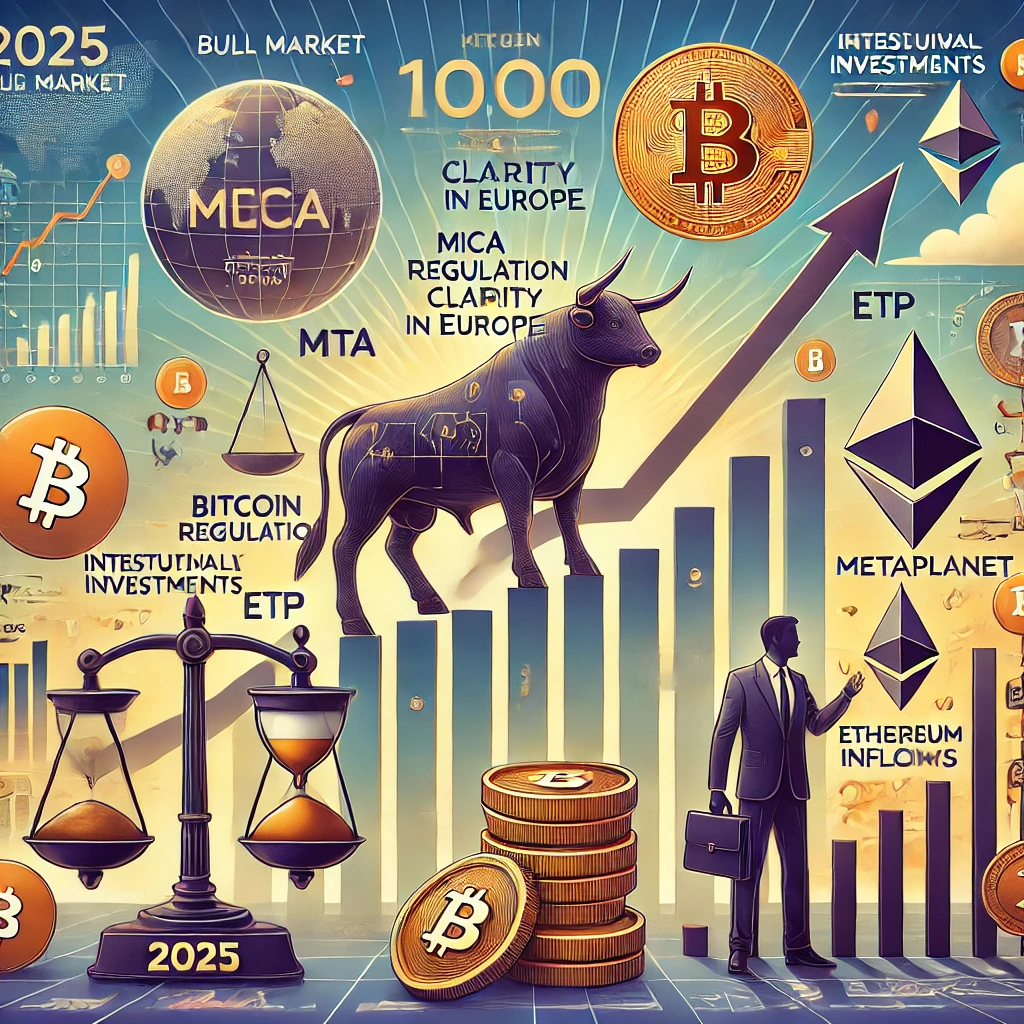
The cryptocurrency landscape in 2025 is dynamic and multifaceted, driven by predictions of Bull Market peaks, surging institutional investments, regulatory clarity through MiCA, and ambitious Bitcoin acquisition strategies by major players. From CryptoQuant’s cautious warnings to Metaplanet’s bold Bitcoin goals, the interplay of optimism, caution, and regulation is shaping a complex narrative. This analysis unpacks the key stories, market implications, and investor insights for the year ahead. 1. CryptoQuant: Bull Market in Final Stage, Peaks Expected in 2025 Analysis: CryptoQuant’s analysis suggests that the cryptocurrency market is in the latter phases of its current bull cycle, which began in early 2023. This phase is characterized by significant inflows from both new investors and reinvestments by existing players, signaling that a cyclical market peak may occur by Q2 2025. A key indicator of this maturation is the percentage of Bitcoin held for less than one month, which has risen to 36%—a figure reminiscent of trends seen during previous bull market peaks. However, CryptoQuant’s caution contrasts with other analysts’ forecasts. While CryptoQuant sees the potential for a market correction shortly after the peak, firms like VanEck and Steno Research anticipate continued strength throughout 2025. VanEck, for example, predicts Bitcoin could surpass $180,000 by year-end, with Ethereum breaching $6,000. This divergence reflects the speculative nature of the crypto markets, where sentiment and macroeconomic factors can create widely varying scenarios. Impact: The CryptoQuant report serves as a reminder for investors to balance optimism with prudent risk management. While high returns remain possible in the short term, the anticipation of a peak within a specific timeframe introduces uncertainty. This outlook might lead to increased market volatility as investors weigh the risks of holding positions versus cashing out near the predicted top. 2. Crypto ETPs See $585 Million Inflows as 2025 Begins: CoinShares Report Analysis: The crypto exchange-traded products (ETPs) market has started 2025 with impressive inflows, marking a continuation of the bullish trend observed in 2024. With $585 million invested in the first three days of the year, the data suggests sustained interest in these instruments, which gained traction after the introduction of U.S. spot Bitcoin ETFs in January 2024. Bitcoin-focused ETPs dominate the inflows, reflecting investor confidence in the leading cryptocurrency. In 2024 alone, Bitcoin ETPs attracted $38 billion, cementing their position as a preferred vehicle for institutional and retail investors. Ether-based ETPs also gained attention, adding $4.8 billion in 2024. Regional disparities, however, highlight differing investor sentiments, with the U.S. leading inflows while Canada and parts of Europe saw notable outflows. Impact: These figures underscore the growing mainstream adoption of crypto assets, particularly through structured products like ETPs. The inflows at the start of 2025 suggest that institutions and individuals view these products as both a hedge and an opportunity for substantial returns. For Bitcoin, increased AUM (assets under management) solidifies its role as the flagship digital asset, potentially boosting its price in the months ahead. 3. MiCA: Regulatory Clarity for European Crypto Markets Analysis: The implementation of the Markets in Crypto-Assets (MiCA) regulation marks a pivotal moment for cryptocurrency markets in Europe. By setting clear guidelines for compliance, licensing, and taxation, MiCA addresses concerns over the “Wild West” nature of the crypto industry. While critics warn of potential overregulation, proponents argue that MiCA will enhance investor confidence and attract more significant institutional participation. Key developments under MiCA include increased scrutiny on retail investors, requiring them to disclose detailed financial and personal data. This regulatory demand, while cumbersome, could pave the way for future crypto taxation and streamlined compliance frameworks. Institutions like Société Générale and MoonPay have already aligned with MiCA, signaling a shift towards legitimacy in the sector. Impact: MiCA’s comprehensive approach has the potential to position Europe as a leader in crypto innovation. However, the immediate impact may be mixed. While institutional investors are likely to embrace the regulatory clarity, retail participation could temporarily decline due to heightened compliance requirements. Over time, MiCA could set a precedent for other regions seeking to balance innovation with investor protection. 4. Bitcoin Price Rally Faces Uncertainty Ahead of Trump Inauguration Analysis: Bitcoin’s price surge in early 2025, fueled by optimism surrounding Donald Trump’s return to the White House, faces potential obstacles. Positive inflation data expected mid-January may provide a short-term boost, but caution prevails as the Federal Reserve’s Federal Open Market Committee (FOMC) meeting approaches on January 29. The meeting is likely to influence interest rate decisions, which have historically impacted Bitcoin’s price volatility. Market analysts have mixed views on Bitcoin’s trajectory. While Markus Thielen of 10x Research predicts Bitcoin could stabilize in the $97,000–$98,000 range by January’s end, others like John Glover anticipate a more volatile pattern. The role of institutional inflows via Bitcoin ETFs and stablecoins will be critical in determining the market’s direction. Impact: The interplay between macroeconomic indicators and political developments creates a complex environment for Bitcoin investors. While the inaugural optimism may spur temporary gains, the looming FOMC meeting could introduce downward pressure, emphasizing the importance of staying attuned to policy shifts and market dynamics. 5. Metaplanet’s Ambitious Plan to Hold 10,000 BTC by 2025 Analysis: Japanese venture capital firm Metaplanet has set an ambitious target to expand its Bitcoin holdings from 1,762 BTC to 10,000 BTC by the end of 2025. This aggressive accumulation plan is fueled by predictions of Bitcoin reaching $200,000 in the current bull cycle. Metaplanet intends to use a mix of loans, equity, and convertible bonds to finance the purchases, reflecting its bullish outlook on Bitcoin’s long-term potential. The firm’s strategy aligns with the growing trend of institutional adoption. Metaplanet’s stock performance, which has risen by 950% since it began acquiring Bitcoin in April 2024, demonstrates strong investor confidence. Additionally, the company projects an operating profit for the first time since 2017, driven partly by its crypto investments. Impact: Metaplanet’s move could inspire other institutional players to increase their exposure to Bitcoin, further driving demand and price appreciation. By positioning itself as a leader in crypto investment, the firm underscores the growing institutional