
7 Important Daily Crypto News: Market Resilience, Bitcoin’s Bull Run, Crypto-to-Debit Services, Memecoin Legislation, Futures Correction Risks, Bitcoin Reserve Plans, and Pakistan’s Regulatory Council… Botslash Daily Crypto News Analysis
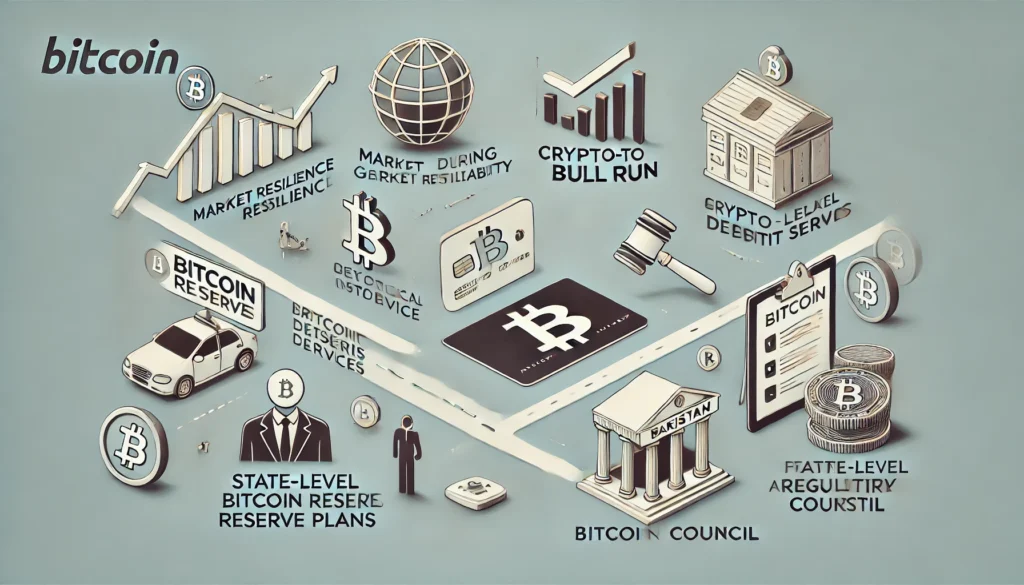
The latest developments in the crypto world underscore the sector’s resilience amid global financial uncertainties. From regulatory actions to new market features, the crypto ecosystem continues to evolve rapidly. Institutional demand for Bitcoin remains strong, even as governments propose new legislation targeting memecoins and the integration of Bitcoin into state reserves faces hurdles. Meanwhile, innovation in crypto payments and partnerships, such as the collaboration between Cronos and Crypto.com, highlights the growing use case for digital currencies in everyday transactions. Let’s dive into these key updates: Crypto Holds Firm as Traditional Markets Struggle with Trump’s Tariff Threat The cryptocurrency market has shown resilience amid a downturn in traditional finance triggered by Donald Trump’s latest tariff threats. Major stock indices, including the S&P 500 and Dow Jones, suffered losses as investors grew wary of potential economic repercussions. However, Bitcoin and other leading cryptocurrencies remained stable, demonstrating their role as alternative assets during economic uncertainty. This divergence between TradFi and crypto highlights the growing perception of digital assets as a hedge against geopolitical risks and macroeconomic instability. A key factor behind crypto’s stability is institutional demand, with many investors turning to Bitcoin as a digital store of value. Historically, Bitcoin has performed well in times of financial distress, and its decentralized nature shields it from direct government policies like tariffs. Furthermore, growing adoption in emerging markets and increasing utility in payment systems continue to strengthen crypto’s long-term outlook. Despite concerns over regulatory challenges, the sustained demand for digital assets suggests they are becoming more integrated into the global financial ecosystem. While Bitcoin’s price action remains relatively steady, altcoins like Ethereum and Solana are also seeing interest from investors seeking diversification. If economic uncertainty persists, crypto markets may continue to decouple from traditional assets, further reinforcing their role as an independent financial system. However, regulatory scrutiny and potential policy shifts remain risks that could impact market sentiment. Market Impact: The market impact of this development suggests that digital assets, particularly Bitcoin, are increasingly seen as a safe-haven investment during times of geopolitical and financial uncertainty. As traditional markets react negatively to Trump’s tariff threats, cryptocurrencies are holding steady, potentially attracting institutional investors who seek protection from external macroeconomic pressures. This trend could further solidify Bitcoin’s role as a store of value, separate from traditional assets, especially if geopolitical tensions continue to rise. CryptoQuant CEO: Bitcoin’s Bull Run Still Has Momentum CryptoQuant CEO Ki Young Ju remains confident that Bitcoin’s bull market is far from over, citing strong on-chain data as evidence. He highlights that long-term holders continue to accumulate Bitcoin while exchange reserves remain low, indicating that investors are not eager to sell. Historically, bull markets end when a “blow-off top” occurs, marked by excessive retail euphoria and large-scale profit-taking—something Ju believes has not yet happened. One key metric supporting his argument is Bitcoin’s realized cap, which is approaching all-time highs. This suggests that new capital is entering the market rather than old money exiting. Additionally, institutional adoption continues to grow, with major financial firms integrating Bitcoin into their offerings, further solidifying its position as a legitimate asset class. The approval of spot Bitcoin ETFs has introduced a new wave of demand, which could sustain the bull cycle for longer than previous market cycles. Despite short-term corrections, Ju sees Bitcoin’s fundamentals as strong, with supply-side dynamics favoring further price appreciation. The reduced availability of BTC on exchanges, coupled with strong holding patterns, indicates that any dips could be buying opportunities rather than signs of a market top. However, investors should remain cautious of external macroeconomic factors that could trigger temporary downturns. Market Impact: The market impact of this news suggests that Bitcoin’s bullish trend is likely to persist in the medium to long term. Strong on-chain metrics and low exchange reserves point to continued accumulation, especially by long-term holders and institutional investors. As Bitcoin’s realized cap approaches all-time highs, there may be more upward pressure on its price, which could lead to more institutional interest and stronger demand, even in the face of short-term volatility or corrections. Cronos Enables Crypto-to-Debit Card Transfers in Partnership with Crypto.com Cronos has introduced a seamless crypto-to-debit card transfer service in partnership with Crypto.com, allowing users to spend digital assets directly. This initiative simplifies the crypto payment process by eliminating the need for complex conversions. Users can now load their debit cards with cryptocurrencies and use them for everyday purchases, marking a step toward mainstream adoption. The partnership between Cronos and Crypto.com aims to bridge the gap between digital assets and traditional finance. One of the biggest barriers to crypto adoption is the difficulty of using it in real-world transactions. By offering a direct conversion service, Cronos enhances the usability of its ecosystem, positioning itself as a key player in crypto payments. Additionally, this service may encourage greater adoption of stablecoins and other digital currencies as everyday payment methods. As crypto regulation continues to evolve, services like these could influence how authorities perceive and regulate digital payments. The ability to seamlessly use crypto for daily spending may accelerate regulatory discussions, potentially leading to clearer policies. If successful, this initiative could set a precedent for other crypto platforms to follow, pushing digital assets closer to mass adoption. Market Impact: This development is expected to drive further adoption of cryptocurrency for everyday transactions. The ability to load debit cards directly with crypto makes it more practical for users to use digital assets for purchases, thereby increasing their utility in real-world applications. This could lead to increased demand for Cronos’ platform and Crypto.com services, while also creating a more mainstream pathway for crypto integration in traditional financial systems. Over time, this could reduce barriers to entry for those unfamiliar with crypto exchanges or wallets, promoting further mass adoption. U.S. House Democrats Propose Law to Ban Presidential-Themed Memecoins A group of U.S. House Democrats has introduced a bill seeking to ban presidential-themed memecoins, citing concerns over financial scams and misinformation. The rise of politically charged tokens, including those based on Donald Trump
Bitcoin Bull Cycle, State Reserves, ETFs, DeFi Growth, and Central Bank Adoption : 5 Transformative Crypto Events

From predictions of Bitcoin’s longest Bull Cycle to U.S. states proposing Bitcoin reserves, ETFs acquiring record amounts of BTC, and central banks exploring digital currencies, the market is showcasing its growing integration into global finance. This article unpacks the latest developments and their potential to reshape the industry. CryptoQuant CEO Predicts Longest Bitcoin Bull Cycle in History News Analysis: CryptoQuant CEO Ki Young Ju has sparked optimism in the cryptocurrency market by predicting that Bitcoin is on the verge of its longest bull cycle ever. The assertion is based on extensive data analysis and on-chain metrics, including dormant Bitcoin supply, whale activity, and macroeconomic conditions. The CEO highlighted that a significant portion of Bitcoin is being held for long-term gains, a trend indicating strong market confidence. Additionally, recent institutional interest and the forthcoming halving in 2024 are expected to act as catalysts for a prolonged rally. The prediction is timely as Bitcoin has recently regained momentum, crossing critical resistance levels and boosting market sentiment. While previous cycles have been marked by intense volatility, this cycle could see steadier growth due to increased adoption and regulatory clarity. However, the CEO also urged caution, pointing out that external macroeconomic factors like inflation and geopolitical instability could pose risks to this bullish forecast. Market Impact: This news is likely to strengthen Bitcoin’s narrative as a reliable store of value, attracting both retail and institutional investors. As optimism builds, altcoins could see increased attention, typically benefiting from Bitcoin-led bull markets. However, traders and investors might also experience heightened volatility as the market adjusts to speculation and new capital flows. Overall, the prediction sets a positive tone, encouraging long-term holders and boosting market activity. 14th U.S. State Considers Strategic Bitcoin Reserve Legislation News Analysis: The 14th U.S. state is preparing legislation to establish a strategic Bitcoin reserve, reflecting growing state-level interest in cryptocurrency. This initiative signals an innovative approach to managing state finances, with Bitcoin potentially acting as a hedge against inflation and economic uncertainty. The proposal aligns with recent trends of states adopting blockchain-based financial strategies and builds on the groundwork laid by earlier adopters like Texas and Wyoming. Legislation of this kind could set a precedent, encouraging other states to explore digital assets in public finance. Advocates argue that holding Bitcoin reserves could diversify fiscal tools and align with evolving global finance trends. However, the volatility of Bitcoin and regulatory hurdles remain challenges that legislators must navigate. Still, this development highlights Bitcoin’s increasing recognition as a viable financial instrument. Market Impact: The potential adoption of Bitcoin reserves by states could significantly boost confidence in cryptocurrency markets, paving the way for broader institutional and governmental adoption. Such moves may also enhance Bitcoin’s legitimacy, driving price stability and attracting new investors. The announcement reinforces Bitcoin’s role as a strategic asset, sparking bullish sentiment across the market. U.S. Spot Bitcoin ETFs’ BTC Holdings Surpass December Mining Output News Analysis: U.S. spot Bitcoin exchange-traded funds (ETFs) have reported a surge in BTC acquisitions, tripling the amount of Bitcoin mined in December. This significant buying activity highlights the growing institutional demand for Bitcoin-backed investment products. According to aggregated data, this ETF purchasing spree is not only absorbing new Bitcoin supply but also tightening the available market liquidity. The trend underscores the potential of ETFs to amplify market movements, both upward and downward, depending on net demand. This development comes at a critical time when Bitcoin’s supply dynamics are already constrained, with the next halving event just months away. Spot ETFs provide traditional investors with a regulated and simpler means of gaining Bitcoin exposure, which may be driving this heightened interest. However, the rapid accumulation also raises questions about the ETFs’ long-term sustainability in balancing demand and availability without causing price distortions. Market Impact: The ETFs’ aggressive buying spree could trigger bullish momentum, reducing circulating Bitcoin supply and exerting upward pressure on prices. This trend may attract additional retail and institutional investors, further fueling market activity. On the flip side, such concentrated demand might increase volatility, with prices susceptible to sudden corrections if ETF strategies change. Overall, the news strengthens Bitcoin’s position as a mainstream financial asset. Ripple Partners with Chainlink to Enhance DeFi Pricing on Ethereum News Analysis: Ripple has announced a partnership with Chainlink to improve decentralized finance (DeFi) pricing mechanisms on Ethereum. By leveraging Chainlink’s industry-leading decentralized oracle network, Ripple aims to ensure accurate, tamper-proof price feeds for its liquidity solutions. This collaboration enhances Ripple’s expansion into the DeFi space, marking a significant step in integrating its services with Ethereum’s robust DeFi ecosystem. Chainlink’s reputation for reliable data provision makes it a logical choice for ensuring seamless pricing solutions in Ripple’s cross-border payment and financial tools. The partnership aligns with the broader trend of cross-chain collaboration, as platforms seek to maximize their value propositions by pooling their technological strengths. Ripple’s strategic pivot from primarily focusing on cross-border payments to embracing DeFi underscores the sector’s growing significance in the blockchain ecosystem. Additionally, it hints at Ripple’s intention to solidify its relevance beyond the XRP Ledger amid increasing competition in the space. Market Impact: The collaboration is expected to strengthen the adoption of DeFi by bridging institutional-grade liquidity solutions with Ethereum’s decentralized infrastructure. It could also catalyze a price surge for Chainlink (LINK) and Ripple’s XRP token, as both projects benefit from increased utility and visibility. Overall, the news highlights blockchain’s evolution towards interoperability and enhanced market functionality. Czech National Bank Governor Open to Future Bitcoin Reserve Strategy News Analysis: The governor of the Czech National Bank, Aleš Michl, has expressed openness to incorporating Bitcoin as part of the country’s foreign exchange reserves in the future. While the bank currently favors gold for its diversification strategy, Michl’s comments highlight a gradual shift in sentiment toward cryptocurrencies within institutional frameworks. He mentioned the possibility of acquiring small amounts of Bitcoin as a diversification experiment, though this would require approval from the bank’s seven-member board. This cautious yet progressive stance reflects a growing acknowledgment of Bitcoin’s potential role as
Bull Market Peak, Institutional Inflows, MiCA’s Impact, and Bitcoin Ambitions in 2025
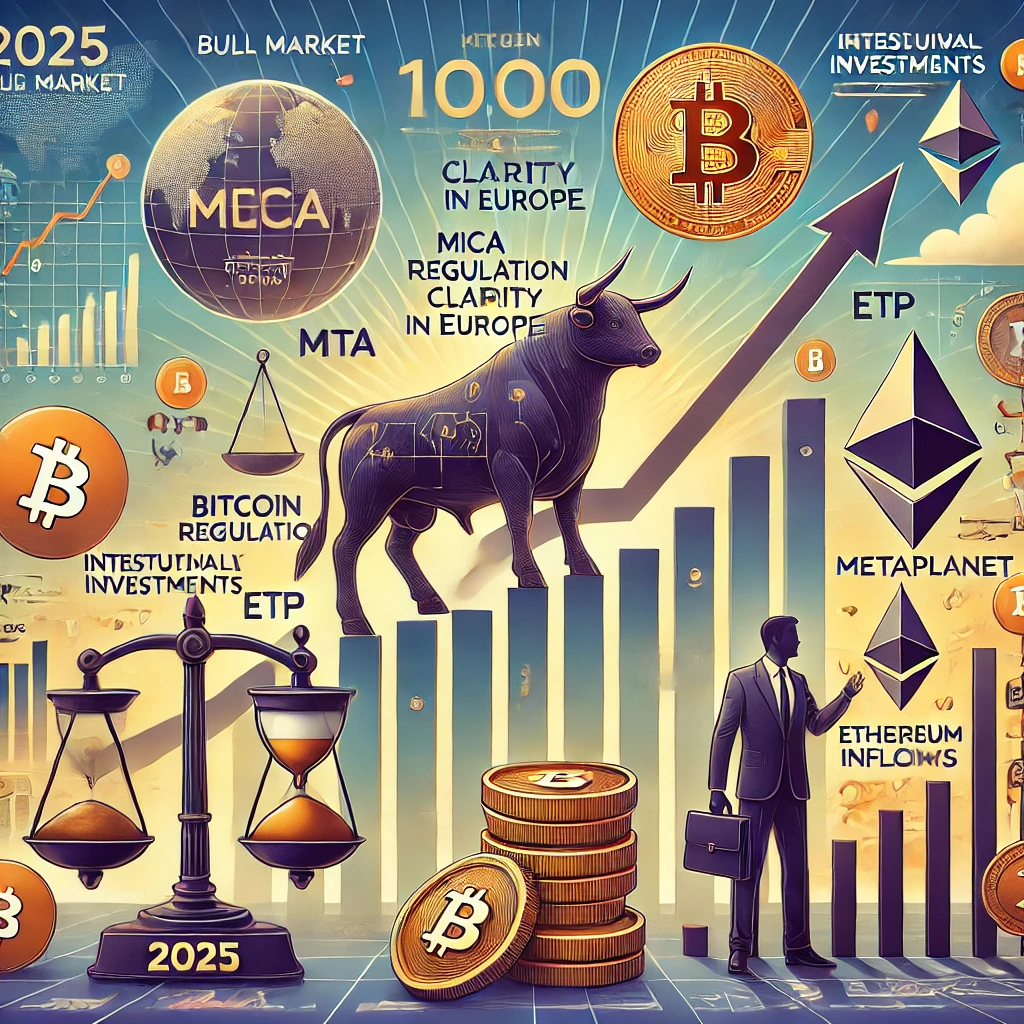
The cryptocurrency landscape in 2025 is dynamic and multifaceted, driven by predictions of Bull Market peaks, surging institutional investments, regulatory clarity through MiCA, and ambitious Bitcoin acquisition strategies by major players. From CryptoQuant’s cautious warnings to Metaplanet’s bold Bitcoin goals, the interplay of optimism, caution, and regulation is shaping a complex narrative. This analysis unpacks the key stories, market implications, and investor insights for the year ahead. 1. CryptoQuant: Bull Market in Final Stage, Peaks Expected in 2025 Analysis: CryptoQuant’s analysis suggests that the cryptocurrency market is in the latter phases of its current bull cycle, which began in early 2023. This phase is characterized by significant inflows from both new investors and reinvestments by existing players, signaling that a cyclical market peak may occur by Q2 2025. A key indicator of this maturation is the percentage of Bitcoin held for less than one month, which has risen to 36%—a figure reminiscent of trends seen during previous bull market peaks. However, CryptoQuant’s caution contrasts with other analysts’ forecasts. While CryptoQuant sees the potential for a market correction shortly after the peak, firms like VanEck and Steno Research anticipate continued strength throughout 2025. VanEck, for example, predicts Bitcoin could surpass $180,000 by year-end, with Ethereum breaching $6,000. This divergence reflects the speculative nature of the crypto markets, where sentiment and macroeconomic factors can create widely varying scenarios. Impact: The CryptoQuant report serves as a reminder for investors to balance optimism with prudent risk management. While high returns remain possible in the short term, the anticipation of a peak within a specific timeframe introduces uncertainty. This outlook might lead to increased market volatility as investors weigh the risks of holding positions versus cashing out near the predicted top. 2. Crypto ETPs See $585 Million Inflows as 2025 Begins: CoinShares Report Analysis: The crypto exchange-traded products (ETPs) market has started 2025 with impressive inflows, marking a continuation of the bullish trend observed in 2024. With $585 million invested in the first three days of the year, the data suggests sustained interest in these instruments, which gained traction after the introduction of U.S. spot Bitcoin ETFs in January 2024. Bitcoin-focused ETPs dominate the inflows, reflecting investor confidence in the leading cryptocurrency. In 2024 alone, Bitcoin ETPs attracted $38 billion, cementing their position as a preferred vehicle for institutional and retail investors. Ether-based ETPs also gained attention, adding $4.8 billion in 2024. Regional disparities, however, highlight differing investor sentiments, with the U.S. leading inflows while Canada and parts of Europe saw notable outflows. Impact: These figures underscore the growing mainstream adoption of crypto assets, particularly through structured products like ETPs. The inflows at the start of 2025 suggest that institutions and individuals view these products as both a hedge and an opportunity for substantial returns. For Bitcoin, increased AUM (assets under management) solidifies its role as the flagship digital asset, potentially boosting its price in the months ahead. 3. MiCA: Regulatory Clarity for European Crypto Markets Analysis: The implementation of the Markets in Crypto-Assets (MiCA) regulation marks a pivotal moment for cryptocurrency markets in Europe. By setting clear guidelines for compliance, licensing, and taxation, MiCA addresses concerns over the “Wild West” nature of the crypto industry. While critics warn of potential overregulation, proponents argue that MiCA will enhance investor confidence and attract more significant institutional participation. Key developments under MiCA include increased scrutiny on retail investors, requiring them to disclose detailed financial and personal data. This regulatory demand, while cumbersome, could pave the way for future crypto taxation and streamlined compliance frameworks. Institutions like Société Générale and MoonPay have already aligned with MiCA, signaling a shift towards legitimacy in the sector. Impact: MiCA’s comprehensive approach has the potential to position Europe as a leader in crypto innovation. However, the immediate impact may be mixed. While institutional investors are likely to embrace the regulatory clarity, retail participation could temporarily decline due to heightened compliance requirements. Over time, MiCA could set a precedent for other regions seeking to balance innovation with investor protection. 4. Bitcoin Price Rally Faces Uncertainty Ahead of Trump Inauguration Analysis: Bitcoin’s price surge in early 2025, fueled by optimism surrounding Donald Trump’s return to the White House, faces potential obstacles. Positive inflation data expected mid-January may provide a short-term boost, but caution prevails as the Federal Reserve’s Federal Open Market Committee (FOMC) meeting approaches on January 29. The meeting is likely to influence interest rate decisions, which have historically impacted Bitcoin’s price volatility. Market analysts have mixed views on Bitcoin’s trajectory. While Markus Thielen of 10x Research predicts Bitcoin could stabilize in the $97,000–$98,000 range by January’s end, others like John Glover anticipate a more volatile pattern. The role of institutional inflows via Bitcoin ETFs and stablecoins will be critical in determining the market’s direction. Impact: The interplay between macroeconomic indicators and political developments creates a complex environment for Bitcoin investors. While the inaugural optimism may spur temporary gains, the looming FOMC meeting could introduce downward pressure, emphasizing the importance of staying attuned to policy shifts and market dynamics. 5. Metaplanet’s Ambitious Plan to Hold 10,000 BTC by 2025 Analysis: Japanese venture capital firm Metaplanet has set an ambitious target to expand its Bitcoin holdings from 1,762 BTC to 10,000 BTC by the end of 2025. This aggressive accumulation plan is fueled by predictions of Bitcoin reaching $200,000 in the current bull cycle. Metaplanet intends to use a mix of loans, equity, and convertible bonds to finance the purchases, reflecting its bullish outlook on Bitcoin’s long-term potential. The firm’s strategy aligns with the growing trend of institutional adoption. Metaplanet’s stock performance, which has risen by 950% since it began acquiring Bitcoin in April 2024, demonstrates strong investor confidence. Additionally, the company projects an operating profit for the first time since 2017, driven partly by its crypto investments. Impact: Metaplanet’s move could inspire other institutional players to increase their exposure to Bitcoin, further driving demand and price appreciation. By positioning itself as a leader in crypto investment, the firm underscores the growing institutional