
4 Important Crypto News: Ripple’s $1.25B Move, Bitcoin’s Slide, BlackRock’s EU ETF, and Hive’s Paraguay Expansion — BotSlash Daily Crypto News Analysis
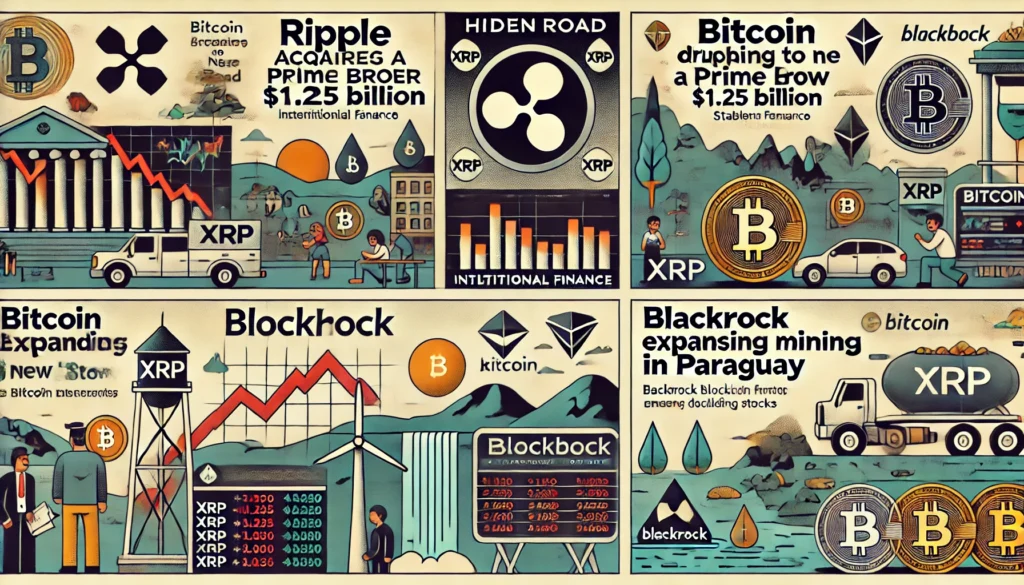
The past 24 hours brought impactful developments across key sectors of the crypto world, signaling a deepening institutional presence and reactive market shifts. Ripple is making a power move with a $1.25 billion acquisition aimed at expanding its DeFi influence. Meanwhile, the broader crypto market reacted negatively to macroeconomic fears, pulling Bitcoin to new lows and dragging crypto stocks down. In contrast, BlackRock is charging ahead, debuting its first Bitcoin product in Europe — a milestone for the region’s digital asset exposure. And Hive Blockchain is going green, announcing new mining operations in Paraguay, tapping into sustainable energy. Ripple’s $1.25 Billion Acquisition of Prime Broker Hidden Road Ripple Labs, the company behind the cryptocurrency XRP, has announced plans to acquire multi-asset prime brokerage firm Hidden Road for $1.25 billion. This strategic move aims to bolster Ripple’s position in institutional decentralized finance (DeFi) by integrating Hidden Road’s extensive client base and clearing capabilities. Hidden Road processes approximately $3 trillion annually across various financial markets and serves over 300 institutional clients. The acquisition is expected to enhance the utility of Ripple’s U.S. dollar-pegged stablecoin, RLUSD, which Hidden Road utilizes as collateral in its brokerage products. This positions Ripple to compete more effectively with established stablecoin providers like Tether and USD Coin. The deal is anticipated to close in the coming months, pending regulatory approvals. Market Impact: This acquisition signifies a substantial expansion of Ripple’s institutional services, potentially increasing XRP’s adoption among institutional investors. The move may also influence the competitive landscape of stablecoins, challenging existing market leaders. U.S. Crypto Stocks Decline as Bitcoin Hits New 2025 Low On April 7, 2025, U.S.-listed crypto company stocks experienced significant declines, mirroring a sharp drop in bitcoin prices. Bitcoin fell by as much as 5.5%, reaching its lowest point in 2025. Shares of major crypto-related firms also suffered, with MicroStrategy falling over 7%, Coinbase dropping 6%, and Robinhood sliding 4%. The downturn is attributed to escalating global trade tensions following new tariffs announced by President Donald Trump, which have dampened investor confidence and risk appetite. Additionally, billionaire investor Bill Ackman warned of a potential “economic nuclear winter,” further fueling market concerns. Market Impact: The recent market volatility underscores the sensitivity of crypto assets to broader economic and geopolitical developments. Investors may need to reassess the role of cryptocurrencies as safe-haven assets during times of economic instability. BlackRock Launches First Bitcoin Product in Europe BlackRock, the world’s largest asset manager, has introduced its first bitcoin exchange-traded product (ETP) in Europe, named the ‘iShares Bitcoin ETP.’ Domiciled in Switzerland, the product is listed in Paris, Amsterdam, and Frankfurt. This launch follows BlackRock’s success in the United States, where it attracted over $50 billion into similar cryptocurrency products after the Securities and Exchange Commission approved such offerings in January 2024. BlackRock has partnered with Coinbase as the custodian and Bank of New York Mellon as the administrator for this new product. Reuters Market Impact: BlackRock’s expansion into the European crypto market reflects growing institutional interest and could pave the way for increased adoption of bitcoin ETPs across the continent. Hive’s Expansion of Bitcoin Mining Operations in Paraguay Hive Blockchain Technologies, under the leadership of Executive Chairman Frank Holmes, is expanding its bitcoin mining operations into Paraguay. The move aims to leverage Paraguay’s abundant hydroelectric power to support sustainable and cost-effective mining activities. This expansion aligns with Hive’s strategy to diversify its operations geographically and enhance its mining capacity while adhering to environmentally friendly practices. Market Impact: Hive’s expansion into Paraguay could set a precedent for other mining companies seeking sustainable energy sources, potentially influencing global mining operations’ geographical distribution and environmental strategies. Key Takeaways: Ripple’s acquisition of Hidden Road for $1.25 billion aims to enhance its institutional DeFi services and stablecoin utility. U.S. crypto stocks have declined amid bitcoin’s drop to a new 2025 low, influenced by escalating trade tensions and economic concerns. BlackRock has launched its first bitcoin ETP in Europe, reflecting growing institutional interest in cryptocurrency products. Hive Blockchain is expanding its bitcoin mining operations into Paraguay, leveraging sustainable hydroelectric power.
5 Crypto latest news analysis : Institutional Surge, Regulatory Challenges, and Emerging Trends
The crypto market is undergoing a transformative phase as institutional adoption accelerates, regulatory scrutiny intensifies, and emerging sectors like AI crypto face critical tests. Recent developments, including the approval of spot Bitcoin ETFs, IRS reporting rules for crypto, Tether’s reserve controversies, and the decline in AI token valuations, highlight the dynamic nature of the crypto landscape. These stories reveal a market balancing between innovation, adoption, and regulation, with significant implications for investors and developers alike. 1. Bitcoin Institutional Adoption Surges Amid Spot ETF Filings News Summary: The approval of spot Bitcoin exchange-traded funds (ETFs) by the U.S. Securities and Exchange Commission (SEC) marks a landmark moment in Bitcoin’s integration into mainstream finance. Since January 2024, Bitcoin ETFs have witnessed $18.5 billion in net inflows, reflecting strong institutional investor interest. Hedge funds like Millennium Management and Tudor Investment have significantly increased their holdings in Bitcoin ETFs, bolstering confidence in digital assets. This surge in institutional activity has contributed to Bitcoin’s price exceeding $100,000 in December 2024. Market Analysis: The introduction of Bitcoin ETFs has simplified access to the cryptocurrency market for traditional investors, reducing barriers to entry and offering a regulated investment avenue. This development has not only fueled Bitcoin’s price rally but also legitimized it as a viable asset class within the financial ecosystem. The increased inflows from hedge funds indicate rising confidence in Bitcoin’s potential as both a store of value and a speculative asset. Furthermore, the institutional adoption provides a buffer against market volatility by anchoring prices through large-scale investments. Market Impact: Bitcoin’s price rally to $100,000 can be directly attributed to ETF-related demand and its ripple effect on investor sentiment. This milestone could set the stage for broader adoption across institutional portfolios, potentially boosting other cryptocurrencies indirectly linked to Bitcoin’s performance. Traditional finance adapting to crypto integration reflects a long-term shift towards legitimizing digital currencies globally. 2. IRS Cryptocurrency Reporting Rules Face DeFi Backlash News Summary: The IRS has introduced new regulations requiring cryptocurrency brokers to report user transactions for enhanced tax compliance. This broad definition of “brokers” could encompass decentralized exchanges and wallet providers, raising practical concerns. The decentralized finance (DeFi) community has responded with lawsuits, arguing these requirements are overly burdensome and could stifle innovation. Market Analysis: The IRS regulations aim to close tax loopholes and bring greater oversight to the rapidly evolving cryptocurrency space. However, imposing traditional compliance frameworks on decentralized systems could create friction. DeFi platforms, characterized by pseudonymity and lack of centralized control, may find it challenging to meet these standards without compromising their fundamental principles. Legal challenges could delay enforcement, leaving market participants uncertain about future operational requirements. Market Impact: Uncertainty surrounding these regulations could deter investment in the DeFi space, causing developers and projects to relocate to jurisdictions with friendlier policies. While the lawsuit’s outcome remains pivotal, prolonged legal battles could stymie innovation and impact DeFi token valuations negatively in the short term. Regulatory clarity, on the other hand, could pave the way for broader adoption by reducing perceived risks. 3. Crypto Stocks Decline Amid Market Volatility News Summary: Crypto-exposed stocks like Cipher Mining, Marathon Digital, and CleanSpark experienced significant declines, even as broader financial markets, including the S&P 500, performed positively. This coincided with Bitcoin’s price falling below the $100,000 psychological threshold, reflecting the high volatility associated with cryptocurrency valuations. Market Impact: The underperformance of crypto-related stocks relative to traditional financial indices highlights their sensitivity to Bitcoin’s price movements. Companies involved in crypto mining and infrastructure are particularly vulnerable to such volatility, given their dependence on Bitcoin’s profitability metrics. This correlation underscores the need for investors to evaluate the broader crypto market before making equity investments tied to digital assets. Market Impact: The decline in crypto stock valuations could signal a cautious investor sentiment, particularly towards high-risk assets during periods of volatility. This might affect the fundraising and expansion plans of crypto-centric companies. However, a rebound in Bitcoin prices could quickly reverse these trends, demonstrating the intertwined nature of digital currencies and related equities. 4. Tether Faces Fresh Scrutiny Over Reserve Claims News Summary: Tether (USDT), the largest stablecoin by market capitalization, is once again under scrutiny following allegations questioning the adequacy of its financial reserves. Critics claim that Tether’s reserve holdings may not fully back the USDT tokens in circulation, casting doubt on its solvency. These claims have fueled uncertainty and concern among investors, reigniting debates about the transparency and reliability of the stablecoin. Despite the criticism, Tether maintains that its tokens are fully backed by reserves, including traditional currency and liquid cash equivalents. The company has pointed to regular attestations by third-party accounting firms as evidence of its financial stability. Market Analysis: Stablecoins like USDT are the backbone of the cryptocurrency ecosystem, providing liquidity and stability amid the market’s inherent volatility. Tether’s position as the dominant stablecoin makes its reserve adequacy a systemic issue. Allegations of insufficient reserves raise concerns about the potential risks to traders, investors, and decentralized platforms that rely heavily on USDT. While Tether has repeatedly defended its practices and emphasized transparency through attestations, critics argue that attestations fall short of full audits and leave room for doubt. The persistence of these allegations underscores the need for stronger regulatory oversight and comprehensive audits to ensure stablecoin reliability. Market Impact: If Tether fails to convincingly address these concerns, it could face a loss of market confidence, which might lead to a shift towards alternative stablecoins like USDC, DAI, or BUSD. Such a transition could destabilize liquidity pools on DeFi platforms and disrupt trading volumes on centralized exchanges. On the other hand, if Tether can provide clear and comprehensive audits, it would likely solidify its market position, restoring trust and maintaining its dominance. The ongoing controversy highlights the critical importance of transparency and robust financial practices in fostering confidence in the crypto ecosystem. 5. AI Cryptocurrencies Face Decline, Hope for Altcoin Season News Summary: AI-related cryptocurrencies have seen their market capitalization drop by 28%, reflecting broader market trends, including a 14% decline in Bitcoin’s price.