
6 Important Crypto News : Stablecoin Expansion, RWAs in Mastercard, PayPal’s PYUSD Push & Bitcoin Trends – BotSlash Daily Crypto News Analysis
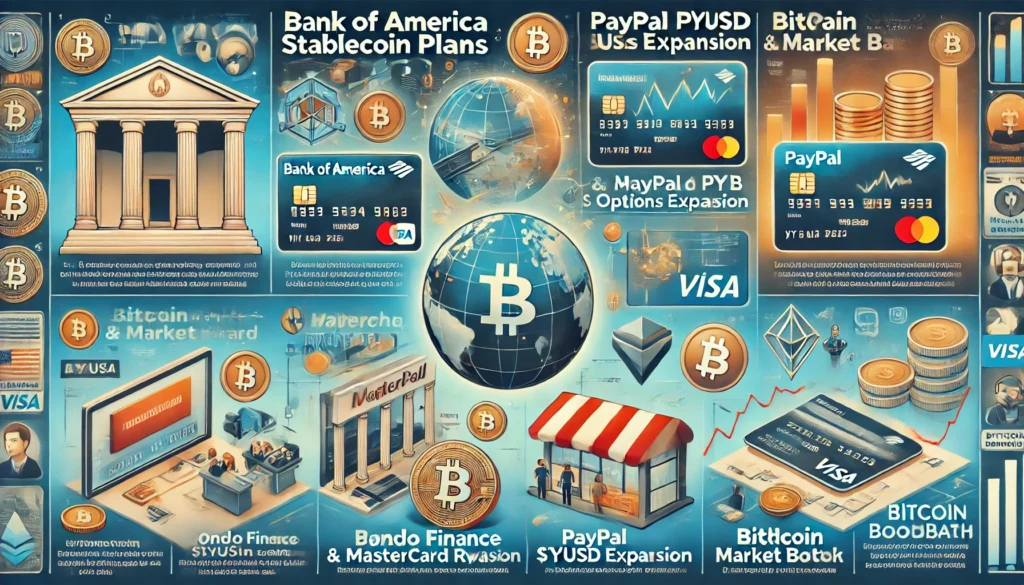
As financial giants continue integrating blockchain into their operations, Bank of America is exploring the possibility of launching a stablecoin, pending regulatory clarity. Meanwhile, Ondo Finance is set to bring real-world assets (RWAs) to the Mastercard network, reinforcing the growing institutional interest in asset tokenization. PayPal has set a bold target of onboarding 20 million merchants to accept PYUSD by 2025, a move that could redefine stablecoin adoption in mainstream commerce. In another push for mass adoption, Avalanche has introduced a Visa card, allowing AVAX holders to spend their tokens seamlessly. On the Bitcoin front, a $5 billion options expiry could impact BTC prices, while analysts suggest the recent Bitcoin “bloodbath” may have marked the market bottom. These developments reflect the increasing convergence of traditional finance and crypto, signaling major shifts in adoption and market sentiment. Bank of America CEO Hints at Stablecoin Launch, Pending Regulatory Clarity Bank of America CEO Brian Moynihan has indicated the bank’s willingness to explore stablecoin issuance, provided that regulatory clarity is achieved. This statement marks a potential shift in how major U.S. financial institutions approach blockchain-based payment solutions. Unlike JPMorgan, which launched its own digital token (JPM Coin) for internal settlements, Bank of America has been cautious about direct crypto involvement. However, with growing demand for stablecoins in global transactions, a trusted banking giant entering the space could significantly impact adoption. Regulatory uncertainty remains the primary obstacle. The U.S. government has been divided over stablecoin regulation, with proposals ranging from Federal Reserve oversight to state-level frameworks. If Bank of America proceeds with a stablecoin, it would require strict compliance with anti-money laundering (AML) and know-your-customer (KYC) regulations. This could set a precedent for other financial institutions looking to enter the space, pushing for clearer rules that balance innovation with consumer protection. A stablecoin issued by Bank of America would compete directly with PayPal’s PYUSD and Circle’s USDC, potentially giving traditional banks an edge in the rapidly expanding digital payments industry. While execution depends on regulatory approvals, this development highlights the increasing convergence of traditional banking and blockchain-based finance. If greenlit, Bank of America’s stablecoin could drive wider adoption of digital assets among mainstream financial institutions. Market Impact: Positive: If Bank of America launches a stablecoin, it could boost institutional adoption and regulatory clarity. Neutral to Negative: Delay due to regulatory hurdles could slow down stablecoin innovation in the U.S. Ondo Finance to Bring RWAs to Mastercard Network Ondo Finance has announced a strategic partnership with Mastercard to integrate real-world assets (RWAs) into its network. This move is part of a broader trend where financial institutions are embracing tokenization to improve efficiency, liquidity, and accessibility of traditional assets. RWAs, which include tokenized U.S. Treasuries, bonds, and other financial instruments, have been gaining traction as institutions seek blockchain-based alternatives to legacy financial systems. By leveraging Mastercard’s global payments infrastructure, Ondo Finance can offer institutional and retail investors access to tokenized yield-bearing assets. This is significant because Mastercard’s vast reach could provide legitimacy and scale to the RWA sector, making it easier for businesses and individuals to access these assets. The move follows similar initiatives by BlackRock and JPMorgan, both of which are experimenting with blockchain-based financial instruments. The integration of RWAs into a mainstream payments network like Mastercard could lead to increased demand for tokenized assets, providing better liquidity and lower transaction costs. However, regulatory uncertainty and compliance requirements remain challenges for full-scale implementation. If successful, this could set a precedent for other payment processors to explore blockchain-based asset management. Market Impact: Positive: Strengthens the case for tokenized RWAs, increasing institutional adoption. Neutral: Regulatory uncertainty could limit immediate large-scale deployment. PayPal Targets 20 Million Merchants for PYUSD Adoption by 2025 PayPal has outlined an ambitious goal of onboarding 20 million merchants to accept PYUSD, its stablecoin, by the end of 2025. Since launching in mid-2023, PYUSD has seen steady growth but faces competition from USDT and USDC, which dominate the stablecoin market. PayPal’s strategy hinges on leveraging its existing merchant network to make PYUSD a mainstream payment method. The company is promoting stablecoins as a superior alternative to traditional fiat transactions, offering lower fees and instant settlements. PayPal’s vast network could significantly boost stablecoin adoption if merchants and consumers embrace PYUSD as a viable payment option. However, the challenge remains in convincing businesses to integrate and actively promote crypto payments. Many merchants still perceive stablecoins as niche financial tools rather than essential components of digital commerce. If successful, this initiative could pave the way for stablecoins to be widely used in e-commerce, remittances, and business-to-business payments. However, regulatory scrutiny, particularly in the U.S., could impact adoption rates. The next two years will be crucial in determining whether PayPal’s vision for PYUSD materializes. Market Impact: Positive: Increased adoption of PYUSD could drive stablecoin transactions in mainstream commerce. Neutral to Negative: Regulatory roadblocks could slow PayPal’s expansion plans. Avalanche Visa Card Launches to Drive Crypto Mass Adoption Avalanche has introduced a Visa card to facilitate crypto payments, allowing users to spend AVAX tokens like traditional fiat currency. This move aligns with the broader push to integrate cryptocurrencies into mainstream financial systems. The Avalanche Visa card offers a seamless user experience, making it easier for individuals to transact with digital assets without needing complex wallet interactions. Visa has been expanding its crypto offerings, partnering with multiple blockchain projects to enable crypto-to-fiat transactions. By supporting Avalanche, Visa is further solidifying its role in the digital payments revolution. Unlike previous crypto debit cards, which often faced issues with usability and merchant adoption, Avalanche’s integration focuses on creating a frictionless experience for everyday transactions. However, widespread adoption of crypto payments remains an ongoing challenge. While the Avalanche Visa card could attract early adopters, its success depends on merchant acceptance and user demand. Nonetheless, this launch represents another step toward making cryptocurrencies a practical alternative to traditional banking systems. Market Impact: Positive: Enhances the usability of AVAX, potentially increasing adoption. Neutral: Merchant adoption remains uncertain, affecting overall impact. Bitcoin’s $5 Billion Options
Crypto Daily News Analysis: Bitcoin Nears $100K, XRP Surges, Binance & Coinbase Expand, and Hong Kong Strengthens Oversight

Bitcoin has surged past $99K, bringing fresh optimism to the market, while XRP rallied 40%, signaling renewed interest in altcoins. Regulatory advancements are reshaping the industry, with Coinbase securing a UK VASP license and Kraken expanding into Europe’s derivatives market. Meanwhile, Binance is pushing forward with crypto adoption, forming key partnerships and maintaining confidence despite recent market turbulence. On the innovation front, TON has launched a $100 million fund to accelerate blockchain development. At the same time, Hong Kong is reinforcing its regulatory framework, even as it faces financial challenges. With shifting global trade policies and new regulatory approvals, the market is experiencing a mix of bullish momentum and cautious optimism. Institutional players are gaining clearer pathways to enter the space, and payment adoption is expanding across Europe. These developments set the stage for greater mainstream adoption, increased market liquidity, and potential price volatility as investors react to changing economic conditions. 1. Bitcoin Surges Above $99K and XRP Rallies 40% as Trade War Tensions Ease Bitcoin crossed the $99,000 mark after easing trade war tensions between major economies, signaling renewed investor confidence. Alongside Bitcoin, XRP recorded an impressive 40% surge, leading a broader altcoin rally. This price jump comes as global economic uncertainty diminishes, allowing risk assets to thrive. The trade war between the U.S. and China had previously created market volatility, with Bitcoin acting as a safe-haven asset. However, the recent de-escalation encouraged more investments into traditional and digital assets alike. XRP’s sharp rise suggests that investor interest is shifting back toward altcoins, possibly due to improving sentiment in the crypto market. If Bitcoin manages to maintain its position above $99K, analysts suggest it could soon reach six figures. However, caution remains as external macroeconomic events still influence price movements. A stable global economy tends to reduce Bitcoin’s appeal as a hedge, but if new tensions arise, crypto could once again see volatility. XRP’s rally is promising, but its history of sharp price swings suggests a high-risk, high-reward scenario for investors. Market Impact: Bullish sentiment for Bitcoin – breaking $99K could push it past the $100K milestone. Altcoin market revival – XRP’s rally might inspire renewed interest in alternative cryptocurrencies. Global trade stability favors traditional investments, but crypto remains attractive as a long-term store of value. 2. Kraken Expands into Europe with Regulated Crypto Derivatives Kraken has announced its expansion into Europe with regulated crypto derivatives, positioning itself as a leading exchange in the region. This move is significant as it aligns with increasing demand for compliant trading products, particularly among institutional investors. Crypto derivatives—such as futures and options—allow traders to hedge risk, speculate on price movements, and increase market liquidity. However, they have been under heavy regulatory scrutiny due to concerns over market manipulation. Kraken securing regulatory approval gives it an advantage over competitors that face restrictions in certain regions. This move also highlights Europe’s growing role as a crypto-friendly regulatory environment, especially as the U.S. imposes stricter crypto rules. With more U.S. exchanges struggling with compliance, companies like Kraken are looking abroad for growth. If Kraken’s European derivatives market succeeds, it could set a precedent for other exchanges to expand under similar regulatory frameworks. Market Impact: Institutional adoption grows as Kraken brings compliance-focused products. Europe solidifies its role as a key crypto hub, attracting more exchanges and investors. Derivatives trading expands liquidity, potentially reducing market volatility. 3. US and Mexico Delay Trump Tariffs, Crypto Market Reacts Positively The U.S. and Mexico agreed to delay tariffs proposed by Donald Trump, bringing relief to both traditional and crypto markets. This news helped Bitcoin and altcoins recover, as economic stability reduces the immediate need for hedging against fiat risks. Previously, tariff uncertainties led investors to seek safe-haven assets like Bitcoin. With the delay, risk assets—including stocks and cryptocurrencies—saw renewed investor confidence. However, this does not eliminate the possibility of future trade tensions, meaning crypto could remain a key hedge. If long-term resolutions emerge, crypto might experience lower volatility as economic stability increases. However, if trade disputes resurface, Bitcoin could regain its hedge appeal. For now, the market is responding positively, but traders should watch for further geopolitical developments. Market Impact: Short-term bullish sentiment for Bitcoin and altcoins. Decreased hedge demand if economic stability continues. Future tariffs could reintroduce volatility, making crypto attractive again as a hedge. 4. Binance CEO Remains Optimistic Despite Market Crash Binance CEO Changpeng Zhao (CZ) has reassured investors that market downturns are a normal part of crypto’s evolution. He emphasized that historical patterns show recovery after major corrections and urged patience among traders. CZ’s confidence is backed by ongoing developments within Binance, including regulatory compliance and new product launches. This message appears to have calmed investor fears, especially as Binance continues to expand globally. While optimism from an industry leader like CZ helps maintain market morale, external factors like regulatory crackdowns and macroeconomic conditions still impact crypto’s long-term stability. If Binance continues innovating and securing regulatory approvals, it could mitigate some of the market’s volatility. Market Impact: Positive sentiment boost for Binance users and the broader market. Reinforces long-term investment mindset, despite short-term downturns. Regulatory actions remain a key factor in Binance’s future. 5. TON Launches $100M Fund to Boost Blockchain Development The Open Network (TON) has launched a $100 million fund to support projects built on its blockchain. This move aims to attract developers and enhance adoption within the TON ecosystem, which has been growing due to Telegram integration. The fund will likely support DeFi projects, dApps, and blockchain infrastructure, making TON a more competitive alternative to platforms like Ethereum and Solana. If executed well, this could position TON as a major player in Web3 development. However, the success of this initiative depends on developer interest and real-world adoption. If funded projects gain traction, TON’s value and network usage could increase significantly. Market Impact: TON ecosystem expansion through new projects and funding. Increased developer activity, making the blockchain more competitive. Long-term value potential depends on adoption success. 6. Coinbase Secures UK VASP License for
Arizona’s Bitcoin Bill, EU concerns over USD Stablecoin Dominance and Binance’s Legal Troubles : 6 Major Crypto Updates:

The cryptocurrency landscape continues to evolve at breakneck speed, with significant developments impacting everything from stablecoin dominance to state-level adoption of Bitcoin. Key highlights include Arizona’s bold legislative move to hold Bitcoin in its reserves, renewed scrutiny on Binance as it faces legal probes in France, and market turbulence after Bitcoin’s sharp sell-off. Corporate adoption is also heating up, with Japan’s Metaplanet planning a massive Bitcoin purchase, while innovative payment platforms like PayFi aim to bridge crypto with everyday commerce. As geopolitical, corporate, and regulatory forces collide, these stories underscore the transformative shifts underway in the digital finance ecosystem. 1. USD Stablecoin Dominance Sparks EU Concerns Amid Trump-Era Policies The lingering effects of a 2020 executive order by former U.S. President Donald Trump have renewed focus on the global dominance of USD-pegged stablecoins. The policy, originally intended to curb China’s influence in digital finance, unintentionally fortified the position of dollar-backed stablecoins like USDT and USDC. The European Union has voiced increasing concerns over the stability and potential risks posed by this dominance, fearing that it could overshadow the euro in the emerging digital financial ecosystem. The EU has ramped up regulatory efforts to counter this imbalance, promoting euro-backed stablecoins while advancing its Markets in Crypto-Assets (MiCA) framework. This framework aims to control stablecoin issuance, curbing the influence of non-EU players. However, the U.S. remains ahead in this race due to its early regulatory clarity and the global preference for dollar-denominated assets. Market Impact: The stablecoin debate underscores the intensifying geopolitical dynamics in crypto finance. The euro’s push to regain relevance may lead to an increased issuance of euro-pegged stablecoins, presenting an alternative to dollar-backed options. While this is unlikely to displace the USD in the near term, it could shift regional market behaviors in Europe. The broader implications of such competition could tighten the regulatory landscape for stablecoins, impacting liquidity and global adoption patterns. 2. PayFi’s Crypto Payment Gateway Could Revolutionize Retail PayFi, a newly launched payment platform, promises to make crypto payments a practical reality. By acting as a middle layer between blockchain systems and traditional financial rails, PayFi enables merchants to accept cryptocurrencies seamlessly while receiving fiat settlements. This dual-model shields merchants from crypto price volatility, a critical barrier that has previously slowed adoption. In addition to reducing fees and offering instant cross-border settlements, PayFi also addresses inefficiencies in existing payment systems. The gateway aims to cater to both merchants and consumers by combining the speed and cost-effectiveness of blockchain with the reliability of fiat systems. While still in its infancy, the platform’s hybrid design has the potential to serve as a blueprint for future crypto payment solutions. Market Impact: PayFi’s development is a positive indicator for the mainstream adoption of cryptocurrency as a means of payment. If successful, it could drive demand for crypto assets like Bitcoin, Ethereum, or stablecoins, as consumers and merchants adopt these currencies for day-to-day transactions. Its impact on market liquidity and user experience will be closely monitored, potentially paving the way for other similar services to emerge. 3. French Authorities Target Binance in Judicial Probe Binance, the world’s largest cryptocurrency exchange, is under scrutiny in France after investigators launched a formal judicial probe into alleged money laundering and unlicensed operations. The accusations suggest that Binance facilitated illicit financial transactions without adhering to strict anti-money laundering (AML) rules. This adds to a growing list of regulatory troubles faced by Binance globally, including lawsuits by U.S. agencies like the SEC and CFTC. Binance has responded to the allegations by emphasizing its commitment to regulatory compliance. However, the investigation places significant pressure on the exchange, particularly in Europe, where MiCA regulations are expected to tighten operational requirements for crypto platforms. This probe could potentially result in penalties, restrictions, or even suspension of Binance’s services in France. Market Impact: Heightened scrutiny of Binance could create short-term market uncertainty, particularly for BNB (Binance Coin), which is tied to the platform. If the exchange faces operational disruptions in Europe, traders and investors may shift to alternative platforms, affecting market liquidity. This case highlights the ongoing friction between rapid crypto expansion and regulatory oversight, emphasizing the need for robust compliance mechanisms. 4. BTC Market Shakeup: CME Open Interest Declines Amid Sell-Off Bitcoin markets faced turbulence earlier this week as a sharp price drop triggered an exodus of short-term holders. The sell-off led to a record decline in open interest on the Chicago Mercantile Exchange (CME), underscoring a growing sense of caution among leveraged traders. The sell-off coincided with broader macroeconomic concerns, including rising bond yields and fears of extended Federal Reserve rate hikes. While short-term holders exited their positions, long-term investors have shown resilience, potentially using the dip as an opportunity to accumulate Bitcoin. Historically, such sell-offs result in a redistribution of assets from speculative traders to long-term holders, strengthening the asset’s foundation for future growth. Market Impact: The decline in CME open interest highlights the volatile nature of Bitcoin derivatives, especially during macro-driven corrections. Reduced speculative activity could temporarily decrease market liquidity, but the entry of long-term investors might provide stability. This event also serves as a reminder that Bitcoin remains sensitive to broader economic factors, reinforcing the importance of tracking macro trends. 5. Metaplanet’s $745M Bitcoin Buy Reflects Growing Corporate Interest Japanese tech firm Metaplanet has announced plans to raise $745 million to acquire 21,000 Bitcoin, echoing the strategy of U.S.-based MicroStrategy. The company aims to finance the purchase through a combination of equity and debt, betting on Bitcoin’s long-term value as a hedge against inflation and economic uncertainty. This decision highlights the increasing institutional interest in Bitcoin, particularly in regions like Japan, which has a favorable regulatory environment. Despite market volatility, Metaplanet’s move demonstrates confidence in Bitcoin’s potential as a strategic asset. If successful, the firm could influence other corporations in Asia to adopt similar strategies. Market Impact: A purchase of this magnitude would inject significant liquidity into Bitcoin markets, potentially supporting price stabilization or even upward momentum. It also reinforces Bitcoin’s narrative