
7 Important Crypto News: FOMC-Induced Volatility, SEC’s Crypto Roundtable, North Carolina’s Bitcoin Bill & More – BotSlash Daily Crypto News Analysis

Regulatory shifts, institutional trends, and economic policies continue to shape the cryptocurrency landscape. With the Federal Reserve’s FOMC decision expected to drive price swings in Bitcoin, Ether, and Solana, traders are bracing for volatility. Meanwhile, the SEC’s first cryptocurrency roundtable signals a possible shift toward clearer regulations, and North Carolina is exploring Bitcoin as a strategic reserve asset. BlackRock’s Bitcoin ETF inflows are hitting multi-week highs, yet institutional adoption has yet to translate into significant price appreciation. Regulatory scrutiny remains high, with the SEC reviewing crypto custody rules while Nova Energy’s new gas-powered mining facility in Pennsylvania underscores ongoing debates about crypto’s environmental impact. Bitcoin, Ether, Solana Likely to See 3%-5% Price Swings on FOMC Rate Decision, Volmex’s Data Suggests Volmex’s recent data highlights the likelihood of 3%-5% price swings in Bitcoin, Ether, and Solana around the upcoming Federal Open Market Committee (FOMC) interest rate decision. This expectation aligns with previous market behavior, as macroeconomic events like interest rate adjustments significantly influence asset prices, particularly in the crypto sector. Traders often anticipate rate hikes or cuts, leading to increased volatility in the days surrounding these decisions. The crypto market, being highly sensitive to liquidity shifts, tends to respond aggressively to policy changes by the U.S. Federal Reserve. The correlation between crypto assets and traditional financial markets has strengthened, particularly as institutional adoption has grown. If the Fed adopts a hawkish stance—indicating further rate hikes—Bitcoin and other cryptos may face downward pressure due to reduced risk appetite. Conversely, a dovish policy with potential rate cuts could fuel bullish momentum, as investors seek higher returns in risk-on assets. The role of Volmex’s implied volatility indices in predicting market reactions could become a critical tool for traders looking to hedge against abrupt price changes. Market Impact: Traders should prepare for heightened volatility leading up to and following the FOMC decision. Options markets and derivatives trading volumes may rise as investors position themselves for potential price swings. Additionally, leveraged positions could face liquidations if price fluctuations exceed expectations, impacting short-term market stability. SEC to Host First Cryptocurrency Roundtable on Regulatory Issues The U.S. Securities and Exchange Commission (SEC) is set to hold its first cryptocurrency roundtable, signaling a willingness to engage in open discussions with industry leaders. This initiative aims to address critical regulatory concerns, including investor protection, market transparency, and compliance frameworks. Given the rapid growth of the crypto sector, regulatory clarity has become a pressing issue, with industry participants calling for well-defined guidelines. This roundtable could set the foundation for a more structured approach to cryptocurrency regulation in the U.S. The SEC’s engagement suggests that regulatory bodies are recognizing the growing importance of digital assets in the financial system. This event will likely bring together major stakeholders, including crypto firms, legal experts, and institutional investors, to discuss compliance challenges and potential policy changes. While the SEC has historically taken a cautious stance, recent developments indicate a shift towards more constructive dialogue. However, the outcome of this meeting remains uncertain—whether it will lead to more favorable regulations or stricter compliance measures depends on the discussions and subsequent policy actions. Market Impact: Regulatory uncertainty has been a major factor affecting crypto market sentiment. If the roundtable results in positive engagement, investor confidence could improve, leading to potential market rallies. Conversely, discussions around stricter enforcement actions might trigger short-term bearish reactions, especially for projects with regulatory concerns. North Carolina Eyes Bitcoin as Strategic Reserve Asset in New Senate Bill North Carolina’s Senate is considering a bill to classify Bitcoin as a strategic reserve asset, a move that could set a precedent for state-level crypto adoption. This initiative reflects a growing trend of governments and financial institutions acknowledging Bitcoin’s potential as a hedge against inflation and economic instability. If passed, the bill would enable North Carolina to allocate a portion of its financial reserves into Bitcoin, similar to how companies like MicroStrategy and Tesla have incorporated Bitcoin into their treasury holdings. The decision to explore Bitcoin as a reserve asset is driven by concerns over fiat currency depreciation and the long-term sustainability of traditional financial systems. Given Bitcoin’s finite supply and decentralized nature, proponents argue that it offers a safeguard against excessive monetary expansion and economic downturns. However, critics warn of the asset’s volatility and regulatory uncertainties, which could pose risks for state funds. Market Impact: This move could encourage other U.S. states and government entities to consider Bitcoin adoption, potentially driving further institutional demand. If successfully implemented, it could also spark a broader policy discussion on the role of digital assets in national financial strategies. Institutional Adoption of Bitcoin Yet to Reflect in Its Price, Says BlackRock Executive Despite significant institutional adoption of Bitcoin, its price has yet to reflect the scale of this investment, according to a BlackRock executive. Large financial institutions, including asset management giants and pension funds, have increasingly integrated Bitcoin into their portfolios. However, this demand has not translated into immediate price appreciation, raising questions about market structure and supply-demand dynamics. One possible explanation is that institutions accumulate Bitcoin through over-the-counter (OTC) markets, which do not directly impact exchange prices. Additionally, Bitcoin’s liquidity and the influence of short-term traders can suppress upward price movements despite strong underlying fundamentals. Another factor could be macroeconomic uncertainty, where risk-averse institutions remain cautious in their allocations. If Bitcoin’s adoption trend continues, its price might eventually catch up, but the timeline remains uncertain. Market Impact: While institutional involvement strengthens Bitcoin’s long-term outlook, the short-term price impact remains subdued. Traders should focus on on-chain data, ETF inflows, and macroeconomic indicators to assess Bitcoin’s future trajectory. SEC Set to Examine New Regulation Regarding Cryptocurrency Custody The SEC is reconsidering existing regulations on cryptocurrency custody, potentially revising rules that were introduced under the Biden administration. The initial regulations imposed strict requirements on investment advisors holding digital assets, raising compliance costs and limiting institutional participation. The proposed changes aim to streamline these regulations, making them more practical for crypto firms while maintaining investor protection. Custody has been a significant
5 Important Crypto News : BlackRock Bitcoin ETF, Solana Futures, Bitcoin Crash, Texas & Arizona Crypto Reserves – Botslash Daily Crypto News Analysis
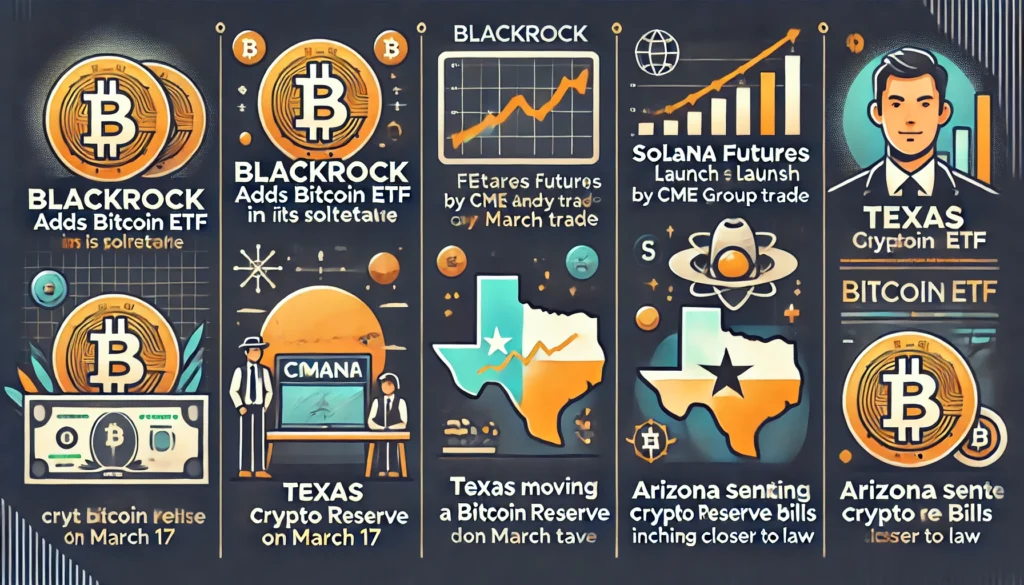
The crypto market is witnessing major institutional movements that could reshape the future of digital assets. From BlackRock’s Bitcoin ETF integration to Solana futures on CME, and states like Texas and Arizona moving forward with crypto reserves, these developments highlight a growing trend toward crypto adoption and regulation. Meanwhile, Bitcoin’s price volatility continues to stir concerns, as seen with recent market crashes and the erosion of ETF-based trades. These key moments mark important milestones that could influence market sentiment and shape future regulatory frameworks. BlackRock Adds Its iBIT Bitcoin ETF to Alternative Asset Model Portfolio BlackRock’s decision to add its iBIT Bitcoin ETF to its alternative asset model portfolio reflects a growing acceptance of Bitcoin among traditional financial institutions. The iBIT Bitcoin ETF, launched by the world’s largest asset manager, aims to provide institutional investors with a regulated pathway to Bitcoin exposure. By adding this ETF to its portfolio, BlackRock recognizes Bitcoin’s place within a diversified investment strategy, enhancing its legitimacy in the eyes of both retail and institutional investors. This move aligns with the broader trend of institutional adoption of cryptocurrency, further indicating that Bitcoin is becoming a mainstream asset class. While Bitcoin ETFs remain relatively new in the market, BlackRock’s participation lends credibility to the idea of digital assets being part of long-term investment strategies. This integration is expected to increase Bitcoin’s accessibility, particularly for institutions looking to gain exposure without directly purchasing or managing the digital asset. The choice to include Bitcoin in the alternative assets model portfolio is a sign that traditional investment vehicles are gradually expanding their scope to accommodate digital currencies. Market Impact: The addition of the iBIT Bitcoin ETF to BlackRock’s model portfolio signals a positive step forward for Bitcoin’s institutional adoption. It shows that major asset managers are acknowledging Bitcoin’s growing relevance in diversified investment strategies, which is likely to encourage other institutions to follow suit. In the longer term, this move may support Bitcoin’s price, potentially driving demand from institutional investors who seek to balance portfolios with alternative assets. This move could lead to more mainstream recognition of Bitcoin as a credible asset class. Solana Futures Launch Date: CME Group to Roll Out SOL Futures on March 17 CME Group’s announcement of launching Solana (SOL) futures trading on March 17 is an important development in the cryptocurrency market. Solana, known for its high throughput and low fees, has gained significant attention as a leading competitor to Ethereum. By introducing Solana futures, CME Group opens up an opportunity for institutional investors to hedge, trade, or speculate on Solana’s price movement in a regulated environment. Futures contracts provide a more secure means for institutions to gain exposure to Solana without directly holding the token, which is particularly valuable given the volatility in the cryptocurrency market. The introduction of Solana futures also marks a key moment for the Solana ecosystem, as it elevates the network’s profile within the broader financial market. Futures contracts often lead to greater liquidity and price discovery, helping to stabilize the market over time. Additionally, it could pave the way for other major cryptocurrencies to see futures contracts listed on regulated exchanges like CME Group, contributing to the overall maturation of the digital asset space. Market Impact: The launch of Solana futures is likely to have a positive impact on the Solana market. As a regulated financial product, it is expected to attract institutional investors who have been hesitant to invest directly in the cryptocurrency due to concerns about volatility and regulatory uncertainty. This could lead to an influx of capital into the Solana ecosystem, potentially increasing liquidity and supporting the long-term price of SOL. The futures market also increases transparency, which can help reduce price manipulation and foster a more stable trading environment for Solana. Bitcoin Crash Triggered by Erosion of ETF Cash-and-Carry Trade — Analyst This article highlights the significant role played by hedge funds using a cash-and-carry trade strategy involving Bitcoin ETFs and CME futures in the recent price crash. The trade, which had been a reliable low-risk way to generate yield by exploiting the price difference between spot and futures markets, became unprofitable when Bitcoin’s price fell. As a result, large outflows from Bitcoin ETFs followed, accelerating the crash. The major losses were particularly concentrated among recent buyers who entered the market in the past month, with over 74% of realized losses coming from those new investors. The erosion of the cash-and-carry trade underscores the risks that institutional investors face when relying on market arbitrage strategies, especially in volatile markets like cryptocurrency. The sharp drop in Bitcoin’s price serves as a reminder that even traditionally less volatile assets, such as ETFs, can experience sharp declines in extreme market conditions. While this might trigger temporary pain, analysts believe that such market shakeouts can ultimately lead to more mature and stable market behavior in the long term. Market Impact: This news has a negative impact on the Bitcoin market, as it underscores the vulnerability of ETF-based strategies to sharp market movements. The erosion of the cash-and-carry trade may cause short-term instability and loss of investor confidence, particularly among those reliant on leveraged and arbitrage strategies. However, the market might eventually stabilize as weaker hands exit, leaving behind more resilient holders. The price drop may also encourage future regulation to address these kinds of market risks, potentially leading to improved market stability over time. Texas Proceeds with Bitcoin Reserve Despite Price Fluctuations Texas is moving ahead with its Bitcoin reserve project, despite the volatile nature of Bitcoin prices. The state is focused on securing its position in the evolving world of digital assets, aiming to build a reserve that will protect the value of state funds over the long term. Bitcoin’s price volatility presents a challenge, but Texas believes the asset has long-term potential, especially as part of a diversified investment portfolio. The decision to continue with the reserve project, even amid market fluctuations, highlights the state’s commitment to using cryptocurrency for innovative financial strategies. By proceeding