
Understanding Bitcoin’s Scarcity: The Stock-to-Flow Model Explained
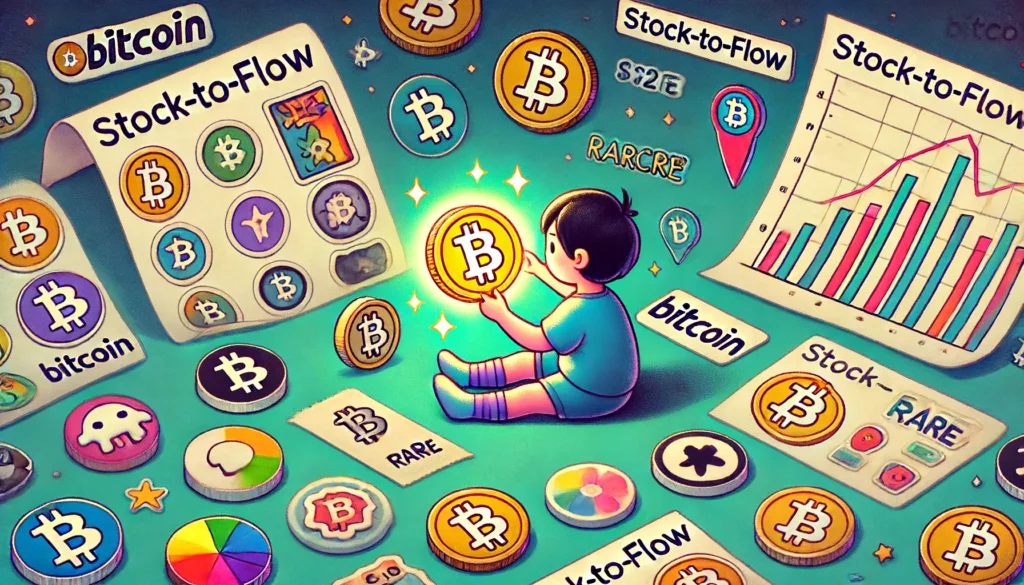
Imagine you’re a child who loves collecting rare stickers. Some stickers are common and easy to find, while others are incredibly rare and much more valuable. Now, let’s think about Bitcoin as one of those rare stickers. This is where the concept of scarcity comes into play, and a fascinating model called the “Stock-to-Flow” (S2F) helps us understand why Bitcoin might be considered so valuable. What is the Stock-to-Flow Model? The Stock-to-Flow model is a way to measure the scarcity of a particular asset. It was originally created by a financial analyst who goes by the pseudonym “PlanB“. He used this model to predict Bitcoin’s price by examining its scarcity. In simple terms, the S2F model compares the current stock (total amount available) of an asset with its flow (the amount produced each year). For example, if we think of gold, the stock is all the gold ever mined, and the flow is how much gold is mined each year. How Does S2F Apply to Bitcoin? Bitcoin is like digital gold. There will only ever be 21 million Bitcoins, which makes it scarce. To create new Bitcoins, miners solve complex puzzles, and this process gets harder over time, slowing down the production rate. This means the flow of new Bitcoins decreases over time, making Bitcoin scarcer and scarcer. The S2F model uses this concept to predict Bitcoin’s price. It suggests that as Bitcoin becomes more scarce, its price should increase. If we look at the chart below, we see Bitcoin’s price (in colourful dots) closely following the S2F model (in grey). We will discuss colours of dots in future. For now, we are trying to understand its concept. This has happened consistently over the past decade. Bitcoin vs. Gold in S2F Terms Let’s compare Bitcoin and gold using the S2F model: Gold: Gold has been around for thousands of years. There’s a large stock of gold already mined, and each year, a relatively small amount is added to this stock. This gives gold a high S2F ratio, indicating it is very scarce. Bitcoin: Bitcoin, although only around since 2009, also has a high S2F ratio. The stock of Bitcoin is increasing at a slower rate because the creation of new Bitcoins is halved approximately every four years (an event known as “halving”). In terms of S2F, Bitcoin’s ratio is expected to surpass that of gold in the future, making it even scarcer. This is one reason why many believe Bitcoin’s price will continue to rise over the long term. The Results and Future of Bitcoin’s S2F Model So far, the S2F model has been remarkably accurate in predicting Bitcoin’s price. This accuracy has made it a popular tool among Bitcoin investors. However, it’s important to remember that no model can predict the future with 100% certainty. Factors such as government regulations, technological changes, and market sentiment can all influence Bitcoin’s price. Looking ahead, the S2F model suggests that Bitcoin’s price will continue to rise as it becomes more scarce. If the past is any indication, and if Bitcoin continues to follow the S2F model, we might see significant price increases in the coming years. As per S2F the price can increase to $400K till Q3 of 2025 but again, no model can predict the future with 100% certainty. Summary In summary, the Stock-to-Flow model is a useful tool for understanding the value of scarce assets like Bitcoin. Created by PlanB, it compares the current stock of an asset with its flow to measure scarcity. Both Bitcoin and gold have high S2F ratios, but Bitcoin’s is expected to surpass gold’s, potentially driving its price higher in the future. While the S2F model has been accurate in the past, always remember that investing in Bitcoin, like any investment, comes with risks. It’s an exciting space, but it’s crucial to stay informed and cautious as the landscape evolves.
How American Interest Rates Drive the Crypto Rollercoaster

Do you ever think why the price of cryptocurrencies, like Bitcoin, seems to be on a wild rollercoaster ride, going up and down with dizzying speed? To understand this, we need to take a closer look at something that might seem unrelated at first: American interest rates. Yes, those numbers set by the Federal Reserve can have a profound impact on the risky world of crypto markets. Let’s dive into the story of how this works. Setting the Stage: Interest Rates and Risk Interest rates, simply put, are the cost of borrowing money. When the Federal Reserve, often just called the Fed, raises or lowers these rates, it sends ripples through the entire financial world. Imagine you’re standing at the edge of a calm pond and you toss a stone into it. The splash creates waves that spread out in all directions. That’s what changing interest rates do to the economy. The Link Between Interest Rates and Investments When interest rates are low, borrowing money is cheaper. This encourages businesses to take loans for expansion and individuals to take loans for big purchases, like homes or cars. It also means savings accounts and other low-risk investments offer lower returns, nudging investors to look for higher returns elsewhere. This is where riskier investments, like stocks and cryptocurrencies, come into play. In contrast, when interest rates rise, borrowing becomes more expensive. This can slow down spending and borrowing, and suddenly those safe, low-yield investments look more attractive again. Investors might pull their money out of risky markets and put it into safer places. Cryptocurrencies: The High-Risk, High-Reward Frontier Cryptocurrencies are among the riskiest investments out there. They are not tied to any physical assets, governments, or traditional financial systems, which makes them highly volatile. This means their value can skyrocket or plummet in a very short period, driven by market sentiment, news, and, importantly, interest rates. When interest rates are low, as they have been in recent years, people are more willing to take risks. The potential for high returns in the crypto market becomes very attractive compared to the meager returns on safer investments. More money flows into cryptocurrencies, driving their prices up. The Ripple Effect of Rising Rates Now, let’s consider what happens when interest rates start to climb. As the Fed raises rates to control inflation and stabilize the economy, the environment for investments changes. Suddenly, those high-risk, high-reward crypto investments look a bit too risky compared to safer options that are starting to offer better returns. Investors may start to sell off their cryptocurrencies, leading to a drop in prices. This sell-off can create panic, causing even more people to sell and further driving down prices. It’s a cascading effect that can lead to significant declines in the crypto market. Real-World Examples We’ve seen this happen in recent years. For example, during periods when the Fed hinted at or actually increased interest rates, the crypto market experienced sharp declines. Investors moved their money into safer, more stable assets as the relative attractiveness of risky investments waned. On the flip side, when the Fed cut rates to near zero during the COVID-19 pandemic to stimulate the economy, we saw a surge in crypto investments. People were looking for better returns than what they could get from traditional savings accounts or bonds, which were offering very low yields due to the low interest rates. Conclusion: The Dance of Risk and Reward In essence, the relationship between American interest rates and the crypto market is a dance of risk and reward. When interest rates are low, the music favors high-risk, high-reward investments, and cryptocurrencies often take center stage. When rates rise, the music changes, and investors may shift their focus to safer, more predictable returns. Understanding this dynamic helps us make sense of the seemingly chaotic movements in the crypto market. It’s a reminder that in the world of finance, everything is interconnected. The next time you see headlines about interest rate changes, remember that these shifts can have a ripple effect far beyond traditional investments, influencing even the most modern and volatile markets like cryptocurrency. So, whether you’re a seasoned investor or just curious about the financial world, keeping an eye on interest rates is always a good idea.
The Rise of Altcoins: A Journey from Bitcoin to Stark

In the bustling marketplace of a vibrant city, imagine Bitcoin as the pioneer merchant who set up the very first stall. When Bitcoin unfurled its banner in 2009, it wasn’t just selling a new product; it was introducing an entirely new concept to the masses. This concept was decentralized digital currency, a revolutionary idea where money was not controlled by any government or central authority but rather by the people themselves, using cryptographic principles and blockchain technology. The Basics of Bitcoin Bitcoin’s humble beginnings were akin to the opening of a mysterious new shop in a quiet corner, piquing the curiosity of a few early adopters who believed in its potential. They saw beyond the skepticism of the mainstream financial world and understood the allure of a system where transactions could be made securely, transparently, and without the need for intermediaries. These early believers, or “miners,” used their computers to solve complex mathematical problems, thereby validating transactions and securing the network, all while earning Bitcoin as a reward. As Bitcoin’s stall grew more popular, it attracted attention from a wide array of people, from tech enthusiasts and libertarians to investors and speculators. The success of Bitcoin was undeniable, but like any marketplace, it sparked competition and innovation. Enter the era of altcoins—alternative cryptocurrencies that sought to improve upon or differentiate themselves from Bitcoin’s model. The Birth of Altcoins The first of these was Namecoin, introduced in 2011. Namecoin was like a specialty shop that sprang up next to Bitcoin’s general store. It aimed to decentralize the internet’s domain name system (DNS), which would make internet censorship more difficult. Though it never reached mainstream popularity, Namecoin’s launch was significant—it showed that the blockchain technology Bitcoin was built on could be adapted for other uses. Following Namecoin, the marketplace began to teem with a variety of stalls, each offering unique twists on Bitcoin’s blueprint. Litecoin emerged in 2011, branded as the “silver to Bitcoin’s gold.” Litecoin’s promise was faster transaction times and a more abundant supply, catering to those who found Bitcoin’s processing times and scarcity limiting. Then came Ripple (XRP) in 2012, setting up shop with a focus on enabling instant, low-cost international payments. Ripple’s approach was more cooperative with traditional financial institutions, envisioning a world where cryptocurrencies and conventional banking systems could work hand-in-hand. The Evolution and Diversification of Altcoins As the years went by, new altcoins continued to appear, each one adding its own flavor to the marketplace. Ethereum, launched in 2015 by the young prodigy Vitalik Buterin, was not just another digital currency. Ethereum’s innovation was its ability to execute smart contracts—self-executing contracts with the terms of the agreement directly written into code. This opened up a world of possibilities for decentralized applications (dApps), attracting developers and entrepreneurs who saw the potential for blockchain technology beyond simple transactions. With the foundation laid by Ethereum, the marketplace exploded with creativity and innovation. Coins like Dash, which emphasized privacy and speedy transactions, and Monero, which focused on untraceable transactions, found their niche audiences. The ecosystem became a bustling bazaar, each altcoin stall drawing in different kinds of customers with its unique value proposition. Modern-Day Altcoins and Their Uses In recent years, altcoins have continued to evolve and diversify. Some have become platforms for decentralized finance (DeFi), such as Aave, which allows users to lend, borrow, and earn interest on their crypto assets without traditional banks. Others, like Polkadot and Cardano, aim to solve issues of scalability and interoperability between different blockchain networks, ensuring that the various stalls in this crowded marketplace can communicate and interact smoothly. One of the latest entries in this dynamic marketplace is Stark, a layer 2 solution for Ethereum. Stark aims to provide more speed and lower fees, enhancing the capabilities of Ethereum’s network. Stark represents the continuing innovation within the cryptocurrency world, highlighting how Bitcoin’s original vision has inspired a multitude of paths and purposes, proving that the marketplace is far from reaching its potential. Conclusion In layman’s terms, the rise of altcoins can be likened to the expansion of a bustling market. Bitcoin’s original stall set the stage for a diverse array of new shops, each bringing something unique to the table. These altcoins cater to different needs and desires, from faster transactions and enhanced privacy to the ability to create complex financial contracts without middlemen. Just as a vibrant market thrives on diversity and innovation, the world of cryptocurrencies is continuously enriched by the introduction of new ideas and technologies. This ever-expanding marketplace invites us all to explore, invest, and participate in the exciting evolution of digital finance. Whether you’re an early adopter, a casual observer, or a savvy investor, the story of altcoins is a testament to the transformative power of innovation, driven by the visionaries who dared to dream beyond Bitcoin’s horizon.
Origin of Bitcoin

Bitcoin: Understanding the Digital Gold In the modern era, where everything from your morning coffee to your evening commute is influenced by technology, Bitcoin represents a revolutionary step in how we think about money. Imagine a world where you could send money across the globe without waiting for bank approvals, paying hefty fees, or worrying about exchange rates. That’s the world Bitcoin has begun to create—a financial system built not by banks or governments, but by people. What is Bitcoin? Bitcoin is like digital gold. Just as you can mine gold from the earth, Bitcoin is “mined” through computers. This mining involves solving complex mathematical puzzles, which requires significant computer power. When these puzzles are solved, the miner is rewarded with Bitcoin, much like a gold miner being rewarded with a nugget. Imagine you have a magic notebook. Whatever you write in it, the entries cannot be erased or altered. Bitcoin uses a similar concept where all transactions are recorded in a digital ledger called the blockchain. This ledger is maintained by a network of computers across the world, making Bitcoin a truly decentralized system. No single entity, like a bank or government, controls the Bitcoin network. The Origin of Bitcoin Bitcoin was created in 2009 by an unknown person (or group of people) using the pseudonym Satoshi Nakamoto. The idea was to create a currency independent of any central authority, transferable electronically, more or less instantly, with very low transaction fees. The timing was perfect, as it followed the 2008 financial crisis, highlighting the need for a financial system without the control of banks and governments. Bitcoin vs. Traditional Money To understand Bitcoin better, consider the game of Monopoly. In Monopoly, the bank controls the money, giving it out as it sees fit and taking it back as penalties and taxes. Now, imagine if Monopoly were played where all players could monitor the bank’s actions, and no single player could secretly spend or distribute money. This is similar to how Bitcoin operates—transparently and democratically. The Decentralization of Gold Historically, gold has been seen as a decentralized form of money. It is not issued by any government or central bank. Its value comes from its scarcity and the universal demand for it. Before modern currencies, gold was used worldwide for trade and was a direct means of payment. Bitcoin is often referred to as ‘digital gold’ because, like gold, it is also decentralized and not controlled by a single entity. The main difference is that Bitcoin’s existence and transactions are digital and secured by cryptography. Why Bitcoin? Bitcoin offers several advantages over traditional currencies. For instance, you can send Bitcoin to anyone in the world without going through a bank. It’s like emailing a postcard: direct from you to the recipient without needing the post office. Moreover, Bitcoin is borderless and functions the same way in every country. Real-World Applications Consider a scenario where you want to send money to a relative in another country. Typically, this would involve banks, exchange rates, and fees, and it might take days. With Bitcoin, you could send the equivalent amount directly from your digital wallet to theirs, potentially within minutes, with minimal fees, regardless of where both of you are in the world. In summary, Bitcoin is not just a new kind of money; it’s a new way to think about what money is and what it can do. It strips away the control from centralized institutions and gives it back to the people. This digital gold is creating a new era of finance, echoing the natural and inherent values that gold has represented for millennia. As we move forward, Bitcoin, like gold, may become a cornerstone of secure, decentralized, and democratic economies.