
6 Important Crypto News : Stablecoin Expansion, RWAs in Mastercard, PayPal’s PYUSD Push & Bitcoin Trends – BotSlash Daily Crypto News Analysis
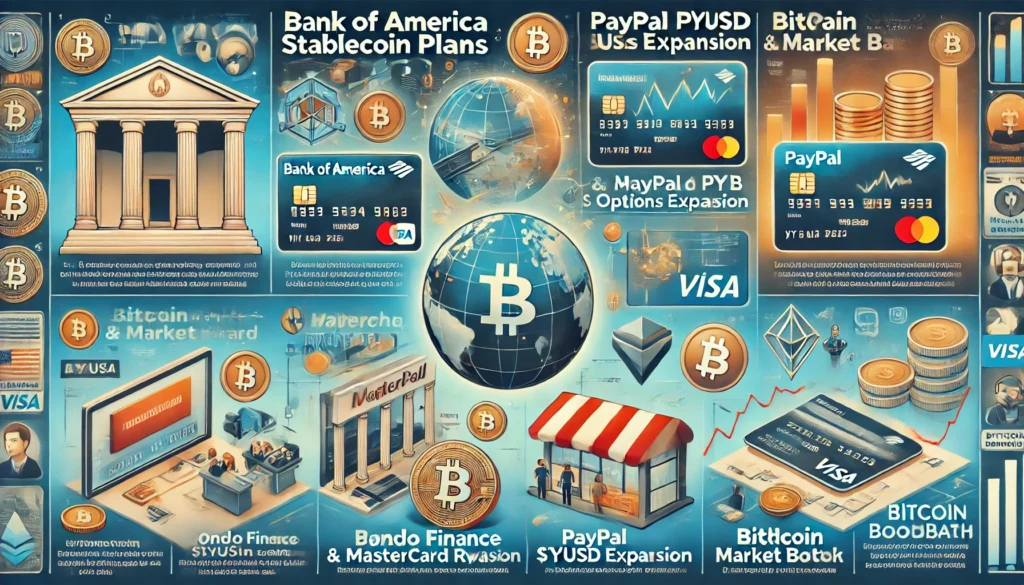
As financial giants continue integrating blockchain into their operations, Bank of America is exploring the possibility of launching a stablecoin, pending regulatory clarity. Meanwhile, Ondo Finance is set to bring real-world assets (RWAs) to the Mastercard network, reinforcing the growing institutional interest in asset tokenization. PayPal has set a bold target of onboarding 20 million merchants to accept PYUSD by 2025, a move that could redefine stablecoin adoption in mainstream commerce. In another push for mass adoption, Avalanche has introduced a Visa card, allowing AVAX holders to spend their tokens seamlessly. On the Bitcoin front, a $5 billion options expiry could impact BTC prices, while analysts suggest the recent Bitcoin “bloodbath” may have marked the market bottom. These developments reflect the increasing convergence of traditional finance and crypto, signaling major shifts in adoption and market sentiment. Bank of America CEO Hints at Stablecoin Launch, Pending Regulatory Clarity Bank of America CEO Brian Moynihan has indicated the bank’s willingness to explore stablecoin issuance, provided that regulatory clarity is achieved. This statement marks a potential shift in how major U.S. financial institutions approach blockchain-based payment solutions. Unlike JPMorgan, which launched its own digital token (JPM Coin) for internal settlements, Bank of America has been cautious about direct crypto involvement. However, with growing demand for stablecoins in global transactions, a trusted banking giant entering the space could significantly impact adoption. Regulatory uncertainty remains the primary obstacle. The U.S. government has been divided over stablecoin regulation, with proposals ranging from Federal Reserve oversight to state-level frameworks. If Bank of America proceeds with a stablecoin, it would require strict compliance with anti-money laundering (AML) and know-your-customer (KYC) regulations. This could set a precedent for other financial institutions looking to enter the space, pushing for clearer rules that balance innovation with consumer protection. A stablecoin issued by Bank of America would compete directly with PayPal’s PYUSD and Circle’s USDC, potentially giving traditional banks an edge in the rapidly expanding digital payments industry. While execution depends on regulatory approvals, this development highlights the increasing convergence of traditional banking and blockchain-based finance. If greenlit, Bank of America’s stablecoin could drive wider adoption of digital assets among mainstream financial institutions. Market Impact: Positive: If Bank of America launches a stablecoin, it could boost institutional adoption and regulatory clarity. Neutral to Negative: Delay due to regulatory hurdles could slow down stablecoin innovation in the U.S. Ondo Finance to Bring RWAs to Mastercard Network Ondo Finance has announced a strategic partnership with Mastercard to integrate real-world assets (RWAs) into its network. This move is part of a broader trend where financial institutions are embracing tokenization to improve efficiency, liquidity, and accessibility of traditional assets. RWAs, which include tokenized U.S. Treasuries, bonds, and other financial instruments, have been gaining traction as institutions seek blockchain-based alternatives to legacy financial systems. By leveraging Mastercard’s global payments infrastructure, Ondo Finance can offer institutional and retail investors access to tokenized yield-bearing assets. This is significant because Mastercard’s vast reach could provide legitimacy and scale to the RWA sector, making it easier for businesses and individuals to access these assets. The move follows similar initiatives by BlackRock and JPMorgan, both of which are experimenting with blockchain-based financial instruments. The integration of RWAs into a mainstream payments network like Mastercard could lead to increased demand for tokenized assets, providing better liquidity and lower transaction costs. However, regulatory uncertainty and compliance requirements remain challenges for full-scale implementation. If successful, this could set a precedent for other payment processors to explore blockchain-based asset management. Market Impact: Positive: Strengthens the case for tokenized RWAs, increasing institutional adoption. Neutral: Regulatory uncertainty could limit immediate large-scale deployment. PayPal Targets 20 Million Merchants for PYUSD Adoption by 2025 PayPal has outlined an ambitious goal of onboarding 20 million merchants to accept PYUSD, its stablecoin, by the end of 2025. Since launching in mid-2023, PYUSD has seen steady growth but faces competition from USDT and USDC, which dominate the stablecoin market. PayPal’s strategy hinges on leveraging its existing merchant network to make PYUSD a mainstream payment method. The company is promoting stablecoins as a superior alternative to traditional fiat transactions, offering lower fees and instant settlements. PayPal’s vast network could significantly boost stablecoin adoption if merchants and consumers embrace PYUSD as a viable payment option. However, the challenge remains in convincing businesses to integrate and actively promote crypto payments. Many merchants still perceive stablecoins as niche financial tools rather than essential components of digital commerce. If successful, this initiative could pave the way for stablecoins to be widely used in e-commerce, remittances, and business-to-business payments. However, regulatory scrutiny, particularly in the U.S., could impact adoption rates. The next two years will be crucial in determining whether PayPal’s vision for PYUSD materializes. Market Impact: Positive: Increased adoption of PYUSD could drive stablecoin transactions in mainstream commerce. Neutral to Negative: Regulatory roadblocks could slow PayPal’s expansion plans. Avalanche Visa Card Launches to Drive Crypto Mass Adoption Avalanche has introduced a Visa card to facilitate crypto payments, allowing users to spend AVAX tokens like traditional fiat currency. This move aligns with the broader push to integrate cryptocurrencies into mainstream financial systems. The Avalanche Visa card offers a seamless user experience, making it easier for individuals to transact with digital assets without needing complex wallet interactions. Visa has been expanding its crypto offerings, partnering with multiple blockchain projects to enable crypto-to-fiat transactions. By supporting Avalanche, Visa is further solidifying its role in the digital payments revolution. Unlike previous crypto debit cards, which often faced issues with usability and merchant adoption, Avalanche’s integration focuses on creating a frictionless experience for everyday transactions. However, widespread adoption of crypto payments remains an ongoing challenge. While the Avalanche Visa card could attract early adopters, its success depends on merchant acceptance and user demand. Nonetheless, this launch represents another step toward making cryptocurrencies a practical alternative to traditional banking systems. Market Impact: Positive: Enhances the usability of AVAX, potentially increasing adoption. Neutral: Merchant adoption remains uncertain, affecting overall impact. Bitcoin’s $5 Billion Options
6 Crypto news Unleashed: Explosive Growth, Bold Innovations, and Resilient Markets
The cryptocurrency industry in 2024 has been a hotbed of innovation, resilience, and dynamic shifts, showcasing its ability to adapt and thrive amidst challenges. From groundbreaking developments in decentralized finance (DeFi) platforms to record-breaking derivatives activity and regulatory interventions, the crypto landscape continues to evolve at an unprecedented pace. Institutional interest has surged to new heights, while layer-2 solutions and blockchain innovations have brought scalability and efficiency to the forefront. Meanwhile, global regulatory shifts remind us of the delicate balance between innovation and compliance. This analysis delves into six pivotal developments that have shaped the crypto markets in 2024. Each event offers unique insights into how technological advancements, market sentiment, and geopolitical forces are redefining the financial ecosystem. Together, these stories paint a comprehensive picture of the trends driving the cryptocurrency sector forward and the challenges it faces as it matures into a global economic force. Let’s explore each of these key developments and their far-reaching implications. 1. PancakeSwap’s Explosive Trading Volume Growth in 2024 PancakeSwap, a leading decentralized exchange (DEX) on the Binance Smart Chain (BSC), reported a staggering 179% year-over-year increase in trading volumes in 2024, reaching $310 billion, compared to $111 billion in 2023. This growth is largely attributed to its strategic adoption of layer-2 scaling solutions like Arbitrum and Base, which have significantly enhanced its transaction efficiency. Arbitrum alone saw a 3,656% year-over-year growth in trading volumes, while Base experienced a 3,539% increase. These platforms enabled PancakeSwap to offer users faster and cheaper transactions, boosting its competitiveness in the DeFi sector. Moreover, PancakeSwap introduced innovative features such as PancakeSwapX, which allows for zero-fee trading and gasless swaps on Ethereum and Arbitrum. Such user-focused advancements have made decentralized finance (DeFi) more accessible, driving user engagement and expanding its customer base. The DEX has also made considerable inroads into Ethereum, achieving a 251% trading volume increase, further cementing its position as a versatile and multi-chain DeFi hub. Market Impact: The exponential growth of exemplifies the increasing appeal and adoption of DeFi platforms as viable alternatives to centralized exchanges. By lowering transaction fees and improving accessibility, PancakeSwap has managed to attract both retail traders and institutional players. This growing user base and liquidity influx are likely to have long-term implications for the broader DeFi ecosystem, potentially leading to price appreciation for native tokens associated with PancakeSwap and other DeFi protocols. Additionally, PancakeSwap’s success places pressure on centralized exchanges to innovate or risk losing market share, signaling a shift toward decentralization in global financial systems. Bitcoin Options Expiry Coming: Will Crypto Market Move This Christmas? As Christmas approaches, the cryptocurrency market is bracing for a record-breaking event with the expiration of $14 billion worth of Bitcoin (BTC) options contracts on December 27, 2024. Representing 44% of the total open interest on Deribit, this massive expiry signals a crucial moment for Bitcoin traders. The “max pain” price—a metric indicating the level at which the most options contracts expire worthless—has been identified at $84,000. This suggests potential downward pressure on Bitcoin’s price, which is currently trading at approximately $98,000. This event coincides with a period of heightened market activity as investors anticipate Bitcoin’s halving in April 2024. While the expiry could lead to temporary price declines, it also presents an opportunity for long-term investors to capitalize on potential dips. Increased trading volumes and significant options activity indicate the growing maturity of the crypto derivatives market, further solidifying Bitcoin’s role as a key financial instrument for both speculative and hedging strategies. Market Impact: The substantial volume of options expiring is likely to introduce considerable volatility into the market. A price drop toward the $84,000 “max pain” level could trigger losses for options holders, particularly for those with bullish positions. However, market resilience may come into play as investors seize the opportunity to “buy the dip,” driving prices back up and stabilizing the market. This dynamic underscores the evolving sophistication of the cryptocurrency ecosystem, where derivatives play a critical role in shaping price movements. 3. Russia’s Ban on Crypto Mining in 10 Regions Russia has implemented a six-year ban on cryptocurrency mining in 10 regions, citing energy shortages and infrastructure challenges. These regions, which include energy-rich Siberian areas and territories annexed from Ukraine, were once attractive hubs for miners due to low electricity costs. However, the increasing strain on the power grid, particularly during harsh winters, has compelled the government to enforce strict regulations. The mining industry in Russia consumes approximately 16 billion kilowatt-hours annually, representing 1.5% of the nation’s total energy consumption. To mitigate the economic impact of this ban, the Russian government has introduced taxes on crypto mining, aiming to generate $2 billion annually. Despite these efforts, concerns are growing about the rise of illegal mining activities, as miners seek to evade detection and continue operations covertly. Market Impact: The ban on mining in key regions is likely to drive miners to relocate to more crypto-friendly jurisdictions, such as Kazakhstan or the United States. This migration could temporarily disrupt Bitcoin’s network hash rate, although the decentralized nature of mining ensures overall stability in the long term. The regulatory crackdown also highlights the need for sustainable mining practices and may accelerate the adoption of energy-efficient protocols in the industry. Meanwhile, the potential rise in illegal mining poses challenges for enforcement and energy management, underscoring the complex interplay between regulation and innovation. 4. Insights from The Satoshi Papers on Bitcoin’s Societal Role Natalie Smolenski’s The Satoshi Papers is a groundbreaking anthology that explores Bitcoin’s broader implications for governance, financial systems, and societal norms. The collection features essays from prominent scholars, delving into topics such as the decentralization of state power, the future of central banking, and the philosophical underpinnings of sound money. Inspired by historical debates between Federalists and Anti-Federalists, the book draws parallels between Bitcoin and the evolution of governance in modern societies. Smolenski’s work highlights Bitcoin’s potential to disrupt traditional financial institutions, prompting a reevaluation of the relationship between individuals and the state. Key discussions include the automation of state