
4 Important Crypto News: Recession Predictions, XRP’s Rise, Bitcoin Futures Optimism & Trump’s Gold Effect – BotSlash Daily Crypto News Analysis

Investor sentiment is shifting as key indicators point to a higher risk of a U.S. recession in 2025, spurring market activity across traditional and crypto assets. Bitcoin futures are heating up with growing open interest and positive funding rates, signaling bullish momentum. Meanwhile, XRP has taken the lead as the top choice in Latin America’s crypto market, outpacing Ethereum and Solana. However, Donald Trump’s trade-centric policies are pushing investors toward gold, highlighting a cautious tone for Bitcoin. Polymarket Predicts 58% Chance of U.S. Economic Recession in 2025 Prediction market Polymarket has raised its estimated probability of a U.S. recession in 2025 to 58%, reflecting growing investor concerns over economic instability. This uptick follows the implementation of aggressive trade tariffs by President Donald Trump’s administration, which have introduced significant volatility into global markets. The heightened recession odds are indicative of the market’s apprehension about the potential negative impact of these policies on economic growth. The increased likelihood of a recession has prompted investors to reassess their portfolios, with many seeking refuge in safer assets. This shift in sentiment is evident in the rising demand for gold and other traditional safe-haven investments. The anticipation of economic downturn is also influencing corporate strategies, with companies adopting more cautious financial outlooks and contingency planning. For the cryptocurrency market, the prospect of a recession presents both challenges and opportunities. While economic uncertainty can lead to increased volatility, it may also drive interest in decentralized assets like Bitcoin as alternatives to traditional financial systems. However, the overall impact will depend on various factors, including regulatory responses and investor confidence. Market Impact: The elevated recession risk is likely to contribute to increased market volatility, influencing investment strategies across asset classes, including cryptocurrencies. 🟢 Bitcoin Futures Market Shows Increased Activity and Positive Funding Rates The Bitcoin futures market is experiencing heightened activity, marked by rising open interest and consistently positive funding rates. These indicators suggest a growing optimism among investors regarding Bitcoin’s near-term performance. The increased open interest reflects a surge in leveraged long positions, indicating that traders are anticipating upward price movements. The positive funding rates further reinforce this bullish sentiment, as traders are willing to pay a premium to maintain their long positions. This trend is often associated with expectations of price appreciation. The combination of these factors points to a strong demand for Bitcoin in the derivatives market, potentially signaling a broader market rally. However, it’s important to note that while these metrics are encouraging, they also warrant caution. High levels of leverage can lead to increased volatility, and sudden market shifts could result in significant liquidations. Investors should remain vigilant and consider risk management strategies to navigate potential market fluctuations. Market Impact: The bullish indicators in the Bitcoin futures market may attract additional investment, potentially driving up spot prices. However, the associated risks of leverage-induced volatility should not be overlooked. 🟢 XRP Emerges as Top Choice in Latin America’s Cryptocurrency Market A recent report by Bitso, a leading cryptocurrency exchange in Latin America, reveals that XRP has become the most purchased altcoin in the region, surpassing Ethereum and Solana. In 2024, XRP accounted for 9% of all crypto purchases on the platform, indicating a significant shift in investor preferences. This surge in popularity is attributed to XRP’s strong performance and its utility in cross-border transactions. The increased adoption of XRP is particularly notable in countries like Mexico, where remittances play a crucial role in the economy. XRP’s efficiency in facilitating fast and cost-effective international payments has made it an attractive option for users seeking alternatives to traditional banking systems. Additionally, the approval of a spot XRP ETF in Brazil underscores the growing institutional interest in the asset. This trend reflects a broader movement towards cryptocurrencies that offer practical use cases, especially in regions with high demand for remittance services. As regulatory clarity improves and infrastructure develops, XRP’s position in the Latin American market is likely to strengthen further. Market Impact: The rising adoption of XRP in Latin America could lead to increased liquidity and price stability for the asset, potentially attracting more investors and fostering greater integration into financial systems. 🔻 Trump’s Policies Drive Investors Toward Gold; Bitcoin Faces Challenges President Donald Trump’s recent economic policies, including the imposition of sweeping tariffs, have led investors to seek refuge in traditional safe-haven assets like gold. Gold prices have surged, reaching record highs, as market participants respond to the increased economic uncertainty. In contrast, Bitcoin has faced challenges, with its performance lagging amid the shifting investment landscape. The divergence between gold and Bitcoin highlights the differing perceptions of these assets during times of economic stress. While gold is widely regarded as a stable store of value, Bitcoin’s volatility and regulatory uncertainties have made some investors cautious. Additionally, the administration’s mixed signals on cryptocurrency regulation have contributed to the market’s apprehension. Despite these challenges, some investors continue to view Bitcoin as a hedge against traditional financial systems, especially in the context of increasing government intervention. However, the asset’s future performance will depend on various factors, including regulatory developments and broader market sentiment. Market Impact: The current economic policies are influencing asset allocation decisions, with a noticeable shift towards gold. Bitcoin’s performance may remain subdued until greater regulatory clarity and market confidence are restored. Key Takeaways: U.S. Recession Probability Rises: Polymarket now predicts a 58% chance of a U.S. recession in 2025, driving investors toward safer assets and increasing market volatility. Bitcoin Futures Turn Bullish: Increasing open interest and sustained positive funding rates show growing optimism in the Bitcoin derivatives market. XRP Dominates Latin America: Bitso reports XRP is now the most purchased altcoin in the region, reflecting a demand for cross-border payment efficiency. Gold Surges on Trump’s Policies: Investors are favoring gold over Bitcoin amid policy-driven uncertainty, causing Bitcoin to underperform.
7 Important Daily Crypto News: Market Resilience, Bitcoin’s Bull Run, Crypto-to-Debit Services, Memecoin Legislation, Futures Correction Risks, Bitcoin Reserve Plans, and Pakistan’s Regulatory Council… Botslash Daily Crypto News Analysis
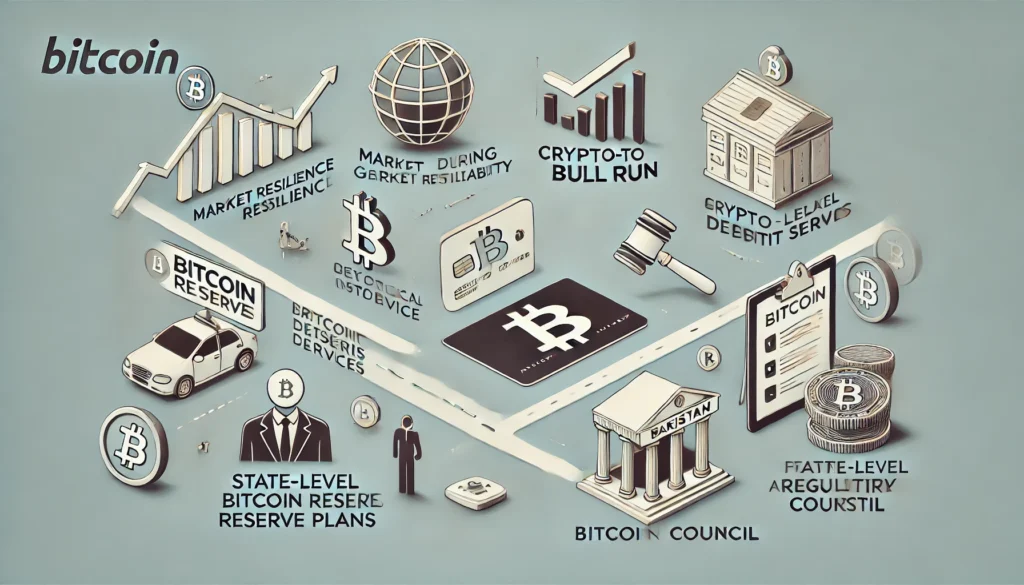
The latest developments in the crypto world underscore the sector’s resilience amid global financial uncertainties. From regulatory actions to new market features, the crypto ecosystem continues to evolve rapidly. Institutional demand for Bitcoin remains strong, even as governments propose new legislation targeting memecoins and the integration of Bitcoin into state reserves faces hurdles. Meanwhile, innovation in crypto payments and partnerships, such as the collaboration between Cronos and Crypto.com, highlights the growing use case for digital currencies in everyday transactions. Let’s dive into these key updates: Crypto Holds Firm as Traditional Markets Struggle with Trump’s Tariff Threat The cryptocurrency market has shown resilience amid a downturn in traditional finance triggered by Donald Trump’s latest tariff threats. Major stock indices, including the S&P 500 and Dow Jones, suffered losses as investors grew wary of potential economic repercussions. However, Bitcoin and other leading cryptocurrencies remained stable, demonstrating their role as alternative assets during economic uncertainty. This divergence between TradFi and crypto highlights the growing perception of digital assets as a hedge against geopolitical risks and macroeconomic instability. A key factor behind crypto’s stability is institutional demand, with many investors turning to Bitcoin as a digital store of value. Historically, Bitcoin has performed well in times of financial distress, and its decentralized nature shields it from direct government policies like tariffs. Furthermore, growing adoption in emerging markets and increasing utility in payment systems continue to strengthen crypto’s long-term outlook. Despite concerns over regulatory challenges, the sustained demand for digital assets suggests they are becoming more integrated into the global financial ecosystem. While Bitcoin’s price action remains relatively steady, altcoins like Ethereum and Solana are also seeing interest from investors seeking diversification. If economic uncertainty persists, crypto markets may continue to decouple from traditional assets, further reinforcing their role as an independent financial system. However, regulatory scrutiny and potential policy shifts remain risks that could impact market sentiment. Market Impact: The market impact of this development suggests that digital assets, particularly Bitcoin, are increasingly seen as a safe-haven investment during times of geopolitical and financial uncertainty. As traditional markets react negatively to Trump’s tariff threats, cryptocurrencies are holding steady, potentially attracting institutional investors who seek protection from external macroeconomic pressures. This trend could further solidify Bitcoin’s role as a store of value, separate from traditional assets, especially if geopolitical tensions continue to rise. CryptoQuant CEO: Bitcoin’s Bull Run Still Has Momentum CryptoQuant CEO Ki Young Ju remains confident that Bitcoin’s bull market is far from over, citing strong on-chain data as evidence. He highlights that long-term holders continue to accumulate Bitcoin while exchange reserves remain low, indicating that investors are not eager to sell. Historically, bull markets end when a “blow-off top” occurs, marked by excessive retail euphoria and large-scale profit-taking—something Ju believes has not yet happened. One key metric supporting his argument is Bitcoin’s realized cap, which is approaching all-time highs. This suggests that new capital is entering the market rather than old money exiting. Additionally, institutional adoption continues to grow, with major financial firms integrating Bitcoin into their offerings, further solidifying its position as a legitimate asset class. The approval of spot Bitcoin ETFs has introduced a new wave of demand, which could sustain the bull cycle for longer than previous market cycles. Despite short-term corrections, Ju sees Bitcoin’s fundamentals as strong, with supply-side dynamics favoring further price appreciation. The reduced availability of BTC on exchanges, coupled with strong holding patterns, indicates that any dips could be buying opportunities rather than signs of a market top. However, investors should remain cautious of external macroeconomic factors that could trigger temporary downturns. Market Impact: The market impact of this news suggests that Bitcoin’s bullish trend is likely to persist in the medium to long term. Strong on-chain metrics and low exchange reserves point to continued accumulation, especially by long-term holders and institutional investors. As Bitcoin’s realized cap approaches all-time highs, there may be more upward pressure on its price, which could lead to more institutional interest and stronger demand, even in the face of short-term volatility or corrections. Cronos Enables Crypto-to-Debit Card Transfers in Partnership with Crypto.com Cronos has introduced a seamless crypto-to-debit card transfer service in partnership with Crypto.com, allowing users to spend digital assets directly. This initiative simplifies the crypto payment process by eliminating the need for complex conversions. Users can now load their debit cards with cryptocurrencies and use them for everyday purchases, marking a step toward mainstream adoption. The partnership between Cronos and Crypto.com aims to bridge the gap between digital assets and traditional finance. One of the biggest barriers to crypto adoption is the difficulty of using it in real-world transactions. By offering a direct conversion service, Cronos enhances the usability of its ecosystem, positioning itself as a key player in crypto payments. Additionally, this service may encourage greater adoption of stablecoins and other digital currencies as everyday payment methods. As crypto regulation continues to evolve, services like these could influence how authorities perceive and regulate digital payments. The ability to seamlessly use crypto for daily spending may accelerate regulatory discussions, potentially leading to clearer policies. If successful, this initiative could set a precedent for other crypto platforms to follow, pushing digital assets closer to mass adoption. Market Impact: This development is expected to drive further adoption of cryptocurrency for everyday transactions. The ability to load debit cards directly with crypto makes it more practical for users to use digital assets for purchases, thereby increasing their utility in real-world applications. This could lead to increased demand for Cronos’ platform and Crypto.com services, while also creating a more mainstream pathway for crypto integration in traditional financial systems. Over time, this could reduce barriers to entry for those unfamiliar with crypto exchanges or wallets, promoting further mass adoption. U.S. House Democrats Propose Law to Ban Presidential-Themed Memecoins A group of U.S. House Democrats has introduced a bill seeking to ban presidential-themed memecoins, citing concerns over financial scams and misinformation. The rise of politically charged tokens, including those based on Donald Trump