
Bitcoin Market Dynamics: In-Depth Analysis & Forward Outlook

As the cornerstone of the digital asset world, Bitcoin (BTC) continues to act as the bellwether for the broader cryptocurrency market. A critical examination of on-chain metrics—such as HODLer behavior, miner activity, market sentiment, and valuation models like MVRV—provides deep insights into the current cycle and potential forward movements. 1. Hodlers’ Balance & Accumulation Behavior: A Market Timing Signal Long-term holders (LTHs), commonly known as hodlers, serve as key participants who accumulate BTC during bearish phases and distribute it during bullish tops. From early 2020 to early 2024, hodlers’ BTC balances rose from 12 million to over 13 million BTC, marking a solid accumulation phase spanning nearly four years. This trend is significant—historically, hodlers distribute heavily near market tops, helping define cyclical peaks. Should we observe a reduction in hodler balances in Q2–Q3 2025, this could indicate distribution is underway, and thus a macro top may be forming. 2. Miner Activity & Volume Share: Reduced Impact but Strong Signals Miners, once dominant in daily volume, now represent a diminished share, dropping from 0.25 in 2015 to just 0.06 in 2025. This reflects a broader decentralization in Bitcoin ownership and transaction activity. Despite this decline, miners remain an important short-term liquidity source. Spikes in miner selling often precede market corrections, as miners offload holdings to manage expenses. Thus, monitoring miner outflows remains essential for short-term price forecasting. 3. Market Sentiment via “Holders in Profit” Metric The percentage of Bitcoin addresses in profit is a key sentiment barometer. Historically: 99% in profit in late 2024 reflected euphoric market conditions. 49% in late 2022 was emblematic of widespread capitulation. As of Q2 2025, this metric hovers in a neutral zone, suggesting mixed sentiment—neither extreme optimism nor panic. Traders and analysts often interpret mid-range values as fertile ground for trend continuation or volatility. 4. Valuation Insight via MVRV Ratio The Market Value to Realized Value (MVRV) ratio compares Bitcoin’s current market cap to its aggregated realized value. This metric helps identify overvaluation (market tops) or undervaluation (market bottoms): 3.73 in Dec 2017 → Bubble territory 0.74 in Dec 2022 → Deep undervaluation 1.94 in Apr 2025 → Fairly valued The current level of 1.94 suggests that Bitcoin is neither significantly overbought nor oversold. Historically, markets in this zone can pivot either into a breakout rally or corrective phase, depending on broader macro and crypto-specific catalysts. Conclusion: Strategic Foresight for a Volatile Market Bitcoin’s market structure is evolving. While hodlers’ accumulation suggests long-term conviction, their future distribution patterns may indicate trend reversals. Miners, though less dominant, continue to signal liquidity shifts, and sentiment indicators remain in watchful balance. The MVRV ratio’s neutral level positions the market at an inflection point. For traders, investors, and institutions alike, maintaining vigilance across these metrics is essential for anticipating and responding to the next major move in the Bitcoin cycle. Prepared by Owais Paracha – May 2025
Bull Market Peak, Institutional Inflows, MiCA’s Impact, and Bitcoin Ambitions in 2025
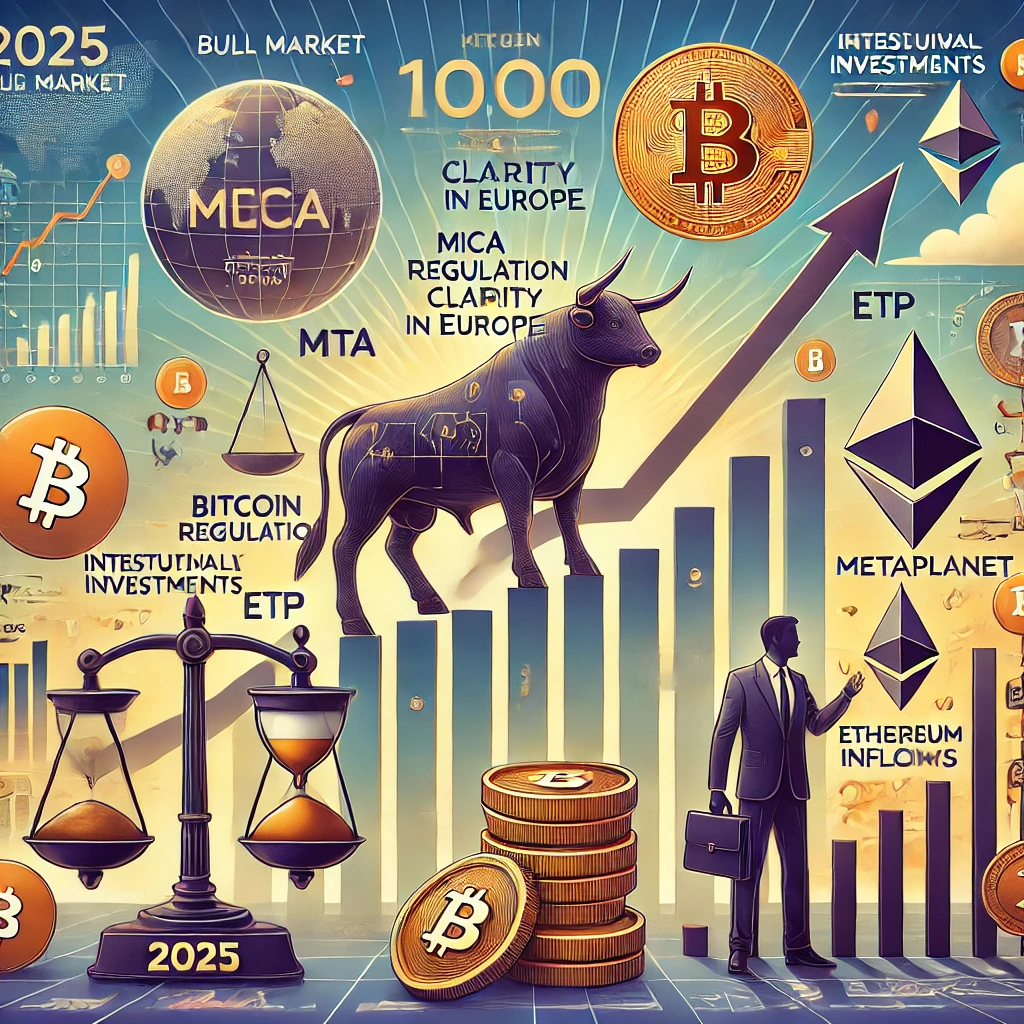
The cryptocurrency landscape in 2025 is dynamic and multifaceted, driven by predictions of Bull Market peaks, surging institutional investments, regulatory clarity through MiCA, and ambitious Bitcoin acquisition strategies by major players. From CryptoQuant’s cautious warnings to Metaplanet’s bold Bitcoin goals, the interplay of optimism, caution, and regulation is shaping a complex narrative. This analysis unpacks the key stories, market implications, and investor insights for the year ahead. 1. CryptoQuant: Bull Market in Final Stage, Peaks Expected in 2025 Analysis: CryptoQuant’s analysis suggests that the cryptocurrency market is in the latter phases of its current bull cycle, which began in early 2023. This phase is characterized by significant inflows from both new investors and reinvestments by existing players, signaling that a cyclical market peak may occur by Q2 2025. A key indicator of this maturation is the percentage of Bitcoin held for less than one month, which has risen to 36%—a figure reminiscent of trends seen during previous bull market peaks. However, CryptoQuant’s caution contrasts with other analysts’ forecasts. While CryptoQuant sees the potential for a market correction shortly after the peak, firms like VanEck and Steno Research anticipate continued strength throughout 2025. VanEck, for example, predicts Bitcoin could surpass $180,000 by year-end, with Ethereum breaching $6,000. This divergence reflects the speculative nature of the crypto markets, where sentiment and macroeconomic factors can create widely varying scenarios. Impact: The CryptoQuant report serves as a reminder for investors to balance optimism with prudent risk management. While high returns remain possible in the short term, the anticipation of a peak within a specific timeframe introduces uncertainty. This outlook might lead to increased market volatility as investors weigh the risks of holding positions versus cashing out near the predicted top. 2. Crypto ETPs See $585 Million Inflows as 2025 Begins: CoinShares Report Analysis: The crypto exchange-traded products (ETPs) market has started 2025 with impressive inflows, marking a continuation of the bullish trend observed in 2024. With $585 million invested in the first three days of the year, the data suggests sustained interest in these instruments, which gained traction after the introduction of U.S. spot Bitcoin ETFs in January 2024. Bitcoin-focused ETPs dominate the inflows, reflecting investor confidence in the leading cryptocurrency. In 2024 alone, Bitcoin ETPs attracted $38 billion, cementing their position as a preferred vehicle for institutional and retail investors. Ether-based ETPs also gained attention, adding $4.8 billion in 2024. Regional disparities, however, highlight differing investor sentiments, with the U.S. leading inflows while Canada and parts of Europe saw notable outflows. Impact: These figures underscore the growing mainstream adoption of crypto assets, particularly through structured products like ETPs. The inflows at the start of 2025 suggest that institutions and individuals view these products as both a hedge and an opportunity for substantial returns. For Bitcoin, increased AUM (assets under management) solidifies its role as the flagship digital asset, potentially boosting its price in the months ahead. 3. MiCA: Regulatory Clarity for European Crypto Markets Analysis: The implementation of the Markets in Crypto-Assets (MiCA) regulation marks a pivotal moment for cryptocurrency markets in Europe. By setting clear guidelines for compliance, licensing, and taxation, MiCA addresses concerns over the “Wild West” nature of the crypto industry. While critics warn of potential overregulation, proponents argue that MiCA will enhance investor confidence and attract more significant institutional participation. Key developments under MiCA include increased scrutiny on retail investors, requiring them to disclose detailed financial and personal data. This regulatory demand, while cumbersome, could pave the way for future crypto taxation and streamlined compliance frameworks. Institutions like Société Générale and MoonPay have already aligned with MiCA, signaling a shift towards legitimacy in the sector. Impact: MiCA’s comprehensive approach has the potential to position Europe as a leader in crypto innovation. However, the immediate impact may be mixed. While institutional investors are likely to embrace the regulatory clarity, retail participation could temporarily decline due to heightened compliance requirements. Over time, MiCA could set a precedent for other regions seeking to balance innovation with investor protection. 4. Bitcoin Price Rally Faces Uncertainty Ahead of Trump Inauguration Analysis: Bitcoin’s price surge in early 2025, fueled by optimism surrounding Donald Trump’s return to the White House, faces potential obstacles. Positive inflation data expected mid-January may provide a short-term boost, but caution prevails as the Federal Reserve’s Federal Open Market Committee (FOMC) meeting approaches on January 29. The meeting is likely to influence interest rate decisions, which have historically impacted Bitcoin’s price volatility. Market analysts have mixed views on Bitcoin’s trajectory. While Markus Thielen of 10x Research predicts Bitcoin could stabilize in the $97,000–$98,000 range by January’s end, others like John Glover anticipate a more volatile pattern. The role of institutional inflows via Bitcoin ETFs and stablecoins will be critical in determining the market’s direction. Impact: The interplay between macroeconomic indicators and political developments creates a complex environment for Bitcoin investors. While the inaugural optimism may spur temporary gains, the looming FOMC meeting could introduce downward pressure, emphasizing the importance of staying attuned to policy shifts and market dynamics. 5. Metaplanet’s Ambitious Plan to Hold 10,000 BTC by 2025 Analysis: Japanese venture capital firm Metaplanet has set an ambitious target to expand its Bitcoin holdings from 1,762 BTC to 10,000 BTC by the end of 2025. This aggressive accumulation plan is fueled by predictions of Bitcoin reaching $200,000 in the current bull cycle. Metaplanet intends to use a mix of loans, equity, and convertible bonds to finance the purchases, reflecting its bullish outlook on Bitcoin’s long-term potential. The firm’s strategy aligns with the growing trend of institutional adoption. Metaplanet’s stock performance, which has risen by 950% since it began acquiring Bitcoin in April 2024, demonstrates strong investor confidence. Additionally, the company projects an operating profit for the first time since 2017, driven partly by its crypto investments. Impact: Metaplanet’s move could inspire other institutional players to increase their exposure to Bitcoin, further driving demand and price appreciation. By positioning itself as a leader in crypto investment, the firm underscores the growing institutional