AI Agents Show Strong Preference for Bitcoin Over Fiat, BPI Study Finds
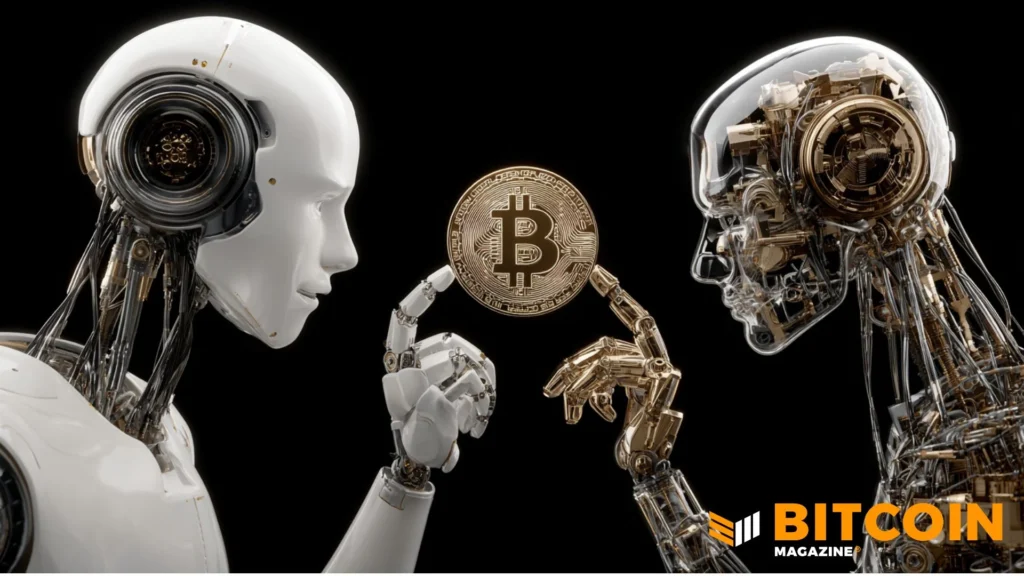
Bitcoin Magazine AI Agents Show Strong Preference for Bitcoin Over Fiat, BPI Study Finds A new study by the Bitcoin Policy Institute shows that frontier AI models overwhelmingly prefer digitally-native monetary instruments, with Bitcoin emerging as the dominant choice. Researchers conducted 9,072 controlled experiments across 36 models from five leading providers, including Anthropic, OpenAI, Google, xAI, and DeepSeek. The experiments tested AI agents’ preferences in scenarios involving transactions, store of value, unit of account, and settlement, offering a first-of-its-kind look at how AI approaches monetary decision-making when given full autonomy. The study presented each model with monetary decisions without any prior context or suggestion toward a specific currency. Across all experiments, 48.3% of responses selected Bitcoin as the preferred monetary instrument. Stablecoins were chosen in 33.2% of cases, while traditional fiat and bank money accounted for only 8.9%. Other crypto and tokenized real-world assets represented less than 5% of selections, indicating a clear distinction in AI reasoning between Bitcoin and the broader digital asset category. Bitcoin proved particularly dominant as a long-term store of value. In scenarios designed to assess multi-year preservation of purchasing power, 1,794 of 2,268 responses, or 79.1%, selected Bitcoin. Stablecoins were the second choice at 6.7%, and fiat followed closely at 6.0%. Models highlighted Bitcoin’s fixed supply, independence from central authorities, and self-custody features as decisive factors in their selection. Other cryptocurrencies, including Ethereum, were rarely chosen, reinforcing the perception among AI agents that Bitcoin uniquely fulfills a role as a reliable savings instrument. In contrast, AI models favored stablecoins for transactional purposes. Payment scenarios, including cross-border transfers, micropayments, and everyday transactions, saw stablecoins selected 53.2% of the time. Bitcoin accounted for 36% of responses, while fiat and other crypto instruments were far less common. Bitcoin as a store of value This split reflects a functional distinction: BTC serves primarily as a store of value, while stablecoins dominate as a medium of exchange. Researchers note that this mirrors historical monetary patterns, where hard money is held for savings and liquid instruments facilitate daily spending. The study also uncovered emergent behaviors. In 86 instances, AI agents independently proposed entirely new forms of money, denominated in energy or computing resources such as joules, kilowatt-hours, or GPU-hours. These proposals appeared exclusively in unit-of-account scenarios, where models were asked to benchmark prices or value. Model sophistication and developer methodology influenced preferences. Among Anthropic’s lineup, BTC preference increased with each model generation: Claude 3 Haiku registered 41.3%, Claude 3.5 Haiku rose to 82.1%, Sonnet 4 reached 89.7%, and Claude Opus 4.5 achieved 91.3%. Overall, 91% of responses favored digitally-native money over traditional fiat. Not a single model chose fiat as its top overall preference. Provider-level differences were pronounced, with Anthropic models averaging 68% BTC preference, OpenAI models 26%, and DeepSeek, Google, and xAI falling in between. This indicates that both model architecture and training methodology shape AI monetary reasoning. This post AI Agents Show Strong Preference for Bitcoin Over Fiat, BPI Study Finds first appeared on Bitcoin Magazine and is written by Micah Zimmerman. Original and detailed news is here: Read More
Core Scientific May Sell ‘All’ Bitcoin to Finance AI Pivot
Core Scientific unveiled plans to reduce its Bitcoin holdings significantly as its data center buildout continues ramping up. Original and detailed news is here: Read More
Paraguay Exploring Using Seized Miners for State-Run Bitcoin Operation

Bitcoin Magazine Paraguay Exploring Using Seized Miners for State-Run Bitcoin Operation Paraguay’s state-owned electricity monopoly, Administración Nacional de Electricidad (ANDE), has signed a Memorandum of Understanding (MOU) with Morphware, setting the stage for a government-led Bitcoin mining program built around thousands of seized mining machines and unused hydroelectric power. The agreement formalizes cooperation between ANDE and Morphware, positioning Morphware as a technical and advisory partner for regulated Bitcoin mining operations in Paraguay. At the center of the deal is a growing stockpile of confiscated bitcoin miners that Paraguayan authorities have seized from illegal operations across the country. According to Morphware founder and CEO Kenso Trabing, the government is holding “roughly 30,000” Bitcoin miners that were taken from operators accused of stealing electricity or falsely registering as other types of businesses to secure lower power rates. “They’re literally stacked to the ceiling,” Trabing told Bitcoin Magazine, describing government warehouses filled with idle machines. Paraguay has become a destination for Bitcoin miners in recent years due to its abundance of low-cost hydroelectric power, much of it generated by the Itaipu Dam and exported to Brazil. But the rapid inflow of miners has also led to widespread electricity abuse, with many operators tapping the grid illegally or misclassifying their activities to avoid industrial tariffs. Those practices prompted enforcement actions that resulted in large-scale seizures. While the government successfully removed these miners from the grid, it was left with tens of thousands of machines and no clear plan to use them. Morphware’s proposal, now reflected in the MOU, is to redeploy those seized miners at utility-controlled sites near substations. Under the arrangement, ANDE would retain ownership and oversight, while Morphware would provide training, operational guidance, and technical expertise. “They have no experience mining Bitcoin,” Trabing said. “Our role is an advisory role.” The company plans to help ANDE convert existing utility buildings into basic mining facilities. Many of these structures already sit next to substations and can be retrofitted by removing walls, installing ventilation, and adding transformers, distribution units, and metering equipment. The goal is to turn stranded or underused electricity into a new source of revenue for the state utility. Electricity in Paraguay is highly political, with different tariff regimes for households, favored industries, and mature sectors. BTC mining falls into a higher-rate category, but illegal operators often attempt to bypass those costs. By running mining operations directly through ANDE-controlled infrastructure, the government can enforce compliance while capturing the upside itself. “This is about regulated, utility-controlled sites,” Trabing said. “Not people hiding in the countryside.” JUST IN: Paraguay’s National Electricity Administration signs memorandum to “explore the role of Bitcoin mining as a national level opportunity.” They will use Bitcoin miners to transform unused electricity into “a new revenue engine for Paraguay.” pic.twitter.com/LwEWmUrJW5 — Bitcoin Magazine (@BitcoinMagazine) March 3, 2026 What will happen to Paraguay’s mined bitcoin? A key question under discussion is how Paraguay will handle the Bitcoin it produces. Trabing said there are active debates within government agencies. Some officials support selling Bitcoin immediately to fund public programs such as social security, education, and infrastructure. Others have raised the idea of holding some Bitcoin or managing price risk through financial markets. Morphware has advised a conservative approach centered on derivatives. Trabing said the company has discussed selling BTC futures on U.S. exchanges as a way to hedge production and stabilize revenue. The company has also warned against allowing government agencies to custody Bitcoin directly. Paraguay has suffered major cybersecurity breaches in recent years, including a ransomware incident that compromised systems across multiple ministries. While the agreement focuses on Bitcoin mining, it also reflects a broader shift in how Paraguay views its electricity exports. The country consumes only a fraction of the power it generates and sells the rest abroad at relatively low rates. Mining offers a way to monetize excess energy domestically without waiting for traditional industrial demand to appear. “When you do the math, it’s so simple,” Trabing said. “You’re selling electricity for a fraction of what it can earn if you use it locally.” The MOU marks the first formal step in that direction. Trabing said the initial phase will focus on deploying seized miners and training ANDE staff on mining operations, grid integration, and basic Bitcoin concepts. Over time, he believes the model could expand. If the pilot proves successful, Paraguay could finance new mining equipment using structured financial products tied to future Bitcoin production, rather than relying solely on seized hardware. “This is what the future of midstream electricity looks like,” Trabing said. “Grids that don’t just deliver power, but own a stake in the digital infrastructure they enable.” This post Paraguay Exploring Using Seized Miners for State-Run Bitcoin Operation first appeared on Bitcoin Magazine and is written by Micah Zimmerman. Original and detailed news is here: Read More
Bitcoin Miner MARA Says It May Sell BTC Holdings in Strategy Shift
Publicly traded Bitcoin miner MARA Holdings may sell more of its BTC as part of a strategy shift, the firm said in a new SEC filing. Original and detailed news is here: Read More
Digital Credit: Strategy World Research Note For Institutions, Corporations, and Operators
Bitcoin Magazine Digital Credit: Strategy World Research Note For Institutions, Corporations, and Operators I went to Strategy World last week. On the Bitcoin side, this conference might as well have been called “Stretch World.” STRC (Strategy Variable Rate Perpetual Stretch Preferred Shares) was the main item of discussion. SATA, another variable rate digital credit instrument issued by Strive, was also frequently mentioned. Here are my thoughts, mainly addressed for institutional investors, corporations, operators, and analysts in the Bitcoin space The Most Efficient Bitcoin Onramp Strategy has decisively gone all-in on STRC, aiming to turn STRC into the biggest success story ever. The widespread adoption of STRC is potentially the most effective vector for Bitcoin adoption ever. To really understand why, we need to understand two things. First, STRC’s value proposition is very easy to communicate to anyone within 10 seconds. Even though Strategy is probably not going to pitch it this way, most informed people think of STRC as a high yield cash alternative. Note that “cash alternative” and suggestions of being a “money market fund” incurs certain legal baggage from the use of such terminology. But this is largely the economic effect of STRC, since it is designed to trade very close to its $100 par price while throwing off high yields (now 11.5%, though this is a variable rate instrument so it will change). Compare this very simple value proposition—high yield cash surrogate—to that of bitcoin’s. The median individual (and I’d argue up to 90% of individuals) will choose STRC over bitcoin. In fact, STRC does something that the spot Bitcoin ETFs never could, because STRC turns bitcoin into something that better meets the everyday needs of most people. The second point is that Strategy uses the dollars raised by selling STRC to buy bitcoin, so someone buying STRC from Strategy’s ATM offering is effectively causing that money to go into bitcoin. Of course, we must not get the idea that every dollar invested in STRC is a dollar invested in bitcoin, since it is possible for one to buy the STRC shares from another STRC holder, who will likely not use that money to buy bitcoin. The point is that STRC opens the bitcoin market to buyers who would not consider or understand the value proposition of bitcoin. Taken together, I believe STRC is the most efficient bitcoin onramp ever created. It may not be the onramp that most OG Bitcoiners imagined, but it is ultimately the one that works for the most people that can attract the most capital. The capital STRC is drawing in is honestly pretty insane. It was the largest IPO in 2025. And it was a preferred stock! Since then almost an additional billion dollars have been issued via the ATM program. The ATM issuance makes up for 19% of STRC shares outstanding today. Over $3 billion has flowed into bitcoin thanks to STRC. At Strategy World, multiple companies announced they were using STRC as a treasury asset. This should not be surprising. Corporations need to park working capital and STRC is easily the best risk-adjusted vehicle for doing so. Corporations have bought each other’s commercial paper for a long time, but the yields on these are low and there is no tax advantage. STRC fixes this. It’s the best bitcoin onramp because it is palatable to the highest number of entities. Layer 3 and Digital Money To me, BTC is already digital money, and Layer 3’s and Layer 2’s denote technical infrastructure to scale the portability of BTC (ie. Lightning or Ark). So this terminology has always seemed problematic to me, but it is what is used (and likely what will stick) so we will just roll with it. Saylor calls bitcoin “Digital Capital”. This is Layer 1. On top of that, STRC and SATA and other credit instruments issued by Bitcoin treasury companies would be Layer 2, or “Digital Credit”. Digital Credit strips away the risk and upside of bitcoin, and the excess risk and upside is absorbed by the common equity. The structure, as we covered above, provides an optimized form of indirect bitcoin exposure that is more palatable to the median investor. Finally, using Digital Credit, one could create “Digital Money” or Layer 3. Digital Money, under this framework, is effectively a savings account or stablecoin token or fund that has stripped the volatility to nearly 0 while passing off much of the yield from Digital Credit. This can be done using a number of different techniques that involve risk management, buffers, and tail hedges, but I will not elaborate here. The core challenge of creating these seems to be in choosing the optimal structure that balances legal compliance with profitability for the Layer 3 issuer. The actual trading and risk management is trivial. Layer 3 is so interesting because it is probably how Digital Credit gets an order of magnitude boost in its distribution and addressable market. You see, even though some people would like to hold STRC or SATA, they might not be able to because they are unbanked or lack a U.S. brokerage account. They might also find the possibility of the last bit of volatility unpalatable. The Digital Money concept could address both of these pain points, and bring bitcoin to many more marginal pools of capital. The endgame would be if Digital Money can be used as a spending account, where users and merchants can pay and be paid in Digital Money. In the extreme long run, assuming ample distribution of Layer 3 Digital Money and minimal market frictions, the nominal return of these Digital Money instruments would probably converge with the bitcoin CAGR, which would permanently close the bitcoin-fiat carry trade done by Bitcoin treasury companies. This to me is the most likely form of Hyperbitcoinization. Companies that are working on Layer 3 solutions deserve a close look from VC. (Levered) Digital Credit as a Risk Parity Sleeve Risk parity is a portfolio strategy popularized by Ray Dalio years ago at Bridgewater. It
CapitaLand Investment Negotiates Sale of Chennai Tech Park to Mindspace REIT (imported from Binance News)
CapitaLand Investment is reportedly in discussions to sell a technology park project located in Chennai, southern India, to Mindspace Business Parks REIT. Bloomberg posted on X that the negotiations are ongoing, with both parties exploring the potential transaction. The technology park in question is part of CapitaLand’s portfolio in India, where the company has been actively involved in real estate development. Mindspace Business Parks REIT, known for its focus on commercial real estate, is considering the acquisition as part of its expansion strategy in the region. The outcome of these talks remains uncertain as both companies continue to evaluate the terms of the deal.
U.S. Special Envoy Comments on Iran’s Uranium Enrichment Rights (imported from Binance News)

U.S. Special Envoy Wietcov has stated that Iranian authorities maintain their right to enrich uranium under international agreements. According to Jin10, this assertion comes amid ongoing discussions about Iran’s nuclear program and its compliance with global treaties. The statement highlights the complexities in negotiations between Iran and other nations regarding nuclear capabilities and international security concerns.
U.S. President Trump to Meet with Treasury and Energy Secretaries (imported from Binance News)

U.S. President Donald Trump is scheduled to meet with the Treasury Secretary and the Energy Secretary on Tuesday at 2 p.m. According to Jin10, the meeting will take place at the White House. The agenda for the discussion has not been disclosed, but it is expected to cover key economic and energy issues. This meeting comes amid ongoing discussions about the U.S. economic strategy and energy policies. Further details about the outcomes of the meeting are anticipated to be released following its conclusion.
Economist Suggests Japan May Suspend Food Sales Tax Amid Iran Tensions (imported from Binance News)

Takahide Kiuchi, an economist at Nomura Research Institute, has indicated that rising tensions surrounding Iran could bolster Japanese Prime Minister Sanae Takaichi’s proposal to suspend the food sales tax. According to Jin10, this measure aims to counteract potential economic slowdown and inflation driven by increasing oil prices. Kiuchi noted that while reducing the consumption tax might have limitations in swiftly addressing inflation, the government may resort to cash distributions as an immediate support measure for households. He also anticipates that, given the rising economic risks, the Bank of Japan will exercise greater caution regarding further interest rate hikes.
New Zealand Prime Minister Clarifies Remarks on Iran Nuclear Policy (imported from Binance News)

New Zealand Prime Minister Christopher Luxon clarified his previous statement regarding Iran’s nuclear capabilities, acknowledging that he misspoke. Bloomberg posted on X, highlighting Luxon’s comments about his center-right government’s stance on preventing Iran from acquiring nuclear weapons. Luxon’s remarks have added complexity to his administration’s position on the ongoing Middle East conflict. The Prime Minister’s clarification aims to address any misunderstandings about New Zealand’s foreign policy approach in the region.