
5 Important Crypto News: Coinbase Stock, Bitcoin-Backed Loans, South Korea’s CBDC & More | Botslash Daily Crypto News Analysis
Innovation and regulatory changes are shaping the future of the crypto industry. From Coinbase receiving a bullish outlook due to potential policy shifts to Xapo Bank introducing Bitcoin-backed loans, financial institutions are adapting to the digital asset landscape. Meanwhile, South Korea is preparing for a major CBDC experiment, while Bitcoin investors debate whether the bull cycle is over. Large Bitcoin holders, or “mega whales,” are accumulating BTC, hinting at possible market movements. These developments highlight the evolving role of digital assets in both traditional finance and decentralized ecosystems. Coinbase Stock a Buy With Over 60% Upside Amid Trump’s New Crypto Regime: Bernstein Bernstein has given Coinbase a strong endorsement, setting a price target of $310, which marks a potential 60% upside from its current valuation. The investment firm attributes this bullish outlook to anticipated regulatory changes under a Trump-led administration. With Donald Trump expressing a pro-crypto stance and calling for the U.S. to be a leader in the digital asset sector, Coinbase stands to benefit from regulatory clarity and institutional adoption. The report highlights that Coinbase is not just a trading platform but a diversified crypto ecosystem, including its staking services, stablecoin revenue, and institutional custody solutions. Furthermore, Coinbase’s potential expansion into more financial services, such as lending and staking, could provide alternative revenue streams beyond trading fees. The exchange has also been positioning itself to comply with evolving U.S. regulations, reinforcing its leadership role in the industry. With the SEC’s crypto policies expected to become more business-friendly, Coinbase could see increased institutional adoption and user growth. Market Impact: If regulatory conditions improve, Coinbase could attract more institutional investors, further legitimizing the crypto industry. A rise in Coinbase’s stock price would also indicate growing confidence in the crypto sector as a whole. Xapo Bank Offers Bitcoin-Backed Loans, Giving Access to $1M in Cash Without Selling BTC Xapo Bank’s introduction of Bitcoin-backed loans is a significant step in bridging traditional finance and digital assets. By allowing clients to borrow up to $1 million against their BTC holdings without selling them, Xapo provides a solution for long-term holders who want liquidity without incurring capital gains tax. This innovation caters to Bitcoin maximalists who prefer to hold their BTC while accessing funds for large investments such as real estate, business expansion, or diversification into other asset classes. The growing demand for Bitcoin-backed loans reflects the increasing recognition of BTC as a legitimate asset class within the financial sector. Other institutions may follow Xapo’s lead, introducing similar services that allow customers to use crypto as collateral. As traditional banks remain skeptical about integrating digital assets, crypto-native banks like Xapo continue to push the boundaries of what’s possible. Market Impact: Services like these enhance Bitcoin’s reputation as a valuable financial instrument. Increased adoption of BTC-backed loans could also reduce selling pressure on Bitcoin, contributing to price stability. Bank of Korea to Launch ‘Hangang’ CBDC Experiment in April The Bank of Korea (BOK) is set to conduct a large-scale central bank digital currency (CBDC) trial, involving 100,000 users and major South Korean banks. This pilot program will allow participants to exchange traditional bank deposits for digital “deposit tokens,” which they can use for payments at selected merchants. The test aims to evaluate how a CBDC could function within South Korea’s financial ecosystem and its potential impact on traditional banking operations. This experiment follows similar initiatives in China and the European Union, where governments are exploring digital currencies to modernize financial infrastructure. Unlike decentralized cryptocurrencies, CBDCs provide central banks with more control over money supply and transactions, raising both optimism and concerns about financial privacy. If successful, South Korea’s model could serve as a reference for other nations looking to implement digital currencies. Market Impact: The launch of a widely adopted CBDC could reshape the role of banks and digital payments, potentially accelerating the decline of cash transactions. However, concerns over surveillance and centralization may limit its acceptance. Is Bitcoin Bull Cycle Over? Stablecoin Inflow Hints at BTC Rally Ahead The question of whether Bitcoin’s bull cycle has ended remains a topic of debate among analysts. Some indicators suggest the cycle may be cooling off, as Bitcoin struggles to break new highs. CryptoQuant CEO Ki Young Ju has pointed out that Bitcoin’s historical patterns indicate extended consolidation phases, lasting up to a year, before the next rally begins. However, an increase in stablecoin inflows suggests that capital is still entering the market, which could fuel another leg of Bitcoin’s price growth. Stablecoin inflows are often a precursor to Bitcoin rallies, as traders move funds into these assets before deploying them into the market. Recent on-chain data shows that large investors are positioning themselves strategically, possibly anticipating another price surge. Historically, Bitcoin has experienced pullbacks before resuming upward trends, making this period crucial for determining the market’s next move. Market Impact: A confirmed rise in stablecoin inflows could indicate fresh buying pressure for Bitcoin, potentially leading to another rally. However, if the inflows slow down, the market may enter a prolonged consolidation phase. Bitcoin ‘Mega Whales’ Starting to Buy: Trend Shift Ahead? On-chain data reveals a fascinating trend—mega whales, or Bitcoin holders with more than 10,000 BTC, have been steadily accumulating more Bitcoin. This behavior is significant because these large holders typically operate with a long-term perspective and often accumulate during market downturns, anticipating future price appreciation. While smaller investors have been selling, possibly due to fear or profit-taking, the confidence of mega whales suggests that Bitcoin’s long-term outlook remains strong. Historically, such accumulation phases have preceded significant price rallies, as supply tightens and demand increases. This trend indicates that institutional players or high-net-worth individuals may be positioning themselves for the next big market move. Market Impact: If the accumulation trend continues, Bitcoin’s supply could become more scarce, driving prices higher. Retail investors may follow suit, reinforcing the bullish sentiment. Key Takeaways Coinbase Poised for Growth: Analysts predict a 60% upside for Coinbase (COIN), driven by expected pro-crypto regulatory shifts under a potential Trump administration. The exchange’s
3 Important Crypto News : Trump’s Crypto Reserve Proposal, Bitcoin Reserve Bill Rejections, and BTC Network Surge – Botslash Daily Crypto News Analysis
Donald Trump’s latest stance on cryptocurrency has sent shockwaves through the market as he proposed XRP, Solana (SOL), and Cardano (ADA) as part of a potential U.S. crypto reserve, leaving Bitcoin (BTC) out of the equation. Meanwhile, Bitcoin faced another challenge as several U.S. states rejected bills that would have allowed BTC to be held as a reserve asset, reflecting ongoing regulatory resistance. However, Bitcoin’s network activity tells a different story, as active addresses have surged, indicating renewed market interest and a potential turning point for its price trend. These developments highlight the intersection of politics, regulation, and market sentiment, shaping the future of cryptocurrency adoption. Donald Trump Names XRP, SOL, ADA – But Not BTC – as Part of U.S. Crypto Reserve Former U.S. President Donald Trump’s proposal to include XRP, Solana (SOL), and Cardano (ADA) in a potential U.S. crypto reserve while excluding Bitcoin (BTC) has created waves in the crypto space. His decision reflects a significant shift in political and financial perspectives regarding digital assets. Trump, who once criticized cryptocurrencies, now appears to be embracing blockchain-based assets with strong enterprise applications. XRP’s regulatory clarity after its partial victory against the SEC, Solana’s high-speed transactions, and Cardano’s research-driven approach make them attractive choices for institutional adoption. The exclusion of Bitcoin, however, has raised concerns among BTC supporters, who argue that it remains the most secure and decentralized cryptocurrency. Some speculate that this move is politically motivated, as Trump may be seeking to distance himself from the current administration’s regulatory stance on Bitcoin. Others believe that Trump’s team is prioritizing cryptocurrencies with faster transaction speeds and lower fees over BTC, which is often criticized for its energy consumption. Regardless, his announcement has driven speculation about potential government involvement in specific digital assets, leading to increased trading activity for XRP, SOL, and ADA. This move could have a broader impact on the crypto market, particularly in terms of regulatory developments. If a future administration officially endorses certain digital assets over others, it could reshape the competitive landscape of cryptocurrencies. Investors are now closely watching how regulators respond to Trump’s proposal and whether other political figures follow suit. The market reaction has already been evident, with the named altcoins experiencing temporary price surges. However, long-term sustainability will depend on concrete policy implementations rather than political rhetoric. Market Impact: The announcement that Donald Trump may consider XRP, Solana (SOL), and Cardano (ADA) for a potential U.S. crypto reserve—while excluding Bitcoin—has triggered significant movements in the crypto market. XRP, SOL, and ADA saw an immediate price surge as investors speculated on potential government backing. This shift has also sparked debate about whether political endorsements could influence institutional investment patterns. Bitcoin’s slight volatility in response to its exclusion reflects the ongoing tension between decentralized digital assets and regulatory favoritism. If Trump or other political figures pursue formal policies favoring specific cryptocurrencies, it could reshape market dynamics and investment strategies. Several U.S. States Reject Bitcoin Reserve Bills A series of U.S. states have rejected bills that would have allowed Bitcoin to be used as a reserve asset, signaling ongoing skepticism about integrating BTC into government holdings. Lawmakers cited volatility, environmental concerns, and regulatory uncertainty as primary reasons for dismissing the proposals. The rejection highlights the broader struggle between Bitcoin adoption and traditional financial institutions’ hesitations regarding digital assets. While Bitcoin has proven its resilience and long-term growth potential, some policymakers remain wary of its unpredictable price fluctuations. The decision contrasts with global trends, where some nations have moved towards Bitcoin adoption at the state level. El Salvador remains the most notable example, having integrated BTC as legal tender and holding it as part of its national reserves. However, in the U.S., the decentralized nature of state governance means that each state can independently decide its stance on crypto reserves. Without a unified federal position, states are unlikely to take bold steps toward adopting Bitcoin as a reserve asset. This lack of consensus could slow down broader institutional acceptance in the country. Despite the rejections, Bitcoin advocates remain optimistic that these bills will be revisited in the future as the market matures and regulatory frameworks evolve. Many believe that increased Bitcoin adoption by companies and institutional investors will eventually push states to reconsider. The rejection does not necessarily signal a complete dismissal of Bitcoin but rather a temporary roadblock due to current regulatory and financial uncertainties. As inflation and economic instability continue to be concerns, Bitcoin’s appeal as a hedge against traditional financial risks may grow stronger. Market Impact: The rejection of Bitcoin reserve bills by several U.S. states represents a temporary setback for BTC’s adoption as a recognized financial asset within government holdings. Although Bitcoin remains a popular hedge against inflation and economic instability, policymakers cited its volatility and regulatory concerns as primary reasons for their opposition. While this decision did not significantly impact Bitcoin’s price, it has reignited debates over regulatory clarity and the role of digital assets in public finance. Institutional adoption remains a key factor, and if major corporations continue accumulating BTC, it may push state governments to reconsider their stance in the future. Bitcoin Active Addresses Surge, Signaling Market Turning Point Bitcoin’s network activity has shown a significant increase, with a surge in active addresses pointing to a possible bullish shift in the market. The number of unique addresses engaging in transactions has reached multi-month highs, a trend historically associated with increased investor participation and potential price rallies. This rise in activity suggests renewed interest from both retail and institutional investors, possibly in anticipation of upcoming events such as the next Bitcoin halving. The increase in active addresses indicates that more wallets are interacting with the blockchain, a key metric often used to gauge the overall health of the Bitcoin network. On-chain analysts have pointed out that this trend often precedes bullish momentum, as it signals higher demand and usage. Furthermore, stable transaction fees suggest that the rise in activity is organic rather than being driven by network congestion or
6 Important Crypto News : Ethereum Leadership Shift, Bitcoin Sentiment Crash, Trump’s Crypto Summit & More – BotSlash Daily Crypto News Analysis
The past few days have been eventful for the crypto industry, with significant developments shaping the market’s trajectory. Ethereum Foundation’s leadership change could influence the network’s future direction, while Bitcoin’s investor sentiment has dropped to a three-year low amid price corrections. Former President Donald Trump is hosting a White House crypto summit, which may impact regulatory clarity in the U.S. Meanwhile, Bitcoin ETFs have snapped an eight-day outflow streak, signaling a possible shift in institutional sentiment. Coinbase secured a legal win, and Marathon Digital showed resilience despite Bitcoin’s price volatility. Lastly, Bitcoin’s price movement is mirroring gold’s rally, with analysts predicting a surge to $125,000 in March. Ethereum Foundation Announces New Leadership The Ethereum Foundation’s leadership transition marks a significant shift in the organization’s governance and strategic direction. The foundation, which plays a crucial role in funding Ethereum’s development and ecosystem growth, has long been seen as a stabilizing force in the blockchain community. Leadership changes can bring fresh perspectives and innovative approaches, but they can also introduce uncertainty, especially when dealing with a decentralized ecosystem like Ethereum’s. The impact of this transition will largely depend on the new leadership’s stance on Ethereum’s ongoing developments, such as Ethereum 2.0, scaling solutions, and regulatory challenges. If the incoming team prioritizes network efficiency and sustainability, it could bolster investor confidence and attract more institutional adoption. However, any perceived instability or internal conflicts could lead to hesitation among developers and enterprises building on Ethereum. Market Impact Ethereum (ETH) may experience short-term price volatility as investors react to leadership changes. Historically, such transitions have led to speculation-driven price movements. If the market perceives the new leadership as capable and aligned with Ethereum’s long-term vision, ETH’s price could stabilize or even rise. Otherwise, a dip in confidence could trigger sell-offs. Bitcoin Bottom? $72K Crypto Investor Sentiment at 3-Year Low Bitcoin’s recent correction to $72,000 has led to the lowest investor sentiment in three years, signaling fear and uncertainty in the market. This sharp decline follows a period of sustained bullish momentum, where Bitcoin reached new all-time highs. A downturn in investor sentiment often aligns with increased selling pressure, which can accelerate price drops in the short term. However, historical trends indicate that low sentiment often precedes strong reversals. The crypto market is notoriously cyclical, and periods of extreme fear have historically been followed by substantial rebounds. Institutional investors might see this dip as a buying opportunity, especially with Bitcoin ETFs gaining traction and institutional adoption rising. The critical factor now is whether Bitcoin can hold key support levels or if further corrections are imminent. Market Impact If sentiment remains low, Bitcoin may continue to struggle in the short term, potentially testing lower support levels. However, a reversal in sentiment—possibly triggered by institutional accumulation or macroeconomic factors—could lead to another upward surge. Traders should watch for key indicators such as whale activity, ETF inflows, and macroeconomic news impacting risk assets. Trump White House Crypto Summit Set for March 7 The upcoming Trump White House Crypto Summit is expected to be a crucial event for the crypto industry, given the former president’s evolving stance on digital assets. While the Trump administration was initially skeptical of cryptocurrencies, there has been a notable shift in rhetoric, especially as political figures recognize the growing importance of blockchain and decentralized finance. A key area of focus at the summit will likely be regulatory clarity. The crypto industry has long struggled with regulatory uncertainty, particularly in the U.S., where the SEC’s stance on various digital assets has created friction between regulators and crypto firms. If the summit results in positive policy discussions, it could lay the groundwork for a more crypto-friendly regulatory environment. Conversely, discussions about stricter regulations could create temporary market jitters. Market Impact Crypto markets may experience heightened volatility leading up to and after the summit. If discussions suggest a favorable regulatory environment, Bitcoin and altcoins could rally. However, if stricter measures are hinted at, markets may react negatively. Investors should closely monitor statements from key political figures and industry representatives attending the summit. Bitcoin ETFs Finally Snap Eight-Day $3.2B Outflow Streak with $94.3M Inflows After eight consecutive days of outflows totaling $3.2 billion, Bitcoin ETFs have finally recorded a net inflow of $94.3 million. This shift could signal renewed investor confidence in Bitcoin’s long-term value proposition, especially as ETFs provide traditional investors with an easy on-ramp to crypto exposure. The recent outflows were likely driven by profit-taking after Bitcoin’s strong performance, combined with macroeconomic factors such as interest rate concerns and regulatory developments. The return to inflows suggests that institutional investors may see Bitcoin’s current price levels as an attractive entry point. This could be a crucial moment for Bitcoin, as sustained ETF inflows often act as a catalyst for renewed price momentum. Market Impact A continued trend of ETF inflows could support Bitcoin’s price recovery and help reestablish bullish sentiment. If institutions continue accumulating BTC through ETFs, it may strengthen the asset’s position as a store of value and hedge against inflation. Traders should monitor ETF flow data closely for signs of sustained buying pressure. Public Keys: Coinbase Wins, Marathon Prints as Bitcoin Enters Choppy Waters Coinbase securing a significant legal victory and Marathon Digital’s strong performance highlight the resilience of key players in the crypto industry, even as Bitcoin faces volatility. Coinbase’s legal win could set a precedent for crypto firms battling regulatory scrutiny, providing more clarity on how exchanges and custodians operate within the U.S. regulatory framework. Meanwhile, Marathon Digital’s growth underscores the ongoing expansion of Bitcoin mining operations despite market fluctuations. The firm’s ability to navigate Bitcoin’s price swings and regulatory challenges suggests that institutional mining remains robust. However, Bitcoin’s recent choppy price action raises concerns about potential short-term weakness, as miners and investors react to macroeconomic shifts. Market Impact Coinbase’s legal victory could boost investor confidence in centralized exchanges, potentially leading to increased trading activity. Marathon’s strong performance may also indicate continued institutional interest in Bitcoin mining, reinforcing BTC’s long-term value proposition. However,
5 Important Crypto News : BlackRock Bitcoin ETF, Solana Futures, Bitcoin Crash, Texas & Arizona Crypto Reserves – Botslash Daily Crypto News Analysis
The crypto market is witnessing major institutional movements that could reshape the future of digital assets. From BlackRock’s Bitcoin ETF integration to Solana futures on CME, and states like Texas and Arizona moving forward with crypto reserves, these developments highlight a growing trend toward crypto adoption and regulation. Meanwhile, Bitcoin’s price volatility continues to stir concerns, as seen with recent market crashes and the erosion of ETF-based trades. These key moments mark important milestones that could influence market sentiment and shape future regulatory frameworks. BlackRock Adds Its iBIT Bitcoin ETF to Alternative Asset Model Portfolio BlackRock’s decision to add its iBIT Bitcoin ETF to its alternative asset model portfolio reflects a growing acceptance of Bitcoin among traditional financial institutions. The iBIT Bitcoin ETF, launched by the world’s largest asset manager, aims to provide institutional investors with a regulated pathway to Bitcoin exposure. By adding this ETF to its portfolio, BlackRock recognizes Bitcoin’s place within a diversified investment strategy, enhancing its legitimacy in the eyes of both retail and institutional investors. This move aligns with the broader trend of institutional adoption of cryptocurrency, further indicating that Bitcoin is becoming a mainstream asset class. While Bitcoin ETFs remain relatively new in the market, BlackRock’s participation lends credibility to the idea of digital assets being part of long-term investment strategies. This integration is expected to increase Bitcoin’s accessibility, particularly for institutions looking to gain exposure without directly purchasing or managing the digital asset. The choice to include Bitcoin in the alternative assets model portfolio is a sign that traditional investment vehicles are gradually expanding their scope to accommodate digital currencies. Market Impact: The addition of the iBIT Bitcoin ETF to BlackRock’s model portfolio signals a positive step forward for Bitcoin’s institutional adoption. It shows that major asset managers are acknowledging Bitcoin’s growing relevance in diversified investment strategies, which is likely to encourage other institutions to follow suit. In the longer term, this move may support Bitcoin’s price, potentially driving demand from institutional investors who seek to balance portfolios with alternative assets. This move could lead to more mainstream recognition of Bitcoin as a credible asset class. Solana Futures Launch Date: CME Group to Roll Out SOL Futures on March 17 CME Group’s announcement of launching Solana (SOL) futures trading on March 17 is an important development in the cryptocurrency market. Solana, known for its high throughput and low fees, has gained significant attention as a leading competitor to Ethereum. By introducing Solana futures, CME Group opens up an opportunity for institutional investors to hedge, trade, or speculate on Solana’s price movement in a regulated environment. Futures contracts provide a more secure means for institutions to gain exposure to Solana without directly holding the token, which is particularly valuable given the volatility in the cryptocurrency market. The introduction of Solana futures also marks a key moment for the Solana ecosystem, as it elevates the network’s profile within the broader financial market. Futures contracts often lead to greater liquidity and price discovery, helping to stabilize the market over time. Additionally, it could pave the way for other major cryptocurrencies to see futures contracts listed on regulated exchanges like CME Group, contributing to the overall maturation of the digital asset space. Market Impact: The launch of Solana futures is likely to have a positive impact on the Solana market. As a regulated financial product, it is expected to attract institutional investors who have been hesitant to invest directly in the cryptocurrency due to concerns about volatility and regulatory uncertainty. This could lead to an influx of capital into the Solana ecosystem, potentially increasing liquidity and supporting the long-term price of SOL. The futures market also increases transparency, which can help reduce price manipulation and foster a more stable trading environment for Solana. Bitcoin Crash Triggered by Erosion of ETF Cash-and-Carry Trade — Analyst This article highlights the significant role played by hedge funds using a cash-and-carry trade strategy involving Bitcoin ETFs and CME futures in the recent price crash. The trade, which had been a reliable low-risk way to generate yield by exploiting the price difference between spot and futures markets, became unprofitable when Bitcoin’s price fell. As a result, large outflows from Bitcoin ETFs followed, accelerating the crash. The major losses were particularly concentrated among recent buyers who entered the market in the past month, with over 74% of realized losses coming from those new investors. The erosion of the cash-and-carry trade underscores the risks that institutional investors face when relying on market arbitrage strategies, especially in volatile markets like cryptocurrency. The sharp drop in Bitcoin’s price serves as a reminder that even traditionally less volatile assets, such as ETFs, can experience sharp declines in extreme market conditions. While this might trigger temporary pain, analysts believe that such market shakeouts can ultimately lead to more mature and stable market behavior in the long term. Market Impact: This news has a negative impact on the Bitcoin market, as it underscores the vulnerability of ETF-based strategies to sharp market movements. The erosion of the cash-and-carry trade may cause short-term instability and loss of investor confidence, particularly among those reliant on leveraged and arbitrage strategies. However, the market might eventually stabilize as weaker hands exit, leaving behind more resilient holders. The price drop may also encourage future regulation to address these kinds of market risks, potentially leading to improved market stability over time. Texas Proceeds with Bitcoin Reserve Despite Price Fluctuations Texas is moving ahead with its Bitcoin reserve project, despite the volatile nature of Bitcoin prices. The state is focused on securing its position in the evolving world of digital assets, aiming to build a reserve that will protect the value of state funds over the long term. Bitcoin’s price volatility presents a challenge, but Texas believes the asset has long-term potential, especially as part of a diversified investment portfolio. The decision to continue with the reserve project, even amid market fluctuations, highlights the state’s commitment to using cryptocurrency for innovative financial strategies. By proceeding
7 Important Daily Crypto News: Market Resilience, Bitcoin’s Bull Run, Crypto-to-Debit Services, Memecoin Legislation, Futures Correction Risks, Bitcoin Reserve Plans, and Pakistan’s Regulatory Council… Botslash Daily Crypto News Analysis
The latest developments in the crypto world underscore the sector’s resilience amid global financial uncertainties. From regulatory actions to new market features, the crypto ecosystem continues to evolve rapidly. Institutional demand for Bitcoin remains strong, even as governments propose new legislation targeting memecoins and the integration of Bitcoin into state reserves faces hurdles. Meanwhile, innovation in crypto payments and partnerships, such as the collaboration between Cronos and Crypto.com, highlights the growing use case for digital currencies in everyday transactions. Let’s dive into these key updates: Crypto Holds Firm as Traditional Markets Struggle with Trump’s Tariff Threat The cryptocurrency market has shown resilience amid a downturn in traditional finance triggered by Donald Trump’s latest tariff threats. Major stock indices, including the S&P 500 and Dow Jones, suffered losses as investors grew wary of potential economic repercussions. However, Bitcoin and other leading cryptocurrencies remained stable, demonstrating their role as alternative assets during economic uncertainty. This divergence between TradFi and crypto highlights the growing perception of digital assets as a hedge against geopolitical risks and macroeconomic instability. A key factor behind crypto’s stability is institutional demand, with many investors turning to Bitcoin as a digital store of value. Historically, Bitcoin has performed well in times of financial distress, and its decentralized nature shields it from direct government policies like tariffs. Furthermore, growing adoption in emerging markets and increasing utility in payment systems continue to strengthen crypto’s long-term outlook. Despite concerns over regulatory challenges, the sustained demand for digital assets suggests they are becoming more integrated into the global financial ecosystem. While Bitcoin’s price action remains relatively steady, altcoins like Ethereum and Solana are also seeing interest from investors seeking diversification. If economic uncertainty persists, crypto markets may continue to decouple from traditional assets, further reinforcing their role as an independent financial system. However, regulatory scrutiny and potential policy shifts remain risks that could impact market sentiment. Market Impact: The market impact of this development suggests that digital assets, particularly Bitcoin, are increasingly seen as a safe-haven investment during times of geopolitical and financial uncertainty. As traditional markets react negatively to Trump’s tariff threats, cryptocurrencies are holding steady, potentially attracting institutional investors who seek protection from external macroeconomic pressures. This trend could further solidify Bitcoin’s role as a store of value, separate from traditional assets, especially if geopolitical tensions continue to rise. CryptoQuant CEO: Bitcoin’s Bull Run Still Has Momentum CryptoQuant CEO Ki Young Ju remains confident that Bitcoin’s bull market is far from over, citing strong on-chain data as evidence. He highlights that long-term holders continue to accumulate Bitcoin while exchange reserves remain low, indicating that investors are not eager to sell. Historically, bull markets end when a “blow-off top” occurs, marked by excessive retail euphoria and large-scale profit-taking—something Ju believes has not yet happened. One key metric supporting his argument is Bitcoin’s realized cap, which is approaching all-time highs. This suggests that new capital is entering the market rather than old money exiting. Additionally, institutional adoption continues to grow, with major financial firms integrating Bitcoin into their offerings, further solidifying its position as a legitimate asset class. The approval of spot Bitcoin ETFs has introduced a new wave of demand, which could sustain the bull cycle for longer than previous market cycles. Despite short-term corrections, Ju sees Bitcoin’s fundamentals as strong, with supply-side dynamics favoring further price appreciation. The reduced availability of BTC on exchanges, coupled with strong holding patterns, indicates that any dips could be buying opportunities rather than signs of a market top. However, investors should remain cautious of external macroeconomic factors that could trigger temporary downturns. Market Impact: The market impact of this news suggests that Bitcoin’s bullish trend is likely to persist in the medium to long term. Strong on-chain metrics and low exchange reserves point to continued accumulation, especially by long-term holders and institutional investors. As Bitcoin’s realized cap approaches all-time highs, there may be more upward pressure on its price, which could lead to more institutional interest and stronger demand, even in the face of short-term volatility or corrections. Cronos Enables Crypto-to-Debit Card Transfers in Partnership with Crypto.com Cronos has introduced a seamless crypto-to-debit card transfer service in partnership with Crypto.com, allowing users to spend digital assets directly. This initiative simplifies the crypto payment process by eliminating the need for complex conversions. Users can now load their debit cards with cryptocurrencies and use them for everyday purchases, marking a step toward mainstream adoption. The partnership between Cronos and Crypto.com aims to bridge the gap between digital assets and traditional finance. One of the biggest barriers to crypto adoption is the difficulty of using it in real-world transactions. By offering a direct conversion service, Cronos enhances the usability of its ecosystem, positioning itself as a key player in crypto payments. Additionally, this service may encourage greater adoption of stablecoins and other digital currencies as everyday payment methods. As crypto regulation continues to evolve, services like these could influence how authorities perceive and regulate digital payments. The ability to seamlessly use crypto for daily spending may accelerate regulatory discussions, potentially leading to clearer policies. If successful, this initiative could set a precedent for other crypto platforms to follow, pushing digital assets closer to mass adoption. Market Impact: This development is expected to drive further adoption of cryptocurrency for everyday transactions. The ability to load debit cards directly with crypto makes it more practical for users to use digital assets for purchases, thereby increasing their utility in real-world applications. This could lead to increased demand for Cronos’ platform and Crypto.com services, while also creating a more mainstream pathway for crypto integration in traditional financial systems. Over time, this could reduce barriers to entry for those unfamiliar with crypto exchanges or wallets, promoting further mass adoption. U.S. House Democrats Propose Law to Ban Presidential-Themed Memecoins A group of U.S. House Democrats has introduced a bill seeking to ban presidential-themed memecoins, citing concerns over financial scams and misinformation. The rise of politically charged tokens, including those based on Donald Trump
6 Important Crypto News : Stablecoin Expansion, RWAs in Mastercard, PayPal’s PYUSD Push & Bitcoin Trends – BotSlash Daily Crypto News Analysis
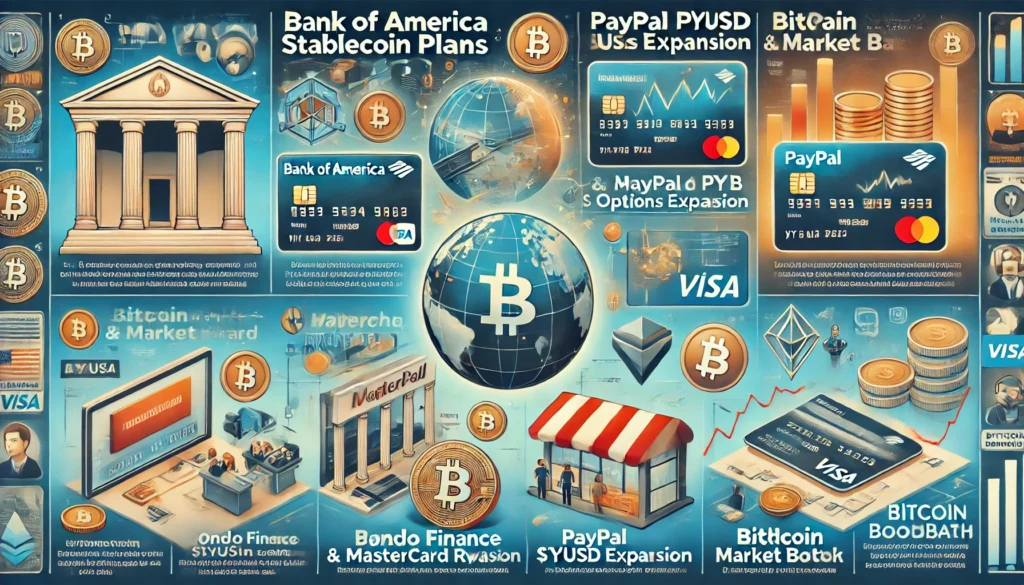
As financial giants continue integrating blockchain into their operations, Bank of America is exploring the possibility of launching a stablecoin, pending regulatory clarity. Meanwhile, Ondo Finance is set to bring real-world assets (RWAs) to the Mastercard network, reinforcing the growing institutional interest in asset tokenization. PayPal has set a bold target of onboarding 20 million merchants to accept PYUSD by 2025, a move that could redefine stablecoin adoption in mainstream commerce. In another push for mass adoption, Avalanche has introduced a Visa card, allowing AVAX holders to spend their tokens seamlessly. On the Bitcoin front, a $5 billion options expiry could impact BTC prices, while analysts suggest the recent Bitcoin “bloodbath” may have marked the market bottom. These developments reflect the increasing convergence of traditional finance and crypto, signaling major shifts in adoption and market sentiment. Bank of America CEO Hints at Stablecoin Launch, Pending Regulatory Clarity Bank of America CEO Brian Moynihan has indicated the bank’s willingness to explore stablecoin issuance, provided that regulatory clarity is achieved. This statement marks a potential shift in how major U.S. financial institutions approach blockchain-based payment solutions. Unlike JPMorgan, which launched its own digital token (JPM Coin) for internal settlements, Bank of America has been cautious about direct crypto involvement. However, with growing demand for stablecoins in global transactions, a trusted banking giant entering the space could significantly impact adoption. Regulatory uncertainty remains the primary obstacle. The U.S. government has been divided over stablecoin regulation, with proposals ranging from Federal Reserve oversight to state-level frameworks. If Bank of America proceeds with a stablecoin, it would require strict compliance with anti-money laundering (AML) and know-your-customer (KYC) regulations. This could set a precedent for other financial institutions looking to enter the space, pushing for clearer rules that balance innovation with consumer protection. A stablecoin issued by Bank of America would compete directly with PayPal’s PYUSD and Circle’s USDC, potentially giving traditional banks an edge in the rapidly expanding digital payments industry. While execution depends on regulatory approvals, this development highlights the increasing convergence of traditional banking and blockchain-based finance. If greenlit, Bank of America’s stablecoin could drive wider adoption of digital assets among mainstream financial institutions. Market Impact: Positive: If Bank of America launches a stablecoin, it could boost institutional adoption and regulatory clarity. Neutral to Negative: Delay due to regulatory hurdles could slow down stablecoin innovation in the U.S. Ondo Finance to Bring RWAs to Mastercard Network Ondo Finance has announced a strategic partnership with Mastercard to integrate real-world assets (RWAs) into its network. This move is part of a broader trend where financial institutions are embracing tokenization to improve efficiency, liquidity, and accessibility of traditional assets. RWAs, which include tokenized U.S. Treasuries, bonds, and other financial instruments, have been gaining traction as institutions seek blockchain-based alternatives to legacy financial systems. By leveraging Mastercard’s global payments infrastructure, Ondo Finance can offer institutional and retail investors access to tokenized yield-bearing assets. This is significant because Mastercard’s vast reach could provide legitimacy and scale to the RWA sector, making it easier for businesses and individuals to access these assets. The move follows similar initiatives by BlackRock and JPMorgan, both of which are experimenting with blockchain-based financial instruments. The integration of RWAs into a mainstream payments network like Mastercard could lead to increased demand for tokenized assets, providing better liquidity and lower transaction costs. However, regulatory uncertainty and compliance requirements remain challenges for full-scale implementation. If successful, this could set a precedent for other payment processors to explore blockchain-based asset management. Market Impact: Positive: Strengthens the case for tokenized RWAs, increasing institutional adoption. Neutral: Regulatory uncertainty could limit immediate large-scale deployment. PayPal Targets 20 Million Merchants for PYUSD Adoption by 2025 PayPal has outlined an ambitious goal of onboarding 20 million merchants to accept PYUSD, its stablecoin, by the end of 2025. Since launching in mid-2023, PYUSD has seen steady growth but faces competition from USDT and USDC, which dominate the stablecoin market. PayPal’s strategy hinges on leveraging its existing merchant network to make PYUSD a mainstream payment method. The company is promoting stablecoins as a superior alternative to traditional fiat transactions, offering lower fees and instant settlements. PayPal’s vast network could significantly boost stablecoin adoption if merchants and consumers embrace PYUSD as a viable payment option. However, the challenge remains in convincing businesses to integrate and actively promote crypto payments. Many merchants still perceive stablecoins as niche financial tools rather than essential components of digital commerce. If successful, this initiative could pave the way for stablecoins to be widely used in e-commerce, remittances, and business-to-business payments. However, regulatory scrutiny, particularly in the U.S., could impact adoption rates. The next two years will be crucial in determining whether PayPal’s vision for PYUSD materializes. Market Impact: Positive: Increased adoption of PYUSD could drive stablecoin transactions in mainstream commerce. Neutral to Negative: Regulatory roadblocks could slow PayPal’s expansion plans. Avalanche Visa Card Launches to Drive Crypto Mass Adoption Avalanche has introduced a Visa card to facilitate crypto payments, allowing users to spend AVAX tokens like traditional fiat currency. This move aligns with the broader push to integrate cryptocurrencies into mainstream financial systems. The Avalanche Visa card offers a seamless user experience, making it easier for individuals to transact with digital assets without needing complex wallet interactions. Visa has been expanding its crypto offerings, partnering with multiple blockchain projects to enable crypto-to-fiat transactions. By supporting Avalanche, Visa is further solidifying its role in the digital payments revolution. Unlike previous crypto debit cards, which often faced issues with usability and merchant adoption, Avalanche’s integration focuses on creating a frictionless experience for everyday transactions. However, widespread adoption of crypto payments remains an ongoing challenge. While the Avalanche Visa card could attract early adopters, its success depends on merchant acceptance and user demand. Nonetheless, this launch represents another step toward making cryptocurrencies a practical alternative to traditional banking systems. Market Impact: Positive: Enhances the usability of AVAX, potentially increasing adoption. Neutral: Merchant adoption remains uncertain, affecting overall impact. Bitcoin’s $5 Billion Options
5 Important Crypto News : GameStop’s Bitcoin Bet, Polkadot ETF, U.S. Economic Uncertainty & Dubai’s Stablecoin Approval – BotSlash Daily Crypto News Analysis

The financial world is witnessing a dynamic shift as major corporations and governments take decisive steps regarding crypto assets. From GameStop’s potential Bitcoin treasury strategy to Nasdaq’s move toward a Polkadot ETF, institutional interest in crypto continues to grow. Meanwhile, macroeconomic concerns in the U.S. are affecting consumer confidence and stock markets, influencing investment behaviors. On the regulatory front, Dubai has approved Circle’s stablecoins, reinforcing its vision of becoming a leading digital asset hub. These developments highlight the interplay between crypto adoption, economic trends, and regulatory advancements, shaping the future of the digital economy. GameStop Urged to Convert Cash Reserves into Bitcoin GameStop, a well-known video game retailer, is being urged by Strive’s CEO, Matt Cole, to convert its $5 billion cash reserves into Bitcoin. Cole believes that adopting Bitcoin as a treasury asset could enhance GameStop’s long-term financial stability and create substantial value for shareholders. This recommendation comes amid an ongoing trend where companies, including MicroStrategy and Tesla, have incorporated Bitcoin into their balance sheets. The move would align GameStop with the growing digital asset economy and potentially position it as an innovative leader in corporate crypto adoption. Despite the potential benefits, analysts caution against such a bold move. Bitcoin’s volatility presents a significant financial risk, and GameStop’s core business model does not directly align with cryptocurrency investments. Wedbush Securities analyst Michael Pachter pointed out that GameStop already trades at a premium relative to its net asset value, much like MicroStrategy, which has a strong Bitcoin correlation. If GameStop were to follow the same strategy, its stock price could become highly correlated with Bitcoin, making it susceptible to the unpredictable nature of the crypto market. Investors might see this as a speculative move rather than a strategic business decision. GameStop’s interest in cryptocurrency is not new. The company has previously explored blockchain and NFT-related initiatives, signaling its openness to digital asset integration. However, a full-scale transition of cash reserves into Bitcoin could attract regulatory scrutiny and investor skepticism. If GameStop follows through with this idea, it may influence other companies to consider similar strategies, especially in sectors looking to hedge against inflation. For now, the market remains divided on whether such a move would be a game-changer or a financial misstep. Market Impact: If GameStop announces a Bitcoin investment, its stock price could experience short-term volatility. Bitcoin’s price may also react positively to the news, as corporate adoption signals growing institutional interest. However, regulatory concerns and investor sentiment will play a crucial role in determining the long-term effects. Nasdaq Submits Filing to List Grayscale’s Polkadot ETF Nasdaq has officially submitted a Form 19b-4 to the U.S. Securities and Exchange Commission (SEC) to list and trade shares of Grayscale’s Polkadot Trust (DOT) as an exchange-traded fund (ETF). If approved, this would mark one of the first ETFs to provide direct exposure to Polkadot, a blockchain network focused on interoperability and scalability. This filing is part of Grayscale’s broader strategy to expand crypto investment products, following its success with Bitcoin and Ethereum ETFs. The potential listing of a Polkadot ETF signals growing institutional interest in blockchain ecosystems beyond Bitcoin and Ethereum. Polkadot, with its parachain technology, aims to improve blockchain interoperability, allowing different networks to communicate and share data efficiently. An ETF offering direct exposure to DOT would allow traditional investors to gain regulated access to the asset without dealing with cryptocurrency exchanges or private wallets. This development could lead to increased liquidity and broader adoption of Polkadot in mainstream financial markets. Despite the optimism, regulatory approval remains a key hurdle. The SEC has historically been cautious with crypto ETFs, especially those tied to altcoins. The decision will depend on market transparency, security, and whether the Polkadot ecosystem meets compliance standards. If approved, this ETF could boost Polkadot’s adoption and price, similar to the impact seen with Bitcoin ETFs. On the other hand, a rejection might delay institutional participation in Polkadot’s ecosystem. Market Impact: If the ETF gets approved, DOT’s price could surge due to increased investor interest. The overall crypto market may benefit from greater institutional inflows. However, a rejection could dampen market sentiment, leading to a short-term price dip for Polkadot. U.S. Consumer Confidence Declines Sharply in February The U.S. consumer confidence index fell significantly in February 2025, dropping from 105.3 in January to 98.3. This marks the steepest monthly decline in over four years. The drop is attributed to persistent inflation concerns, rising interest rates, and economic uncertainty tied to trade policies under President Trump’s administration. Consumer sentiment is a crucial indicator of economic health, as it directly influences spending behavior. With consumer confidence declining, there are fears that reduced spending could slow economic growth. A separate survey from the University of Michigan further reinforced these concerns, showing that consumer sentiment fell from 71.7 to 64.7 in the same period. The survey highlights that more than half of respondents expect unemployment to rise, while 40% report that inflation is negatively impacting their standard of living. These findings indicate that households are becoming more cautious, potentially cutting back on non-essential purchases, which could hurt retail, automotive, and housing sectors. The decline in consumer confidence has already impacted financial markets. The S&P 500 and Nasdaq fell in response to the report, reflecting concerns over a possible economic slowdown. The Federal Reserve may need to reassess its monetary policy approach, balancing inflation control with economic growth. If consumer sentiment continues to weaken, policymakers might be pressured to adjust interest rates or introduce stimulus measures to prevent a prolonged downturn. Market Impact: A sustained drop in consumer confidence could lead to weaker corporate earnings, stock market corrections, and increased economic uncertainty. The crypto market may also experience volatility as investors seek safe-haven assets like Bitcoin during economic downturns. Major U.S. Stock Indexes Experience Decline The U.S. stock market has faced significant declines recently, with major indices posting losses amid economic uncertainty. The S&P 500 fell 1.7%, marking its worst trading day in two months. The Dow Jones Industrial Average dropped 748.63
6 Important Crypto News : Institutional Expansion, Market Volatility, and Security Concerns – BotSlash Daily Crypto News Analysis

Major developments in the crypto space have shaped the market landscape, reflecting both institutional growth and ongoing challenges. Germany’s DekaBank is expanding into crypto trading and custody, while Wall Street-backed EDX Markets has introduced 17 new cryptocurrencies, signaling increasing institutional involvement. However, concerns over Bitcoin’s adoption are emerging as new Bitcoin addresses decline, and El Salvador has paused its Bitcoin purchases due to IMF loan conditions. Meanwhile, crypto investment products saw massive outflows of $508 million, raising questions about investor sentiment amid U.S. policy uncertainty. On the security front, Bybit suffered a staggering $1.4 billion hack but responded swiftly with a $742 million ETH purchase to stabilize its reserves. These events highlight the evolving nature of the cryptocurrency industry, where institutional expansion, regulatory pressures, and security vulnerabilities continue to shape the market. DekaBank Rolls Out Crypto Trading, Custody Services for Institutions DekaBank, one of Germany’s leading asset management firms, has launched cryptocurrency trading and custody services for institutional clients. This move reflects the growing institutional interest in digital assets, as traditional financial institutions continue integrating crypto into their offerings. DekaBank’s initiative is expected to provide secure and regulated access to cryptocurrencies, catering to hedge funds, pension funds, and corporate investors seeking diversification. By offering trading and custody services, DekaBank positions itself among the increasing number of European banks embracing blockchain technology. The bank’s entry into the crypto space is particularly significant, given Germany’s progressive stance on digital asset regulation. Financial authorities in the country have worked to establish clear guidelines for institutions dealing with cryptocurrencies, making Germany an attractive hub for institutional adoption. This development aligns with a broader trend of traditional finance (TradFi) merging with decentralized finance (DeFi). As major banks enter the sector, the perception of crypto as a volatile and speculative asset class is gradually shifting. This could pave the way for greater liquidity, reduced volatility, and enhanced trust in digital assets. With DekaBank’s involvement, institutional adoption may accelerate in Germany and across Europe, leading to increased mainstream acceptance of crypto investments. Market Impact: Positive Sentiment: Institutional entry strengthens market legitimacy. Increased Liquidity: More institutional players could boost crypto’s stability. Regulatory Influence: Other banks may follow, increasing competition in the crypto custody sector. Wall Street-Backed EDX Markets Expands Cryptocurrency Offerings EDX Markets, a crypto exchange backed by major Wall Street firms, has expanded its offerings by adding 17 new cryptocurrencies, including XRP, SOL, and TRUMP Coin. This move signals increasing institutional engagement in the crypto market and a growing demand for diversified assets. EDX operates on a unique model, where it does not directly hold customers’ assets, relying on financial intermediaries to facilitate trading. This structure mirrors traditional stock exchanges, reducing risks associated with exchange collapses. By adding a mix of major and emerging cryptocurrencies, EDX is catering to investors looking for both stability and high-risk, high-reward opportunities. The inclusion of memecoins like TRUMP Coin and BONK suggests that institutional investors are also interested in speculative assets, not just established cryptocurrencies like Bitcoin and Ethereum. The firm’s plan to launch a perpetual futures exchange in Singapore further indicates its intent to capture global markets beyond U.S. regulations. This expansion comes at a time when regulatory scrutiny in the U.S. remains high. EDX’s compliance-focused model could make it a preferred exchange for institutional players wary of regulatory risks. With backing from financial giants like Fidelity and Citadel, the platform is positioned to compete with existing crypto exchanges like Coinbase and Binance, potentially reshaping institutional trading strategies. Market Impact: Increased Legitimacy: Institutional-backed exchanges bring credibility to crypto markets. Regulatory Compliance: A non-custodial model may attract conservative investors. Altcoin Demand: The addition of 17 tokens could boost trading volumes across various cryptocurrencies. El Salvador Pauses Bitcoin Purchases Amid IMF Loan Agreement El Salvador has temporarily halted its daily Bitcoin purchases after securing a $1.4 billion loan from the International Monetary Fund (IMF). This decision follows increased pressure from global financial institutions, urging the country to scale back its Bitcoin-related initiatives. As part of the agreement, El Salvador has amended its Bitcoin Law, revoking its legal tender status and removing the mandate for businesses to accept Bitcoin as payment. Since adopting Bitcoin as legal tender in 2021, El Salvador has faced criticism from global financial bodies over concerns about financial stability and regulatory risks. While President Nayib Bukele initially championed Bitcoin as a tool for financial inclusion and economic growth, the country’s reliance on external funding has led to policy adjustments. The IMF’s conditions likely reflect broader concerns about market volatility and the need for economic predictability. The pause in Bitcoin purchases does not necessarily indicate a complete reversal of El Salvador’s crypto strategy, but it does highlight the challenges of national-level crypto adoption. The country still holds a substantial Bitcoin reserve, and its long-term stance on digital assets remains uncertain. This development raises questions about the sustainability of state-led crypto initiatives, particularly in emerging economies dependent on traditional financial institutions. Market Impact: Regulatory Shift: Could influence other nations considering Bitcoin adoption. Bitcoin Price Volatility: El Salvador’s policy change may add short-term market uncertainty. Institutional Influence: Highlights the power of global financial institutions over sovereign policies. Crypto Investment Outflows Reach $508 Million Amid US Policy Uncertainty The cryptocurrency market experienced substantial outflows last week, with $508 million withdrawn from digital asset investment products. This marks the second consecutive week of major outflows, bringing the two-week total to $924 million. The trend is primarily driven by concerns over U.S. economic policies, including potential trade tariffs, inflation, and shifts in monetary policy. Bitcoin saw the highest outflows, with investors pulling $571 million from BTC-related products. Interestingly, short-Bitcoin investment products recorded inflows of $2.8 million, indicating that traders are hedging against potential price declines. However, not all digital assets suffered outflows—XRP received $38.3 million in inflows, suggesting optimism regarding its regulatory standing and market position. This decline in crypto investments reflects broader macroeconomic concerns. The U.S. Federal Reserve’s stance on interest rates, combined with regulatory uncertainty surrounding crypto, has made investors cautious. Institutional
7 Important Crypto News : SEC Ends OpenSea Probe, Bybit Hack, Market Volatility, FBI’s Bitcoin-Friendly Director, Fund Outflows, BTC Holders Strategy, Metaplanet’s Big Buy – BotSlash Daily Crypto News Analysis

Regulatory shifts, security breaches, and institutional investments have driven major developments in the crypto space this week. The SEC’s decision to drop its probe into OpenSea has eased concerns in the NFT sector, while Bybit’s $1.5 billion hack has sparked renewed scrutiny on exchange security. Market volatility remains high, influenced by tariff-related economic uncertainty, impacting both traditional and digital assets. Trump’s appointment of Bitcoin advocate Kash Patel as FBI Director suggests a potential shift in regulatory attitudes. Meanwhile, significant outflows from major crypto funds indicate shifting investor strategies, but Bitcoin long-term holders are showing resilience by reducing selling activity. Japanese firm Metaplanet’s growing BTC reserves highlight the increasing role of institutional adoption in shaping the future of cryptocurrency. SEC Drops OpenSea Investigation, Boosting NFT Market Confidence The U.S. Securities and Exchange Commission (SEC) has officially dropped its investigation into OpenSea, the largest NFT marketplace, without pursuing any enforcement actions. This decision provides much-needed relief to the NFT space, which has been under scrutiny due to concerns about whether digital collectibles qualify as unregistered securities. OpenSea, which received a Wells notice in mid-2024, had been in negotiations with regulators to clarify the classification of NFTs. The closure of this probe is a win for OpenSea and sets a positive precedent for the broader NFT industry. The SEC’s decision comes amid shifting regulatory dynamics in the crypto space. Recently, the commission also dismissed its lawsuit against Coinbase, indicating a possible pivot toward a more nuanced approach to digital assets. OpenSea’s leadership, particularly CEO Devin Finzer, has long argued that NFTs should not be classified as securities. The SEC’s choice not to press charges suggests that regulators may be recognizing the unique nature of NFTs, which differ significantly from traditional investment contracts. This development is likely to inject renewed confidence into the struggling NFT market. Over the past two years, NFT trading volumes have dwindled due to regulatory uncertainty and a broader crypto market downturn. With the SEC stepping back, institutional investors and major brands may feel more comfortable engaging with NFTs again. The ruling could also set a legal precedent for other NFT platforms, reducing the likelihood of similar enforcement actions in the future. Market Impact: NFT Market Sentiment: Positive—likely to encourage trading activity and investment. OpenSea’s Position: Strengthened as a leader in the NFT space. Regulatory Climate: Potentially signals a friendlier approach to NFTs and digital assets. Bybit Hack Drains $1.5 Billion, Ethereum Market Reacts On February 21, 2025, cryptocurrency exchange Bybit suffered a major security breach, resulting in the theft of over 400,000 ETH and stETH, valued at approximately $1.5 billion. The attack exploited vulnerabilities in Bybit’s multisignature wallet infrastructure, allowing hackers—potentially linked to North Korea’s Lazarus Group—to siphon off funds from the exchange’s cold storage. This ranks among the largest crypto exchange hacks in history, putting further pressure on the industry to improve security measures. Despite the massive financial loss, Bybit has assured users of its solvency, confirming that customer assets remain unaffected. The exchange quickly secured a bridge loan covering 80% of the stolen funds from undisclosed industry partners. Additionally, Binance and Bitget have contributed over 50,000 ETH to support Bybit’s liquidity. These measures indicate strong industry cooperation, aimed at preventing a market-wide panic similar to the one triggered by the FTX collapse. Ethereum’s price initially dropped nearly 7% following the hack, falling from $2,845 to $2,625. However, reports that Bybit had begun purchasing ETH over-the-counter to replenish reserves helped stabilize the market, with ETH rebounding to around $2,790. This event underscores the vulnerabilities that centralized exchanges face and highlights the importance of self-custody solutions. Investors are now closely watching how Bybit handles reimbursements and whether this incident will trigger increased regulatory scrutiny on exchange security. Market Impact: Ethereum Price: Short-term volatility but signs of recovery. Crypto Exchange Security: Renewed scrutiny and possible regulatory responses. Investor Sentiment: Cautious—may drive more users toward decentralized platforms. Tariff Jitters Trigger Market Volatility, Crypto Also Impacted Financial markets have entered a period of heightened volatility following the announcement of new U.S. tariffs. President Trump proposed a 25% tariff on imports from Mexico and Canada, along with a 10% tariff on Chinese goods. Although the Mexico and Canada tariffs were temporarily paused, uncertainty surrounding trade policies has led to declines in stock indices. The Dow Jones Transportation Average fell by 2.6%, marking its worst daily performance since December 18, 2024. The cryptocurrency market has also reacted to this economic uncertainty. Bitcoin dropped from above $102,000 to a low of $95,000 before rebounding to around $98,800. Ethereum saw similar turbulence, initially declining by 11% before stabilizing. Historically, crypto has been viewed as a hedge against traditional financial market instability, but recent trends show increased correlation between equities and digital assets. This suggests that macroeconomic factors, such as tariffs and interest rate policies, are now playing a larger role in crypto price movements. Investors are closely monitoring central bank policies and upcoming economic data releases. If inflation concerns persist due to higher import costs, Bitcoin and other cryptocurrencies could see renewed interest as alternative stores of value. However, for now, risk-off sentiment appears to be dominating both traditional and digital asset markets. Market Impact: Stock Market: Bearish—transportation and industrial sectors hit hardest. Crypto Market: Increased volatility—investors reassessing Bitcoin’s role as a hedge. Regulatory Concerns: Tariffs may contribute to inflation, impacting monetary policy decisions. Trump Appoints Bitcoin Advocate Kash Patel as FBI Director President Trump has appointed Kash Patel as the new Director of the FBI, a move that has drawn significant attention due to Patel’s strong pro-Bitcoin stance. The Senate confirmed his appointment by a narrow 51-49 vote, with many lawmakers raising concerns over his financial ties to cryptocurrency. Patel’s personal investment portfolio includes holdings of over $115,000 in Bitcoin ETFs and $250,000 in Bitcoin mining stocks. Supporters argue that Patel’s appointment signals a shift toward a more crypto-friendly regulatory environment. Given his background, he may push for more transparent guidelines on crypto enforcement rather than the aggressive crackdowns seen in previous years. However,
6 Improtant latest Crypto News : SEC Drops Coinbase Lawsuit, BNB Chain’s Smart Contract Wallets, Bybit Hack Fallout, Altvest’s Bitcoin Adoption, ECB’s Wholesale CBDC Push : Botslash Daily Crypto News Analysis

The cryptocurrency market is seeing dynamic shifts across multiple fronts, with key regulatory actions and technological advancements shaping its future. From the U.S. SEC’s reversal on a major lawsuit against Coinbase, to BNB Chain’s upcoming hard fork aimed at enhancing smart contract capabilities, the industry is in a state of flux. Additionally, the aftermath of the Bybit hack has raised concerns around centralized exchange security, while institutional adoption continues to grow with firms like Altvest embracing Bitcoin. Meanwhile, central banks are making strides toward their own digital currencies, with the European Central Bank advancing its wholesale CBDC plans. Together, these developments illustrate the evolving nature of crypto markets and regulatory landscapes. 1. U.S. Senators Push for SEC to Rethink Crypto Staking in Exchange Funds U.S. senators are urging the Securities and Exchange Commission (SEC) to reconsider its stance on staking within exchange-traded funds (ETFs). Specifically, lawmakers have expressed concern over the exclusion of staking activities in crypto ETFs, pointing out that it harms innovation in the cryptocurrency market. Staking, particularly within Ethereum and other PoS (Proof of Stake) protocols, plays a crucial role in securing blockchain networks while offering additional rewards to token holders. The senators are arguing that staking in ETFs should be allowed, particularly since it aligns with decentralized principles and contributes to the broader cryptocurrency ecosystem. While the SEC has historically resisted including staking in ETFs due to concerns about unregistered securities offerings, the lawmakers point out that staking protocols such as Ethereum’s are well-regulated and provide a legitimate way for investors to earn rewards. The letter penned by the senators reflects growing bipartisan support for embracing crypto activities that could potentially enhance blockchain security and reward holders, thereby adding value to these networks. This type of regulatory shift could be a significant step toward legitimizing crypto ETFs and fostering broader institutional adoption of digital assets. Despite the SEC’s reservations, including staking within ETFs could potentially boost investor confidence by offering more transparent and regulated avenues for exposure to cryptocurrency assets. This change could open the door for institutional investors to more easily interact with crypto markets and further integrate digital assets into traditional financial systems. However, it remains to be seen how the SEC will respond to the growing call for a more inclusive regulatory environment for staking, and whether this move will trigger broader policy shifts in the U.S. toward cryptocurrency adoption. Market Impact: If this proposal gains traction, it could significantly impact the crypto market by accelerating institutional involvement in staking, potentially increasing liquidity and market stability. Staking integration within ETFs may also open new investment avenues, especially for risk-averse institutional investors. 2. Bybit Hack Update: Reasons Behind the Breach and How It Affects the Crypto Market The Bybit exchange, a major player in the cryptocurrency sector, was recently targeted by hackers in a sophisticated security breach that compromised user funds. This breach exposes ongoing vulnerabilities in centralized crypto exchanges, which are more susceptible to attacks compared to decentralized platforms. The incident highlights the need for stronger security protocols to protect user assets, especially in light of growing institutional interest in cryptocurrencies. Bybit’s quick response, including freezing compromised accounts and launching investigations with cybersecurity experts, shows its commitment to safeguarding user funds, though the hack raises broader concerns about the security of centralized exchanges. Centralized exchanges, which are tasked with handling user funds and transactions, have often been the target of hackers due to their large liquidity pools and single points of control. This breach serves as a reminder to both traders and institutions that they must carefully consider security when selecting platforms to interact with digital assets. The hack also adds to the ongoing discussion about the risks associated with using centralized platforms versus decentralized alternatives, which rely on smart contracts and distributed ledgers to enhance security. The hack’s impact on the market sentiment has been noticeable. Following the breach, many traders are reassessing the risks of trading on centralized exchanges, which could lead to a temporary decrease in trading volumes on Bybit and similar platforms. This heightened risk awareness might shift investor preferences toward decentralized exchanges (DEXs), which do not hold user funds and are less vulnerable to hacking. If the breach continues to affect Bybit’s reputation, the broader crypto market might see an increase in regulatory scrutiny of exchange security practices. Market Impact: This hack could trigger a wave of caution among crypto traders and investors, leading to decreased trust in centralized exchanges. Consequently, we may see increased adoption of decentralized finance (DeFi) solutions and platforms that prioritize user control and security over centralized models. 3. BNB Chain Sets Mid-March Pascal Hard Fork Date to Bring Native Smart Contract Wallets BNB Chain has announced the date for its upcoming Pascal hard fork in mid-March 2025, which will introduce native smart contract wallets on the network. This upgrade is designed to improve the functionality and flexibility of BNB Chain, bringing it closer to Ethereum’s ecosystem in terms of transaction capabilities and wallet integrations. The Pascal hard fork will introduce new features such as spending limits, batch transactions, and multisignature support, which could improve the overall user experience and enhance the network’s scalability. Additionally, it aligns BNB Chain with Ethereum’s Pectra upgrade, which is aimed at improving transaction efficiency and data handling across blockchain networks. The decision to implement native smart contract wallets is seen as a key step in BNB Chain’s ongoing efforts to attract more developers and decentralized applications (dApps) to the platform. The introduction of these advanced wallet features will likely attract both retail and institutional investors, further legitimizing BNB Chain as a serious player in the blockchain space. With its rapidly growing ecosystem and significant adoption by meme coins and DeFi projects, the BNB Chain is positioning itself as an alternative to Ethereum, and this update may bolster its competitive edge. By introducing this new functionality, BNB Chain is not only enhancing its usability but also improving its security model. Smart contract wallets offer greater control over digital