Ethereum: The Digital City of Decentralized Dreams

Imagine you live in a bustling city where everything relies on a central authority. For every transaction, whether it’s buying groceries or signing a lease, you need a trusted intermediary like a bank or a lawyer. Now, imagine if you could cut out these middlemen and directly connect with others securely and transparently. Welcome to the world of Ethereum, a digital city where transactions are decentralized, and everyone has equal power. What is Ethereum? Ethereum is a type of cryptocurrency, similar to Bitcoin, but with much more to offer. Think of Bitcoin as digital gold—a valuable, yet limited resource. Ethereum, on the other hand, is more like a vast digital playground where you can build anything from simple transactions to complex applications. At its core, Ethereum is a decentralized platform that runs smart contracts. These are self-executing contracts where the terms of the agreement are directly written into code. Imagine a vending machine: you put in money, select your item, and the machine automatically delivers it. No need for a cashier. Smart contracts work similarly, ensuring that transactions and agreements happen automatically when predefined conditions are met. The Importance of Ethereum Ethereum’s significance lies in its ability to decentralize not just money, but also entire applications. This decentralization means there is no single point of control or failure. Imagine if Facebook were decentralized; it wouldn’t be owned by a single company but rather run by its users, making it nearly impossible for anyone to shut it down or misuse data. Ethereum’s technology has paved the way for numerous innovations: Decentralized Finance (DeFi): This allows people to lend, borrow, and trade without relying on traditional banks. Non-Fungible Tokens (NFTs): These are unique digital items that can represent art, music, or even virtual real estate. Decentralized Applications (DApps): These are apps that run on a network of computers rather than a single server, making them more resilient and transparent. Proof of Work (PoW) and Proof of Stake (PoS) To understand how Ethereum functions, we need to dive into two important concepts: Proof of Work (PoW) and Proof of Stake (PoS). Proof of Work (PoW) In the PoW system, transactions are verified and added to the blockchain by miners. Miners use powerful computers to solve complex mathematical puzzles, and the first one to solve the puzzle gets to add the transaction to the blockchain and is rewarded with some Ethereum. This process is energy-intensive and requires significant computational power, much like a giant puzzle-solving competition. Proof of Stake (PoS) Ethereum is transitioning from PoW to PoS to address the energy consumption issue. In the PoS system, validators are chosen to add new transactions based on the number of coins they hold and are willing to “stake” as collateral. This method is much more energy-efficient and is expected to make the network faster and more scalable. The Ethereum Fork and Ethereum Classic (ETC) Ethereum’s journey hasn’t been without bumps. In 2016, a major event called “The DAO Hack” occurred. A smart contract named The DAO, which was meant to act as a venture capital fund, was exploited, and a significant amount of Ether (Ethereum’s currency) was stolen. To address this, the Ethereum community decided to perform a “hard fork.” A hard fork is like a software update that creates two separate versions of the blockchain. The new version, which reversed the hack and returned the stolen funds, continued as Ethereum (ETH). The original, unaltered version of the blockchain persisted as Ethereum Classic (ETC). Conclusion Ethereum represents a revolution in the way we think about transactions and trust. By decentralizing control and enabling smart contracts, it opens up endless possibilities for innovation in finance, art, gaming, and more. The shift from Proof of Work to Proof of Stake marks a significant step towards a more sustainable and scalable future for the network. And while the hard fork that created Ethereum Classic shows that the journey hasn’t been without its challenges, it also highlights the resilience and adaptability of this remarkable digital ecosystem. In this digital city, the only limit is your imagination. So, whether you’re an artist looking to sell your work as NFTs, a developer wanting to build the next big DApp, or just someone curious about the future of technology, Ethereum is a space where you can explore and create like never before.
Exchanges: A Beginner’s Guide to Cryptocurrency Trading

Imagine you live in a small town where everyone loves to trade goods. In this town, there are two main marketplaces: one is a big, organized store run by a group of managers, and the other is an open field where people trade freely with each other. These two marketplaces represent centralized and decentralized exchanges in the world of cryptocurrency. Centralized Exchanges: The Organized Store Centralized exchanges (CEX) are like the big, organized store. In this store, a team of managers oversees everything. They set the rules, ensure security, and help you find what you need. When you want to trade, you give your goods (or money) to the store, and they handle the trade for you. How It Works: Account Creation: Just like you’d sign up for a membership at the store, you create an account on a centralized exchange, like Binance, OKex, Kucoin, Bitget, Bybit and MEXC etc. You can create account on Binance here. Depositing Funds: You deposit your money or cryptocurrency into the exchange’s account, similar to how you might put your money in the store’s safe deposit box. Trading: The exchange matches buyers and sellers. If you want to buy some cryptocurrency, the exchange finds someone who wants to sell and completes the trade for you. Withdrawal: Once you’re done trading, you can withdraw your funds back to your personal account. Advantages: User-Friendly: Centralized exchanges are usually very easy to use. They offer customer support, clear interfaces, and help with transactions. Security and Trust: These exchanges invest heavily in security to protect users’ funds and have insurance in case something goes wrong. Liquidity: There are often many people trading on these platforms, making it easier to buy or sell quickly. Disadvantages: Control: You don’t have complete control over your funds because they are held by the exchange. Privacy: You often need to provide personal information to use these platforms. Risk of Hacking: Even with strong security, centralized exchanges can be targets for hackers. Decentralized Exchanges: The Open Field Decentralized exchanges (DEX) are like the open field where people trade directly with each other. There are no managers or middlemen; you handle everything yourself. Some examples are uniswap, 1inch and pancakeswap. How It Works: No Account Needed: You don’t need to create an account. All you need is a digital wallet where you store your cryptocurrency, like trust wallet, exodus etc. Direct Trading: You trade directly with other people. Using smart contracts, which are self-executing agreements coded into the blockchain, trades are done automatically and securely. Maintaining Control: Your funds stay in your wallet until you decide to trade, so you have full control over your assets. Advantages: Control: You always control your funds and don’t have to trust a third party. Privacy: You don’t need to provide personal information to trade. Security: Since your funds aren’t stored on a central server, they are less vulnerable to large-scale hacks. Disadvantages: Complexity: Decentralized exchanges can be harder to use, especially for beginners. Liquidity Issues: There may be fewer people trading, which can make it harder to buy or sell quickly. Lack of Customer Support: If something goes wrong, there’s no customer service to help you. Blockchain relation: You can only trade on provided blockchains. If a token is on Ethereum you can not directly change it to BTC. Summary: Choosing Your Marketplace Both centralized and decentralized exchanges have their strengths and weaknesses. If you prefer ease of use, strong security measures, and customer support, centralized exchanges might be the way to go. Many people use CEX only. If you value privacy, control over your funds, and are comfortable with a bit more complexity, decentralized exchanges could be more appealing. In the end, the choice depends on your personal preferences and comfort level with handling digital assets. By understanding the differences between these two types of exchanges, you can make informed decisions about how to trade and manage your cryptocurrency. Happy trading!
Riding the Market Waves with RSI

Imagine you’re a surfer, standing on the shore, watching the waves crash and recede. You’re looking for the perfect moment to jump in, catch a wave, and ride it all the way to the shore. In the world of trading, the Relative Strength Index (RSI) is like your surfing guide, helping you identify those perfect moments when the market’s waves are just right for making your move. Understanding RSI: Your Market Surfing Guide RSI, or Relative Strength Index, is a popular tool among traders, used to measure the momentum of price changes. Think of it as a thermometer for the market’s fever. It tells you that how much price is strong relative to given number of candles. This nifty indicator oscillates between 0 and 100, providing insights into whether an asset is overbought or oversold, revealing potential reversals, and identifying trends. Let’s break down its three primary uses: Oversold and Overbought Conditions: Picture RSI as a pendulum. When it swings too high, above 70 (or in the case of the volatile crypto market, above 80 which we recommend), it signals that the asset might be overbought. This means the price could be higher than what the market considers fair, suggesting a potential drop ahead. Conversely, when the pendulum swings too low, below 30 (or below 20 for crypto), it indicates the asset might be oversold, meaning the price could be lower than its fair value, hinting at a potential rise. Divergence: Divergence is like noticing the wind changing direction while surfing. When the price of an asset moves in one direction and the RSI moves in another, it signals a potential reversal. For example, if prices are rising but RSI is falling, it might be a clue that the upward trend is losing strength and a downward shift could be imminent. Trend Identification: RSI also helps in spotting trends, much like a seasoned surfer reading the ocean waves. A consistently high RSI in the range of 50-70 (or 50-80 for crypto) during an uptrend or a low RSI in the range of 30-50 (or 20-50) during a downtrend can confirm the strength of the ongoing trend. Note these points again: RSI would be consistently HIGH WHEN overall trend is HIGH is uptrend and vice versa. So only high RSI in overall low trend is not indicating uptrend. Crypto Market: Adjusting the RSI Lens In the wild world of cryptocurrency, prices can change as rapidly as ocean waves during a storm. Because of this volatility, traders often adjust their RSI settings to better navigate these tumultuous waters. Instead of the traditional 70-30 thresholds, many use 80 for overbought and 20 for oversold conditions. This adjustment helps in filtering out the noise and focusing on more significant market signals. However, it’s crucial to remember that prices don’t always bounce immediately from these overbought or oversold regions. Sometimes, just like waiting for the right wave, you may need to exercise patience. The market can linger in these regions longer than anticipated, and immediate reversals are not guaranteed. Results can be better if RSI is used with MFI or Bollinger Bands. The Daily Timeframe: Your Go-To Window Among the various timeframes traders use, the daily timeframe is the most popular for RSI analysis. This period provides a balanced view, capturing enough data to smooth out short-term fluctuations while reflecting broader market trends. It’s akin to looking at the tide cycles rather than individual waves, giving a clearer picture of the overall market momentum. RSI Heatmaps: A Bird’s Eye View For those who like to keep an eye on multiple assets simultaneously, RSI heatmaps are invaluable tools. These heatmaps provide a visual representation of RSI levels across various cryptocurrencies at a glance, much like a weather map showing wave conditions across different beaches. With just a quick look, traders can spot which coins are entering overbought or oversold territories, helping them make more informed decisions quickly. Riding the Market Waves with RSI In summary, the Relative Strength Index is like your trusted surfboard, guiding you through the ups and downs of the trading ocean. By understanding and utilizing RSI, especially with adjusted thresholds for the volatile crypto market, traders can better identify overbought and oversold conditions, spot divergences, and confirm trends. Using the daily timeframe offers a balanced view of market momentum, and RSI heatmaps provide a comprehensive overview of multiple assets. Just as surfing requires practice, patience, and a keen eye on the waves, mastering RSI in trading involves similar dedication. By staying informed and vigilant, you can navigate the market’s waves with confidence and skill, making the most of every opportunity that comes your way. So, grab your surfboard, keep an eye on those RSI signals, and ride the market waves to your trading success.
Navigating the Financial Seas: A Guide to Day Trading, Scalping, and Beyond
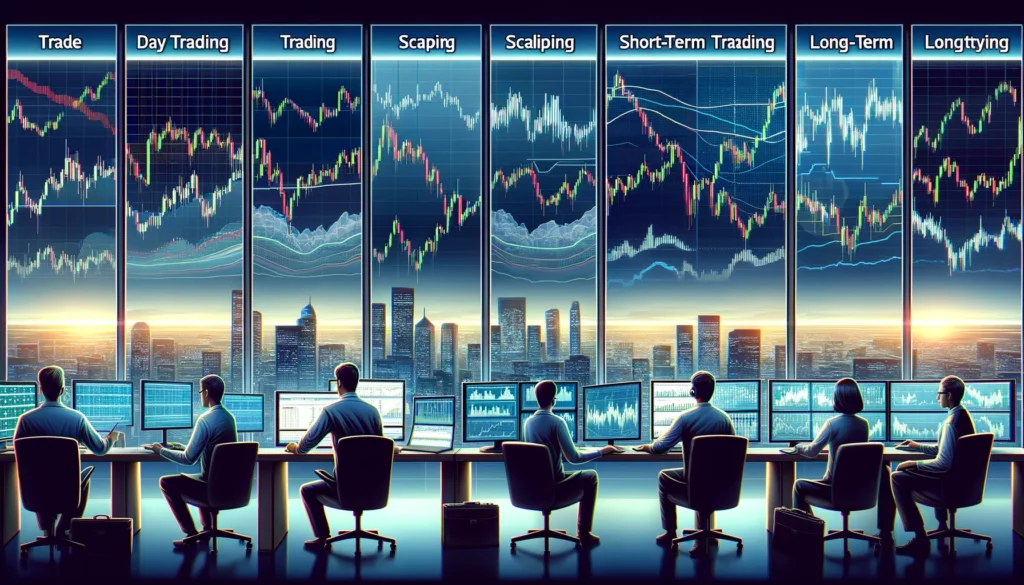
Imagine you’re at a busy farmer’s market. Each vendor and customer is trying to make the best deal possible, whether they’re there for a quick buy or a long-term investment. The world of trading is quite similar, with various strategies tailored to different time frames and market conditions. Understanding these strategies—day trading, scalping, swing trading, short-term trading, mid-term trading, and long-term investing—can help traders make informed decisions based on their goals and market dynamics. Day Trading: Riding the Daily Waves Think of day trading like running a food truck at the market. Each day, you buy fresh ingredients, cook your meals, and sell everything before the day ends. You aim to make a profit within those few hours, and at the end of the day, you close up shop with no leftovers. Day traders buy and sell stocks or other financial instruments within the same trading day. They rely on quick decisions and a constant watch on the market, aiming to capitalize on short-term price movements. It’s fast-paced and can be rewarding, but it also comes with high risks. Scalping: Quick Dips in the Market Scalping is like being a vendor selling small, popular items, such as snacks or drinks, at the market. You make lots of small sales throughout the day, each one contributing to your overall profit. Scalpers make numerous trades in a single day, holding their positions for just a few seconds or minutes to capture tiny price changes. This strategy requires sharp attention and rapid execution, as even minor market shifts can impact profits. Swing Trading: Catching the Market Swings Swing trading is similar to a farmer who plants crops and waits a few weeks to a few months before harvesting. The farmer isn’t concerned with daily weather changes but focuses on the overall growing season. Swing traders hold their positions for several days to weeks, aiming to profit from market trends and patterns. They use a mix of technical and fundamental analysis to identify opportunities and are generally more patient than day traders, waiting for the right moment to buy or sell. Short-Term Trading: Adapting to Market Conditions Short-term trading is like buying seasonal products at the market. For instance, you might buy pumpkins in October or holiday decorations in December, knowing these items will sell well within a few months. Short-term trading typically spans from three to six months. Traders in this category might extend their holding periods when the market is expected to move sideways or temporarily decline. They adapt their strategies based on current market conditions, using both technical and fundamental analysis to guide their decisions. Mid-Term Trading: Balancing Risk and Reward Mid-term trading is akin to investing in a small business at the market, like a new bakery. You’re looking at a time frame of six months to a year, balancing the potential risks and rewards. Mid-term traders aim to benefit from significant market movements without the constant pressure of daily monitoring. They consider broader economic trends, company performance, and industry developments to make their investment decisions. Long-Term Investing: The Patient Path Long-term investing is like owning a stall that sells aged cheese. You buy the cheese, let it mature over several years, and sell it when it reaches its peak quality. Long-term investors hold assets for several years, focusing on the intrinsic value of their investments. They consider factors like company management, competitive advantage, and market potential, with the patience to ride out short-term market volatility for long-term gains. Adjusting Strategies for Market Conditions When the market enters a sideways movement or faces temporary downturns, traders might adjust their strategies. For instance, a fruit vendor might choose to sell preserved jams instead of fresh fruits during the off-season. Similarly, short-term and mid-term traders might extend their holding periods to allow for market recovery, reducing the impact of short-term volatility. Conclusion: Charting Your Course Whether you’re operating a food truck, selling seasonal products, or aging cheese for years, each trading strategy offers unique opportunities and challenges. By understanding these approaches and adapting to market conditions, you can make informed decisions and navigate the financial markets successfully. Choose the strategy that best fits your goals and risk tolerance, and you’ll be well on your way to financial success.
Guarding the Blockchain: Understanding and Preventing 51% Attacks

Imagine you’re playing a game of Jenga with a group of friends. Each block you carefully stack represents a piece of the game’s history. The taller the tower gets, the more secure and unchangeable the lower blocks become because they are buried under a growing pile of more recent blocks. This is much like how a blockchain works, especially those using Proof of Work (PoW) mechanisms like Bitcoin. In the blockchain world, each “block” contains a record of transactions, and these blocks are linked together in a chronological chain. The integrity of the chain relies on the majority of participants (or nodes) in the network agreeing on the state of the blockchain. This agreement is reached through a consensus mechanism, which for PoW chains, involves solving complex mathematical puzzles. Now, let’s introduce a potential problem: the 51% majority attack. This scenario is akin to a group of players in our Jenga game suddenly gaining control over more than half of the blocks. If one player or a group of colluding players can control more than 51% of the network’s computing power (hashrate), they can manipulate the game’s outcome to their advantage. How a 51% Attack Works In a 51% attack, a malicious actor gains control over the majority of the network’s mining power. With this control, the attacker can: Double-Spend Coins: Imagine if you could pull out blocks from the middle of the Jenga tower without it collapsing. The attacker can rewrite recent transactions, allowing them to spend the same coins more than once. Prevent Confirmations: They can stop new transactions from gaining confirmations, effectively halting payments and transfers. Block Miners: They can exclude or modify the ordering of transactions, preventing other miners from adding new blocks to the chain. However, the attacker can’t change the entire history of the blockchain. They can only alter the most recent blocks since the computational power required to redo the entire chain would be astronomically high. Impacts on PoW Chains A 51% attack undermines trust in the blockchain. Since the network’s security relies on decentralization and distributed consensus, such an attack can lead to: Loss of Confidence: Users and investors may lose faith in the security and reliability of the blockchain. Financial Losses: Double-spending can result in significant financial damage to businesses and individuals. Network Instability: Frequent attacks can make the network unreliable for everyday transactions. Solutions in the Blockchain Industry To counter the threat of 51% attacks, the blockchain industry employs several strategies: Increasing Network Hashrate: By encouraging more miners to join the network, the total computational power increases, making it harder and more expensive for any single entity to gain majority control. Algorithm Changes: Some blockchains switch to different consensus algorithms (like Proof of Stake or hybrid systems) that are less susceptible to such attacks. For example, Ethereum has been transitioning from PoW to PoS to enhance security. Checkpointing: This involves setting certain blocks as immutable checkpoints. Once a block is checkpointed, even if an attacker gains 51% control, they cannot alter any transactions before that point. Incentive Structures: Designing economic incentives that discourage attacks. If attacking the network costs more than the potential rewards, it becomes a less attractive option. Community Vigilance: Active monitoring and quick responses to unusual activity can help mitigate the effects of an attack. For instance, exchanges can increase the number of confirmations required for large transactions, making double-spending attacks less effective. In conclusion, while a 51% attack poses a serious threat to PoW blockchains by allowing the possibility of double-spending and transaction manipulation, it doesn’t enable the attacker to rewrite the entire blockchain history. The blockchain community continues to develop and implement various strategies to strengthen network security and maintain trust in these decentralized systems. Just like in our Jenga game, the goal is to keep building higher and stronger, ensuring that the foundation remains secure and reliable for everyone involved.
How American Interest Rates Drive the Crypto Rollercoaster

Do you ever think why the price of cryptocurrencies, like Bitcoin, seems to be on a wild rollercoaster ride, going up and down with dizzying speed? To understand this, we need to take a closer look at something that might seem unrelated at first: American interest rates. Yes, those numbers set by the Federal Reserve can have a profound impact on the risky world of crypto markets. Let’s dive into the story of how this works. Setting the Stage: Interest Rates and Risk Interest rates, simply put, are the cost of borrowing money. When the Federal Reserve, often just called the Fed, raises or lowers these rates, it sends ripples through the entire financial world. Imagine you’re standing at the edge of a calm pond and you toss a stone into it. The splash creates waves that spread out in all directions. That’s what changing interest rates do to the economy. The Link Between Interest Rates and Investments When interest rates are low, borrowing money is cheaper. This encourages businesses to take loans for expansion and individuals to take loans for big purchases, like homes or cars. It also means savings accounts and other low-risk investments offer lower returns, nudging investors to look for higher returns elsewhere. This is where riskier investments, like stocks and cryptocurrencies, come into play. In contrast, when interest rates rise, borrowing becomes more expensive. This can slow down spending and borrowing, and suddenly those safe, low-yield investments look more attractive again. Investors might pull their money out of risky markets and put it into safer places. Cryptocurrencies: The High-Risk, High-Reward Frontier Cryptocurrencies are among the riskiest investments out there. They are not tied to any physical assets, governments, or traditional financial systems, which makes them highly volatile. This means their value can skyrocket or plummet in a very short period, driven by market sentiment, news, and, importantly, interest rates. When interest rates are low, as they have been in recent years, people are more willing to take risks. The potential for high returns in the crypto market becomes very attractive compared to the meager returns on safer investments. More money flows into cryptocurrencies, driving their prices up. The Ripple Effect of Rising Rates Now, let’s consider what happens when interest rates start to climb. As the Fed raises rates to control inflation and stabilize the economy, the environment for investments changes. Suddenly, those high-risk, high-reward crypto investments look a bit too risky compared to safer options that are starting to offer better returns. Investors may start to sell off their cryptocurrencies, leading to a drop in prices. This sell-off can create panic, causing even more people to sell and further driving down prices. It’s a cascading effect that can lead to significant declines in the crypto market. Real-World Examples We’ve seen this happen in recent years. For example, during periods when the Fed hinted at or actually increased interest rates, the crypto market experienced sharp declines. Investors moved their money into safer, more stable assets as the relative attractiveness of risky investments waned. On the flip side, when the Fed cut rates to near zero during the COVID-19 pandemic to stimulate the economy, we saw a surge in crypto investments. People were looking for better returns than what they could get from traditional savings accounts or bonds, which were offering very low yields due to the low interest rates. Conclusion: The Dance of Risk and Reward In essence, the relationship between American interest rates and the crypto market is a dance of risk and reward. When interest rates are low, the music favors high-risk, high-reward investments, and cryptocurrencies often take center stage. When rates rise, the music changes, and investors may shift their focus to safer, more predictable returns. Understanding this dynamic helps us make sense of the seemingly chaotic movements in the crypto market. It’s a reminder that in the world of finance, everything is interconnected. The next time you see headlines about interest rate changes, remember that these shifts can have a ripple effect far beyond traditional investments, influencing even the most modern and volatile markets like cryptocurrency. So, whether you’re a seasoned investor or just curious about the financial world, keeping an eye on interest rates is always a good idea.
Charting Your Course: The Power of Self SWOT Analysis in Trading

Imagine you’re planning a long road trip across the country. Before hitting the road, you’d probably want to check your car’s engine, fill up the gas tank, and map out your route. This preparation ensures that you’re ready for the journey ahead and can handle any surprises along the way. Entering the world of trading without a self SWOT analysis is like embarking on that road trip with no map, no gas, and an unchecked engine. A self SWOT analysis—assessing your strengths, weaknesses, opportunities, and threats—can be the crucial preparation that sets you up for success in the trading market. What is a Self SWOT Analysis? A SWOT analysis is a strategic planning tool used to identify and evaluate the internal and external factors that can impact your goals. Here’s how it breaks down: Strengths: What are you good at? What resources do you have at your disposal? Weaknesses: What areas need improvement? What skills or knowledge are you lacking? Opportunities: What external factors can you capitalize on to achieve success? Threats: What external challenges could hinder your progress? By understanding these elements about yourself, you can create a tailored strategy that leverages your strengths, addresses your weaknesses, takes advantage of opportunities, and mitigates threats. Strengths: Building on Your Foundation Consider Emma, a detail-oriented financial analyst with a knack for spotting market trends. Her analytical skills and attention to detail are her strengths. When Emma decided to start trading, she capitalized on these strengths by focusing on data-driven strategies and meticulous research. This approach helped her make informed decisions and build a profitable trading portfolio. To identify your strengths, ask yourself: What skills do I excel at? What unique knowledge or experience do I bring to the table? How can I use my strengths to gain an edge in trading? Weaknesses: Acknowledging and Improving Now, let’s take John, who was excited about trading but struggled with emotional decision-making. His impulsive nature often led to hasty trades and significant losses. By acknowledging this weakness, John took steps to improve his emotional discipline. He started using automated trading systems and set strict trading rules to minimize the impact of his emotions on his decisions. To pinpoint your weaknesses, consider: What skills do I need to improve? How do my weaknesses affect my trading decisions? What steps can I take to address these weaknesses? Opportunities: Seizing the Moment Sarah, an early adopter of new technologies, saw the rise of cryptocurrency as a golden opportunity. Her tech-savviness and curiosity about blockchain allowed her to enter the market early and reap substantial rewards. By staying informed about emerging trends and continuously learning, Sarah leveraged her knowledge to capitalize on this new trading frontier. To identify your opportunities, reflect on: What market trends can I take advantage of? How can I stay informed about emerging opportunities? What resources or networks can help me seize these opportunities? Threats: Navigating Challenges Lastly, consider Michael, who entered the trading market without a full understanding of regulatory changes that could impact his investments. He faced unexpected losses when new regulations were introduced. By recognizing this oversight, Michael started keeping a closer eye on legal and market developments, which helped him navigate future challenges more effectively. To recognize your threats, ask yourself: What external factors could negatively impact my trading? How can I stay updated on potential threats? What contingency plans can I develop to mitigate these risks? Conclusion: The Roadmap to Success A self SWOT analysis is your roadmap to success in trading. It equips you with the knowledge of your strengths to leverage, weaknesses to improve, opportunities to seize, and threats to prepare for. As Warren Buffett famously said, “Risk comes from not knowing what you’re doing.” By thoroughly understanding yourself and the market, you can minimize risks and maximize your chances of success. So, before you embark on your trading journey, take the time to conduct a self SWOT analysis. It’s the equivalent of ensuring your car is road-trip ready. With a clear understanding of your strengths, weaknesses, opportunities, and threats, you’ll be well-prepared to navigate the trading landscape and reach your financial destinations. Remember, successful trading is not just about making the right trades but also about being the right trader. By knowing yourself, you can tailor your strategies to align with your unique strengths and weaknesses, turning potential pitfalls into stepping stones towards success. Happy trading!
Blockchain Explained

Imagine you’re part of a huge international book club. Members from all over the world read and exchange books, and every time a book is lent or returned, the transaction is recorded. Instead of relying on a single librarian to keep track of all these transactions, what if every member of the book club kept their own record? Whenever a book changes hands, all members update their records simultaneously after confirming the transaction’s authenticity. This decentralized system is similar to how blockchain technology operates. The Birth of Blockchain: Blockchain technology was first conceptualized in 2008 by an unknown person (or group) under the pseudonym Satoshi Nakamoto. Nakamoto introduced blockchain through the creation of Bitcoin, a decentralized digital currency. The idea was to remove the need for a central authority like a bank, allowing people to trade directly and securely with one another. In fact, this theory was written before in different researches but Nakamoto gave this life removing all flaws. A blockchain is essentially a digital ledger of transactions that is duplicated and distributed across the entire network of computer systems on the blockchain. Each block in the chain contains a number of transactions, and every time a new transaction occurs, it is added to every participant’s ledger. This decentralization ensures transparency and security. How Blockchain Works: To understand how blockchain functions, think about the book club. When a member wants to borrow a book, they announce their intention to the entire club. Members then verify the availability of the book and confirm the borrower’s identity. Once verified, this transaction is added to everyone’s record, or block, which is then linked to the previous block, forming a chain of transactions that cannot be altered without the consensus of the majority. Blockchain’s Evolution: Initially, blockchain was mainly associated with Bitcoin. However, its potential far exceeded just digital currency. In 2015, Ethereum was introduced, bringing with it the concept of smart contracts—self-executing contracts with the terms directly written into code. This advancement opened the door for blockchain applications in various fields like supply chain management, voting systems, and beyond. Challenges and Developments: Despite its groundbreaking potential, blockchain faces several challenges, including scalability, high energy consumption, and slow transaction speeds. For example, Bitcoin’s blockchain can only handle a limited number of transactions per second, leading to bottlenecks during high-demand periods. To overcome these issues, new solutions have been proposed, such as Directed Acyclic Graphs (DAGs). Introduction to DAGs: A DAG is a different type of data structure that offers an alternative to the traditional blockchain. Instead of having a single, linear chain of blocks, DAGs use a graph structure where each transaction is linked to multiple other transactions. This allows for much greater scalability and faster transaction processing. DAG in Action: One prominent implementation of DAG is IOTA, a cryptocurrency designed for the Internet of Things (IoT). In a DAG-based system like IOTA, each transaction confirms two previous transactions, forming a tangled web of interconnected transactions. This eliminates the need for miners, reduces transaction fees, and increases the speed of the network as more transactions are made. The Current Landscape: Today, blockchain technology continues to advance. Numerous projects are working on improving efficiency, security, and scalability. Blockchain is being integrated into various industries, from finance and healthcare to supply chain management and entertainment. Meanwhile, DAGs and other innovative data structures are being developed to address the limitations of traditional blockchains. Conclusion: Blockchain technology, with its promise of decentralization, transparency, and security, has the potential to transform many sectors. While it still faces some challenges, ongoing innovations like DAGs are paving the way for a more scalable and efficient future. As we continue to explore the possibilities of blockchain and DAG technology, we can expect to see even more transformative changes in how we conduct transactions and manage data in our increasingly digital world.
The Rise of Altcoins: A Journey from Bitcoin to Stark

In the bustling marketplace of a vibrant city, imagine Bitcoin as the pioneer merchant who set up the very first stall. When Bitcoin unfurled its banner in 2009, it wasn’t just selling a new product; it was introducing an entirely new concept to the masses. This concept was decentralized digital currency, a revolutionary idea where money was not controlled by any government or central authority but rather by the people themselves, using cryptographic principles and blockchain technology. The Basics of Bitcoin Bitcoin’s humble beginnings were akin to the opening of a mysterious new shop in a quiet corner, piquing the curiosity of a few early adopters who believed in its potential. They saw beyond the skepticism of the mainstream financial world and understood the allure of a system where transactions could be made securely, transparently, and without the need for intermediaries. These early believers, or “miners,” used their computers to solve complex mathematical problems, thereby validating transactions and securing the network, all while earning Bitcoin as a reward. As Bitcoin’s stall grew more popular, it attracted attention from a wide array of people, from tech enthusiasts and libertarians to investors and speculators. The success of Bitcoin was undeniable, but like any marketplace, it sparked competition and innovation. Enter the era of altcoins—alternative cryptocurrencies that sought to improve upon or differentiate themselves from Bitcoin’s model. The Birth of Altcoins The first of these was Namecoin, introduced in 2011. Namecoin was like a specialty shop that sprang up next to Bitcoin’s general store. It aimed to decentralize the internet’s domain name system (DNS), which would make internet censorship more difficult. Though it never reached mainstream popularity, Namecoin’s launch was significant—it showed that the blockchain technology Bitcoin was built on could be adapted for other uses. Following Namecoin, the marketplace began to teem with a variety of stalls, each offering unique twists on Bitcoin’s blueprint. Litecoin emerged in 2011, branded as the “silver to Bitcoin’s gold.” Litecoin’s promise was faster transaction times and a more abundant supply, catering to those who found Bitcoin’s processing times and scarcity limiting. Then came Ripple (XRP) in 2012, setting up shop with a focus on enabling instant, low-cost international payments. Ripple’s approach was more cooperative with traditional financial institutions, envisioning a world where cryptocurrencies and conventional banking systems could work hand-in-hand. The Evolution and Diversification of Altcoins As the years went by, new altcoins continued to appear, each one adding its own flavor to the marketplace. Ethereum, launched in 2015 by the young prodigy Vitalik Buterin, was not just another digital currency. Ethereum’s innovation was its ability to execute smart contracts—self-executing contracts with the terms of the agreement directly written into code. This opened up a world of possibilities for decentralized applications (dApps), attracting developers and entrepreneurs who saw the potential for blockchain technology beyond simple transactions. With the foundation laid by Ethereum, the marketplace exploded with creativity and innovation. Coins like Dash, which emphasized privacy and speedy transactions, and Monero, which focused on untraceable transactions, found their niche audiences. The ecosystem became a bustling bazaar, each altcoin stall drawing in different kinds of customers with its unique value proposition. Modern-Day Altcoins and Their Uses In recent years, altcoins have continued to evolve and diversify. Some have become platforms for decentralized finance (DeFi), such as Aave, which allows users to lend, borrow, and earn interest on their crypto assets without traditional banks. Others, like Polkadot and Cardano, aim to solve issues of scalability and interoperability between different blockchain networks, ensuring that the various stalls in this crowded marketplace can communicate and interact smoothly. One of the latest entries in this dynamic marketplace is Stark, a layer 2 solution for Ethereum. Stark aims to provide more speed and lower fees, enhancing the capabilities of Ethereum’s network. Stark represents the continuing innovation within the cryptocurrency world, highlighting how Bitcoin’s original vision has inspired a multitude of paths and purposes, proving that the marketplace is far from reaching its potential. Conclusion In layman’s terms, the rise of altcoins can be likened to the expansion of a bustling market. Bitcoin’s original stall set the stage for a diverse array of new shops, each bringing something unique to the table. These altcoins cater to different needs and desires, from faster transactions and enhanced privacy to the ability to create complex financial contracts without middlemen. Just as a vibrant market thrives on diversity and innovation, the world of cryptocurrencies is continuously enriched by the introduction of new ideas and technologies. This ever-expanding marketplace invites us all to explore, invest, and participate in the exciting evolution of digital finance. Whether you’re an early adopter, a casual observer, or a savvy investor, the story of altcoins is a testament to the transformative power of innovation, driven by the visionaries who dared to dream beyond Bitcoin’s horizon.
Technical Analysis in Cryptocurrency Trading: Navigating the Digital Markets

Introduction to Technical Analysis Technical analysis is a critical tool in the arsenal of any cryptocurrency trader. Unlike fundamental analysis, which looks at economic and financial factors affecting a currency’s value, technical analysis focuses on price movements and trading volumes, using past market data to predict future trends. This method is especially prevalent in highly volatile markets like cryptocurrencies. What is Technical Analysis? Technical analysis involves studying historical price charts and using various indicators and patterns to forecast potential price movements. Traders use this analysis to make informed decisions on when to buy or sell assets. It is grounded in the idea that price movements are not random and that they often follow predictable patterns primarily influenced by market psychology and supply and demand. Key Properties of Technical Analysis Market Action Discounts Everything: This foundational principle of technical analysis posits that all current market prices reflect all known information. Therefore, the analysis focuses solely on price movements rather than external variables like news events or economic indicators. Prices Move in Trends: Technical analysis operates under the assumption that prices move in identifiable trends over time, and these trends will continue until something happens to disrupt them. History Tends to Repeat Itself: Market psychology, which influences investor behavior, tends to be repetitive. This is why certain patterns and trends reappear, allowing technical analysts to recognize and potentially capitalize on them. Real-World Examples of Technical Analysis Example 1: Moving Averages: Jane, a crypto trader, uses moving averages to smooth out price data to understand the overall direction (trend) of a market. By plotting a 50-day (green in picture) and 200-day (orange in picture) moving average on her Bitcoin chart, she can see a “golden cross”—where the shorter moving average crosses above the longer one, a bullish signal suggesting it might be a good time to buy. Example 2: RSI and MACD: Tom uses the Relative Strength Index (RSI) and Moving Average Convergence Divergence (MACD) to pinpoint entry and exit points. The RSI helps him understand if Bitcoin is overbought (typically above 70) or oversold (below 30), while the MACD shows changes in the momentum of price movements. When RSI approaches 30, and the MACD line crosses above its signal line, Tom considers buying as it indicates potential upward momentum. Benefits of Technical Analysis Timing Trades: It helps traders identify the optimal times to enter or exit trades, maximizing potential profits and minimizing losses. Objective Decision-Making: By relying on chart patterns and statistical indicators, traders can make decisions based on visual cues and data, removing emotional bias from trading. Adaptability: Techniques can be applied across different time frames and cryptocurrencies, making it a versatile tool for day trading and swing trading alike. Limitations of Technical Analysis Self-Fulfilling Prophecies: The widespread use of similar strategies and models can lead to self-fulfilling prophecies, where traders’ collective actions can drive prices in anticipated directions, regardless of underlying fundamentals. Market Manipulation: In smaller or less liquid markets, large traders can manipulate prices, which can lead to misleading signals from technical analysis. External Influences: While technical analysis considers that all information is reflected in price, sudden news or unexpected events can disrupt market trends and patterns, leading to potential losses. Conclusion: The Role of Technical Analysis in Cryptocurrency Trading Technical analysis is an essential technique for anyone involved in cryptocurrency trading. It offers a structured approach to trading by focusing on price trends and patterns, helping traders make informed decisions. However, while it is a powerful tool, it is most effective when used in conjunction with other methods, such as fundamental analysis and a keen awareness of market news and events, to achieve a comprehensive market perspective. Successful traders often balance their reliance on technical analysis with other insights to navigate the complex and fast-paced world of cryptocurrency trading effectively.